Context Engineering
How to Structure Content for LLMs: Extractable Layouts That Get Cited

Sage Holloway
18 min read
Go back to blog
SHARE

The page ranked. Traffic looked fine. Then someone asked ChatGPT the same question your H1 answers, and the model quoted a competitor's table. Same topic. Cleaner chunk. Your narrative never made the cut.
To structure content for LLMs, build pages as self-contained answer-first blocks of about 40 to 75 words that keep entity names explicit. Lead sections with question-shaped headings, put multi-attribute facts in semantic HTML tables and lists, and treat schema such as FAQPage or HowTo as a booster after the layout is clear. Models extract passages, not whole-page narratives.
Last verified: 21 August 2026 (NotebookLM sources; no live CLI run on this pack).
Six months ago that competitor table looked "too salesy" for your brand voice. Today it is the citation. The difference was not a better brand story. It was a layout a model could lift without dragging half a blog post along for context.
If you have ever watched a thoughtful essay lose to a plain comparison grid in an AI answer, this is that wall, named.
This guide is about public web layout for extraction and citation. It is not context engineering best practices for agent windows, and it is not the prompt engineering vs context engineering distinction. Those jobs live on sibling pages. Here we own how to structure content for LLMs so passages survive copy-paste, chunking, and reuse.
On this page
Why LLM extraction differs from page ranking
Extractive-friendly formatting patterns
Metadata and schema as booster, not rescue
How-to guides vs essays for LLM visibility
Audit and rewrite an existing page for extractability
Scale restructuring with agency workflows
Measure citations without a fake AI Search Console
FAQ
Structure for passages. Ranking the whole URL is not enough.
Why LLM extraction differs from page ranking
Picture the filing drawer where every receipt, warranty card, and school form lands in one unmarked stack. When the dishwasher dies, you need one sheet. You pull a wad that starts mid-sentence because three weeks of unrelated paper got stapled together. Nothing in that stack is "wrong." The filing is.
Refile the same papers into hanging folders with one claim per folder. Labels name the appliance, not "misc kitchen." The next time you open a single folder, the sheet still makes sense alone.
That is how large language models, which are systems that generate and retrieve text from patterns in training and live web data, treat your site. They do not grade the whole drawer. They open a folder.
Passage retrieval vs whole-URL ranking
Classic search still cares about the whole URL: authority, links, topical coverage. AI answer surfaces care whether an independent passage, a short chunk of text the system can score on its own, answers the question cleanly.
Hygraph's checklist on structuring content for LLMs frames the shift as moving from ranking pages to retrieving passages. Search Engine Journal's walkthrough of how LLMs interpret structure lands in the same place: models look for meaning they can parse, not for a narrative that only works if the reader started at the hero.
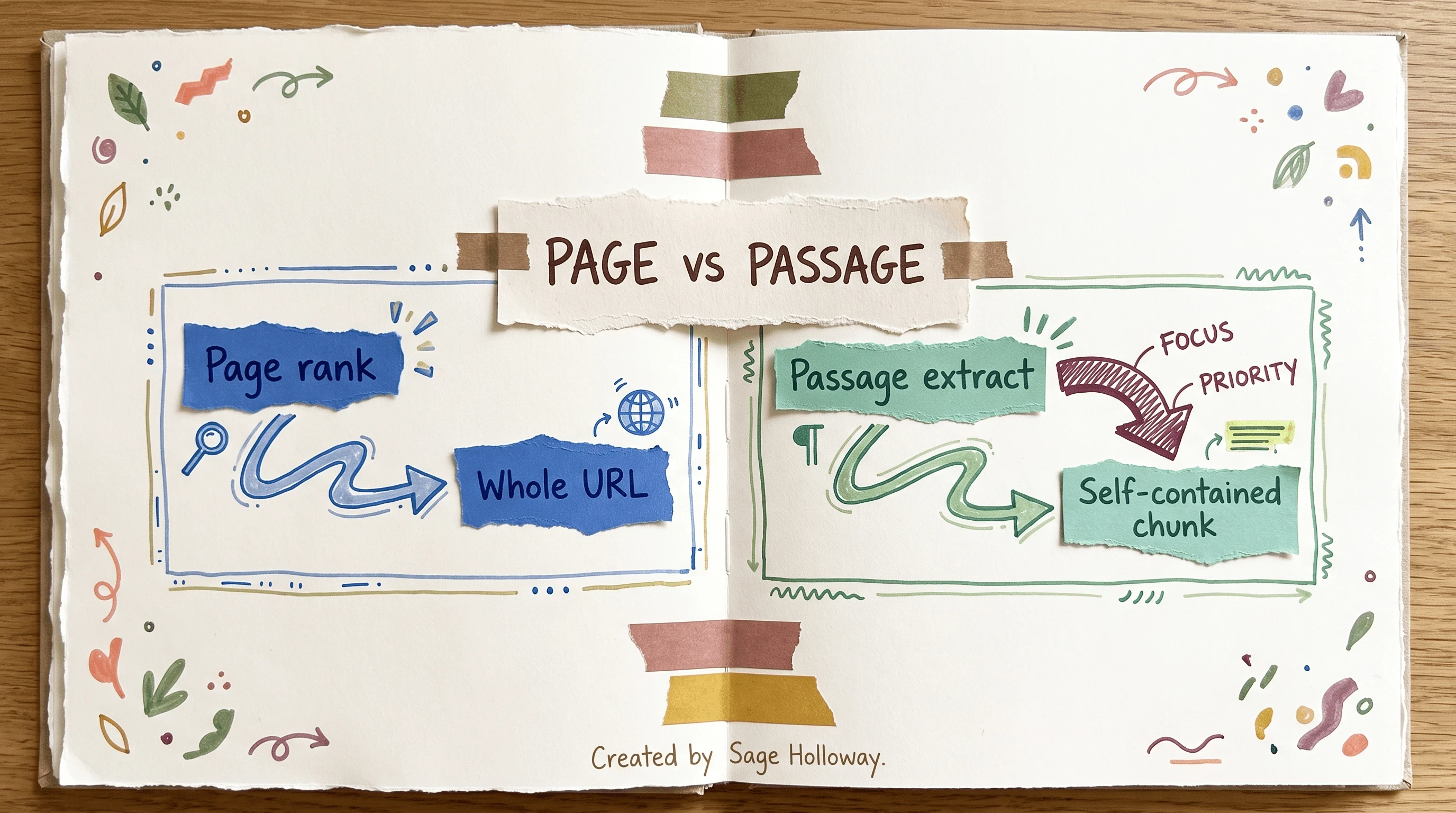
Pages still rank. Models cite passages.
So what fails first? The elegant intro that spends 180 words warming up. The pronoun chain that says "it ships faster" when the extracted chunk no longer names the product. The pricing story that buries three plans inside one paragraph.
Parseability, chunkability, and citability
Think of three mechanical layers, not three marketing slogans.
Parseability is whether the markup and heading hierarchy tell a machine what belongs together. Real h2 and h3 tags, real lists, real tables beat a CSS-grid of divs that only look structured to humans.
Chunkability is whether a section survives being cut out. If the paragraph depends on "as mentioned above," the chunk arrives broken.
Citability is whether the facts are dense enough and named clearly enough that a model can quote or paraphrase them without inventing the missing nouns.
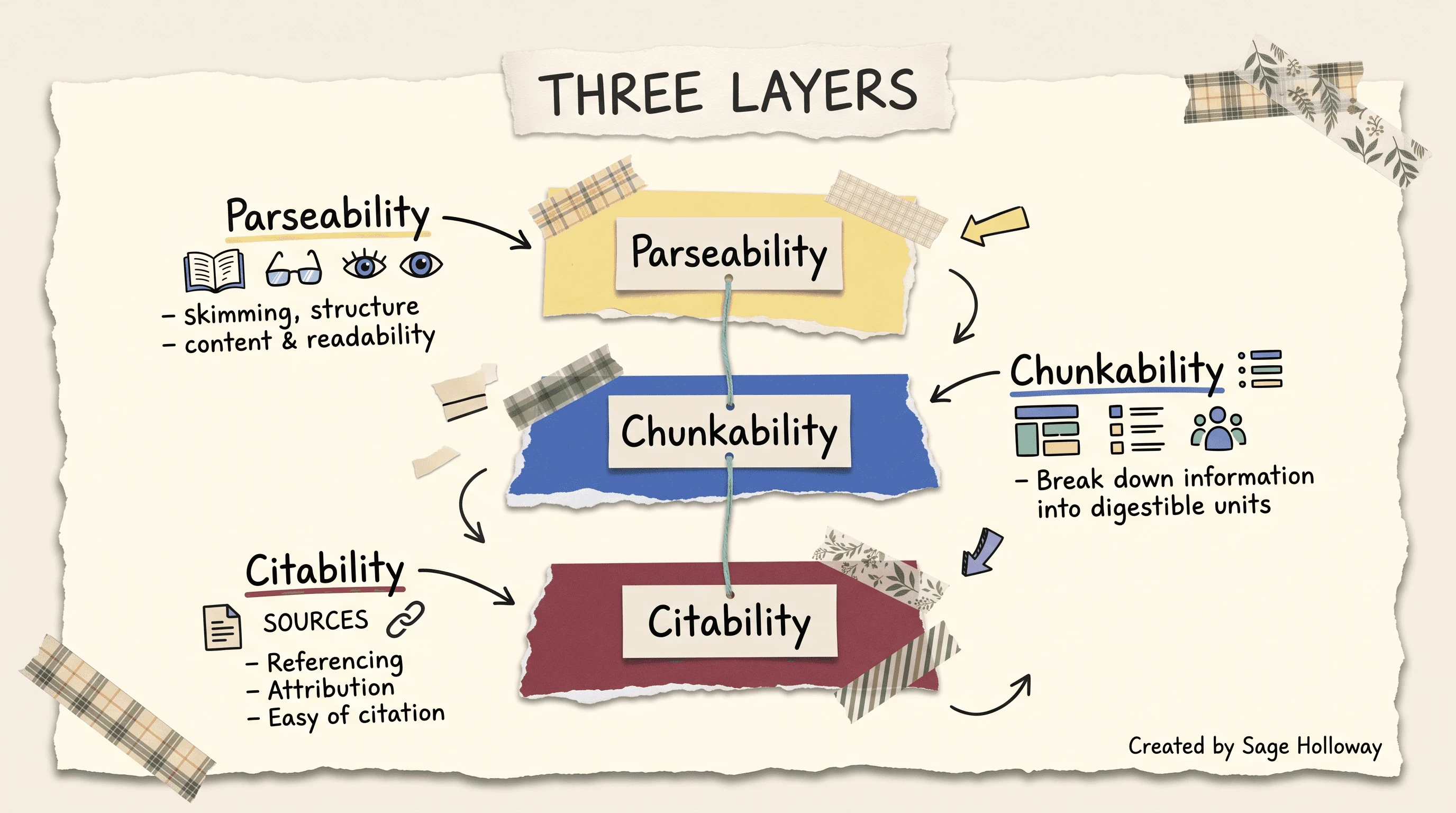
Parseable. Chunkable. Citable. All three matter.
You can win page rank and still lose all three layers. You can also ship a dull-looking page that wins citations because every section survives the copy-paste test. Ranking and extraction are related jobs. They are not the same job.
Extractive-friendly formatting patterns
Extractive-friendly formatting for LLMs is the craft of shaping paragraphs, headings, lists, and tables so a retrieved chunk stays true out of context. KIME's extraction patterns are the clearest on-page checklist in the research pack for this cluster. Treat their citation multipliers as industry analysis, not a fixed law that every niche will reprint forever.
Answer-first blocks (40 to 75 words)
Under each major section, lead with a direct answer of about 40 to 75 words. That block is the inverted pyramid in miniature: lead with the answer, then key details, then background. One idea per short paragraph of about 2 to 4 sentences.
If a paragraph leans on "but," "however," or "meanwhile" to carry a second claim, split it. The second claim deserves its own folder.
Standalone sections matter more than clever transitions. "As we covered earlier" is human glue. It is poison for a chunk that arrives alone.
Question headings and clear-outcome subheads
Write descriptive H2 and H3 headings as natural-language questions when that is how people ask, often under about 10 words. "How much does the Team plan include?" beats "Pricing."
Clear-outcome subheads do the same job for skimmers and for models: the heading should still make sense if the body is truncated. "Drink Driving Laws in England" keeps the subject; "England" alone does not. That is the practical reading of subheadings clear outcomes llm visibility: the outcome and the entity stay in the label.
Name entities explicitly. Prefer "Acme Analytics exports CSV" over "it exports CSV." Pronouns feel elegant in a long scroll. They evaporate the subject the moment the passage is lifted.
Tables, lists, and semantic HTML
Multi-attribute facts belong in semantic HTML tables. Sequential steps belong in numbered lists. Feature sets belong in unordered lists. Industry analyses cited across GEO tutorials put comparison tables near about 4.2x more citations than prose for the same facts, answer-first blocks near about 3.1x, numbered lists near about 2.7x, and unordered lists near about 1.8x. Again: directional pattern analysis, not a contract with every model.
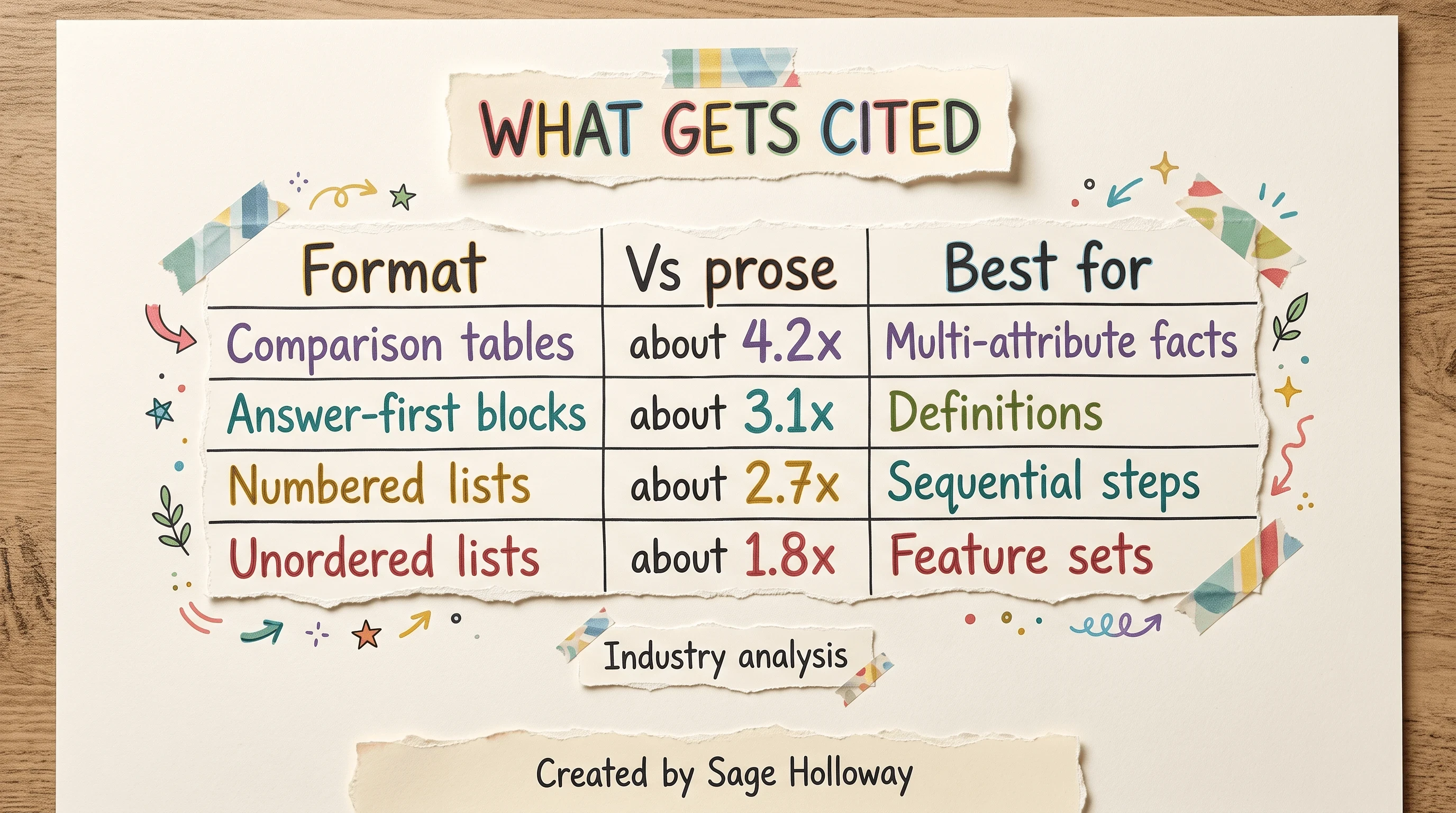
Tables lead. Treat multipliers as industry analysis, not fixed law.
Semantic HTML means the tags match the meaning. Use real headings, lists, and table cells. Do not fake a table with nested divs and CSS grid.
That specimen is boring on purpose. Boring is extractable.
https://www.youtube.com/shorts/4euxgwSYKQ4
Short demo from Majestic: How to Structure Your Content for LLMs. Narrative paragraphs hide facts; answer-first blocks extract.
Metadata and schema as booster, not rescue
Metadata that improves content structure for LLMs, in the web SEO sense on this page, means Schema.org JSON-LD and semantic HTML that tell crawlers what a block is. It does not mean developer prompt serialization, evidence aliases, or token-compression tricks for API payloads. That developer job belongs on a spoke: best structured prompt formats for LLMs.
Schema types that help extraction
Useful types for this job include FAQPage, HowTo, Table, and DefinedTerm. FAQPage marks question and answer pairs. HowTo marks a numbered procedure. Table and DefinedTerm reinforce relational facts and glossary definitions when the visible HTML already carries them.
Minimal FAQPage shape (properties only from Schema.org; validate before shipping):
Minimal HowTo shape for an audit procedure:
Layout first, markup second
Sources disagree on how mandatory schema is. Some tutorials treat rich markup as nearly required for AI Overview-style formats. SEJ's Carolyn Shelby line is the hierarchy this guide ships: schema is a helpful boost, not a magic bullet. Prioritize clear structure first. Use markup to reinforce, not rescue.
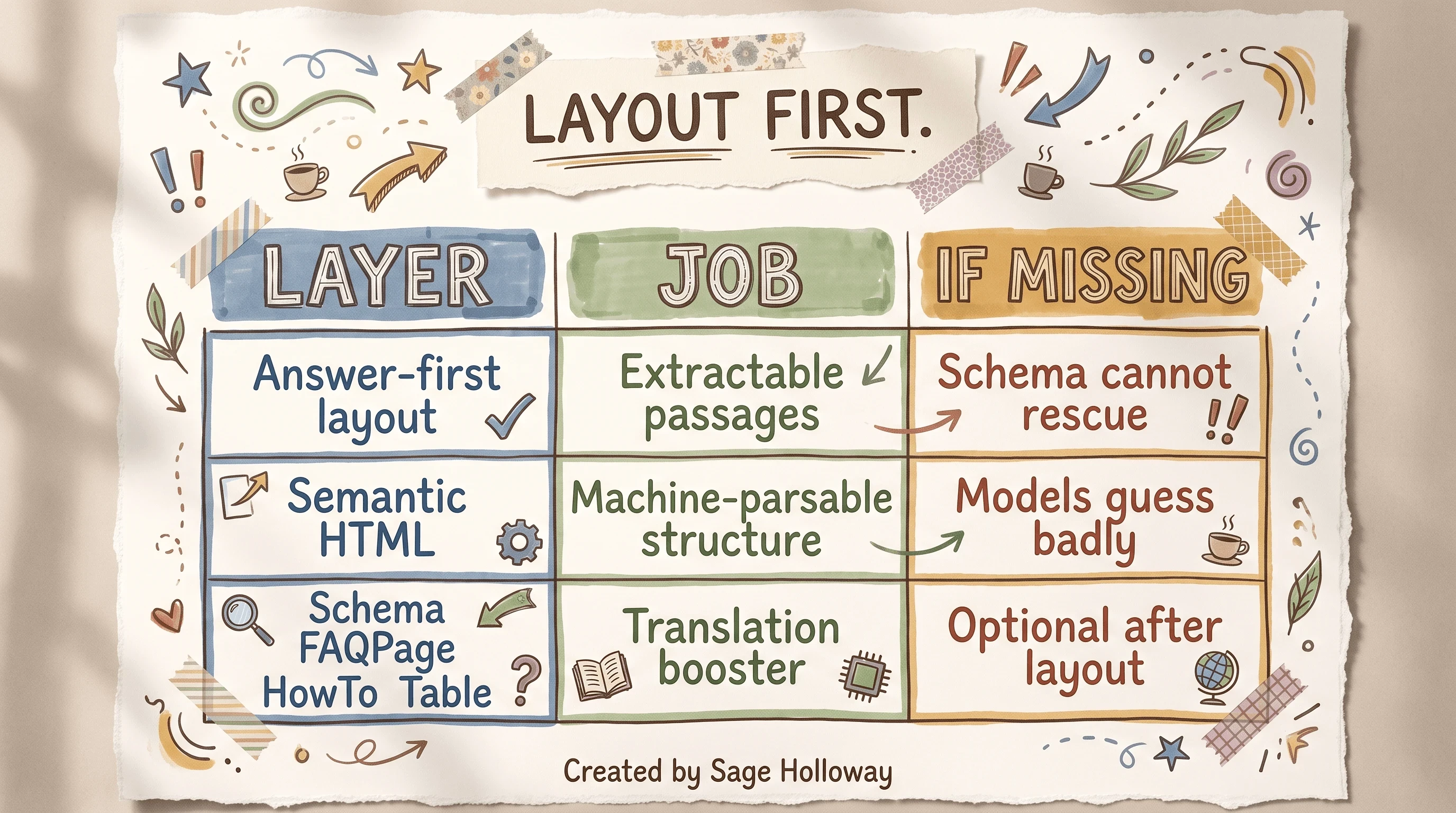
Layout first. Schema boosts. Markup does not rescue a messy page.
Everyone installs FAQPage first. FAQPage never repaired a paragraph that collapsed when you copied it alone.
That is the complication in one line. Markup without layout is theater. Layout without markup still works more often than teams expect. Do both when you can. Never reverse the order because a checklist made schema feel like the finish line.
How-to guides vs essays for LLM visibility
How-to guides vs essays visibility to LLMs is not a taste debate. It is a reuse debate. Models prefer reusable reasoning: definitions, mechanics, constraints, comparisons. Visionary essays and launch posts often fail that test even when humans love them.
Six content types LLMs reuse
Victoria Olsina's framework, widely cited in this research pack, stacks six reusable types. Keep them as one system, not six separate articles:
Canonical explainer: what the thing is, in plain language.
Comparison: criteria side by side, ideally in a table.
How-to procedure: numbered steps a model can replay.
Constraint checklist: limits, prerequisites, "this will not work if."
Evidence block: sourced claims a model can attribute.
Negative qualification: who the product is not for, stated cleanly.
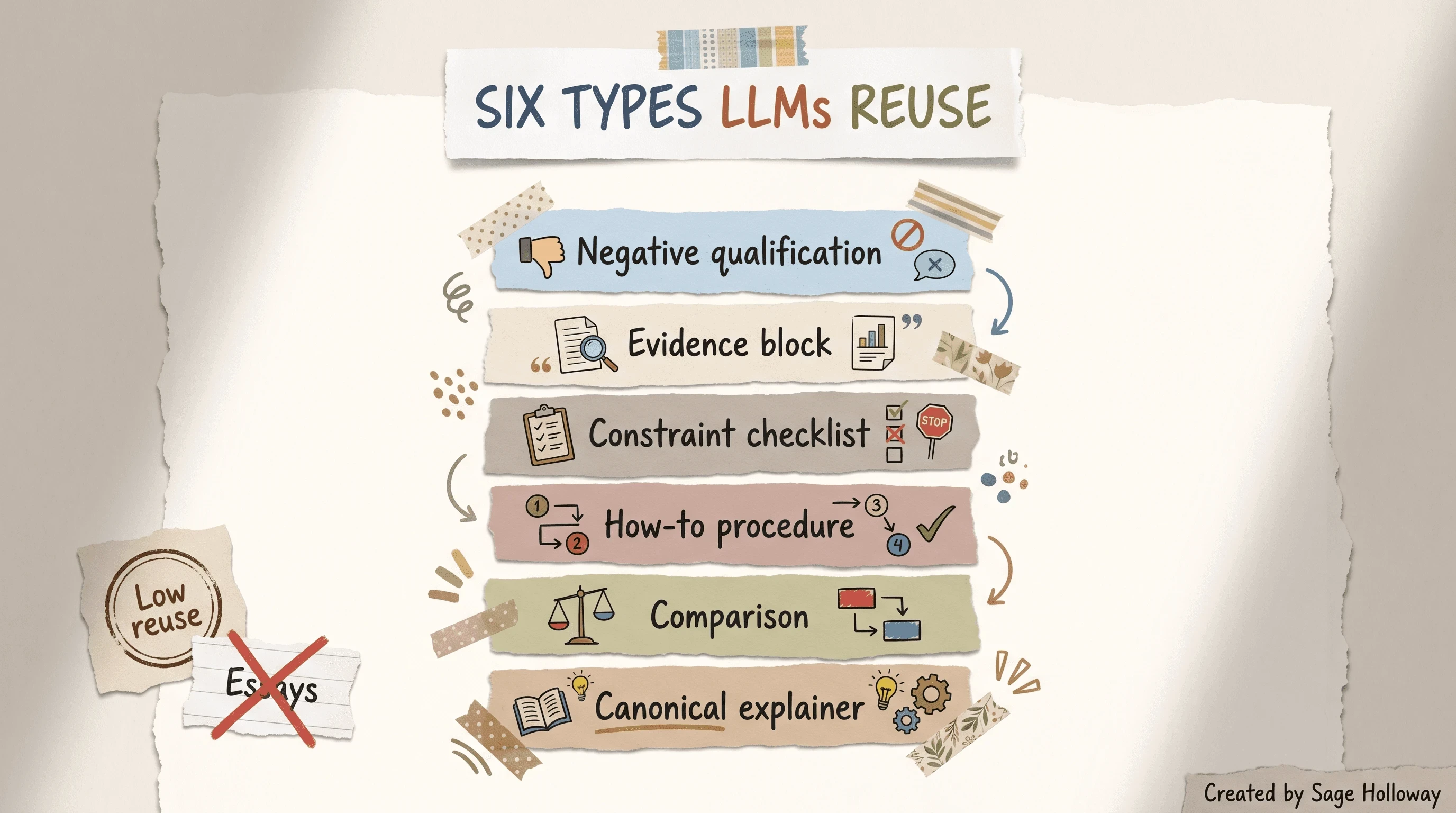
LLMs reuse explainers and constraints more than visionary essays.
Negative qualification is the type teams skip because it feels like leaving money on the table. Models optimizing for safe recommendations often trust the brand that says "not for regulated healthcare workflows" more than the brand that claims everyone. Write the disqualifier as a short bullet list, not a soft apology buried in paragraph seven.
Why essays fail the reuse test
Thought leadership fails when the core definition hides inside a story, risks get softened, and competitor comparisons never appear as structured objects. Launch posts age in days. Procedural how-tos and comparison tables age in quarters if you refresh the numbers.
https://www.youtube.com/watch?v=EWvNQjAaOHw
Pack Keep embed: How I use LLMs · Andrej Karpathy. Use it as adjacent practice footage; the six-types teaching on this page stays in the diagram and prose above.
If your calendar is 80% essays and 20% reusable blocks, flip the ratio for the pages you want cited. Keep the essays if they earn human trust. Do not expect them to carry the extraction job alone.
Audit and rewrite an existing page for extractability
How to make content extractable for LLMs starts with a blunt rule: a paragraph or section must make sense when copy-pasted alone. That extractability test is the audit's pass/fail, not a vibe check on brand voice.
Seven-step audit rewrite
Use this as a HowTo-eligible procedure on one live URL at a time:
Find orphan claims: sentences that depend on a previous section to name the product, price, or limit.
Split multi-idea paragraphs: especially where "but / however / meanwhile" carry a second load.
Rewrite answer-first: 40 to 75 words under the H2 before the narrative continues.
Add question headings: H2/H3 that still work if the body is truncated.
Convert multi-attribute facts to a semantic table.
Name entities: replace pronouns that lose the subject when extracted.
Schedule a 90-day refresh for stats, definitions, and FAQs.
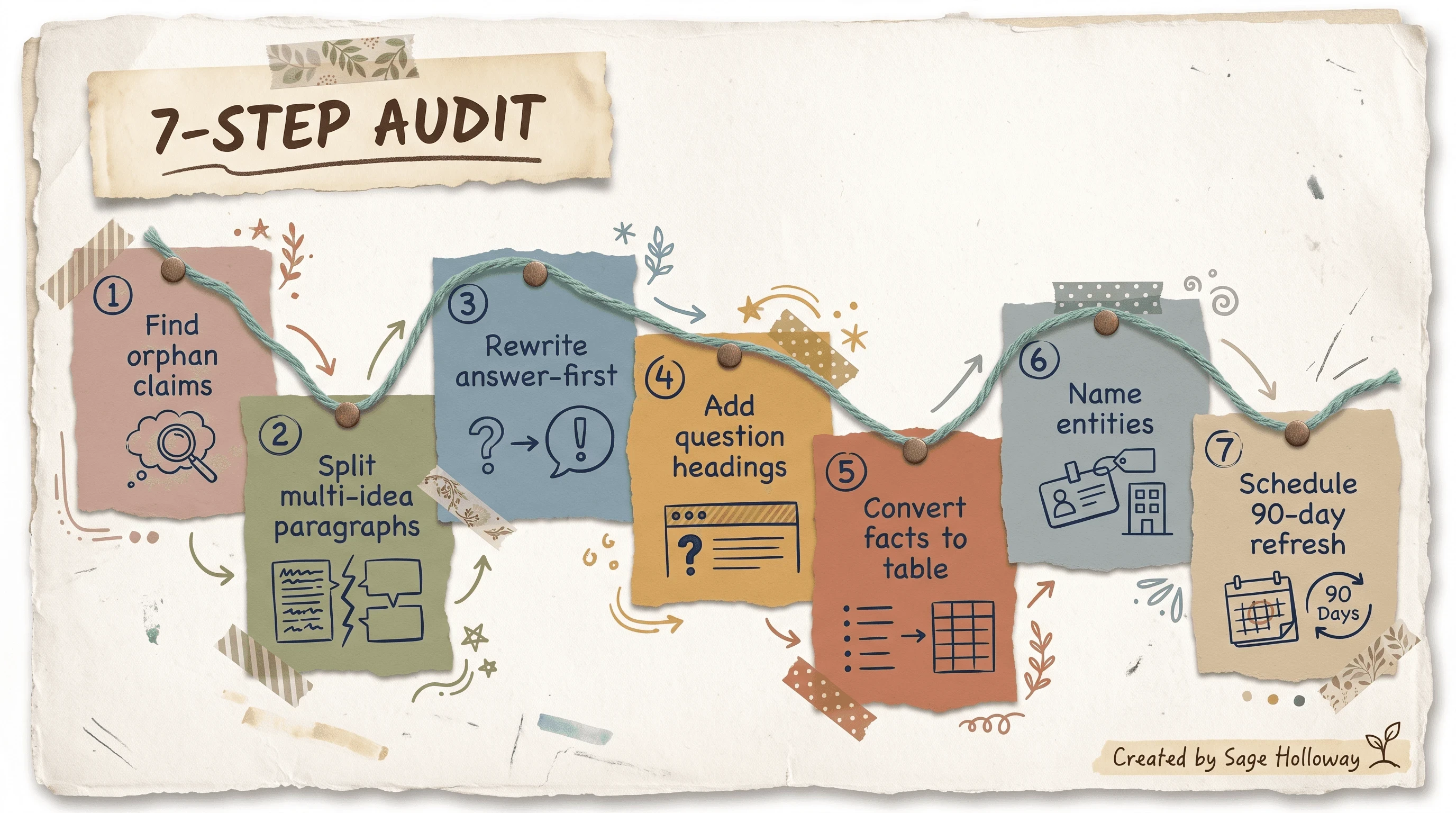
Seven steps from copy-paste test to refresh cycle.
Freshness is part of the audit, not a separate essay. Pack sources treat pages updated within roughly the last two months as cited about 28% more often, with measurable citation shifts often showing in about 30 to 45 days after restructuring. Hold the 90-day cycle so the page does not quietly rot.
Before and after one section
Same facts. Different containers.
Prose specimen (hard to extract): "Our starter plan is cheap and the team plan adds seats while enterprise is custom."
Table specimen (citable): three rows under Plan / Includes: Starter / Core docs, Team / Shared seats, Enterprise / Custom terms. On Medium that comparison ships as an image, not a live table.
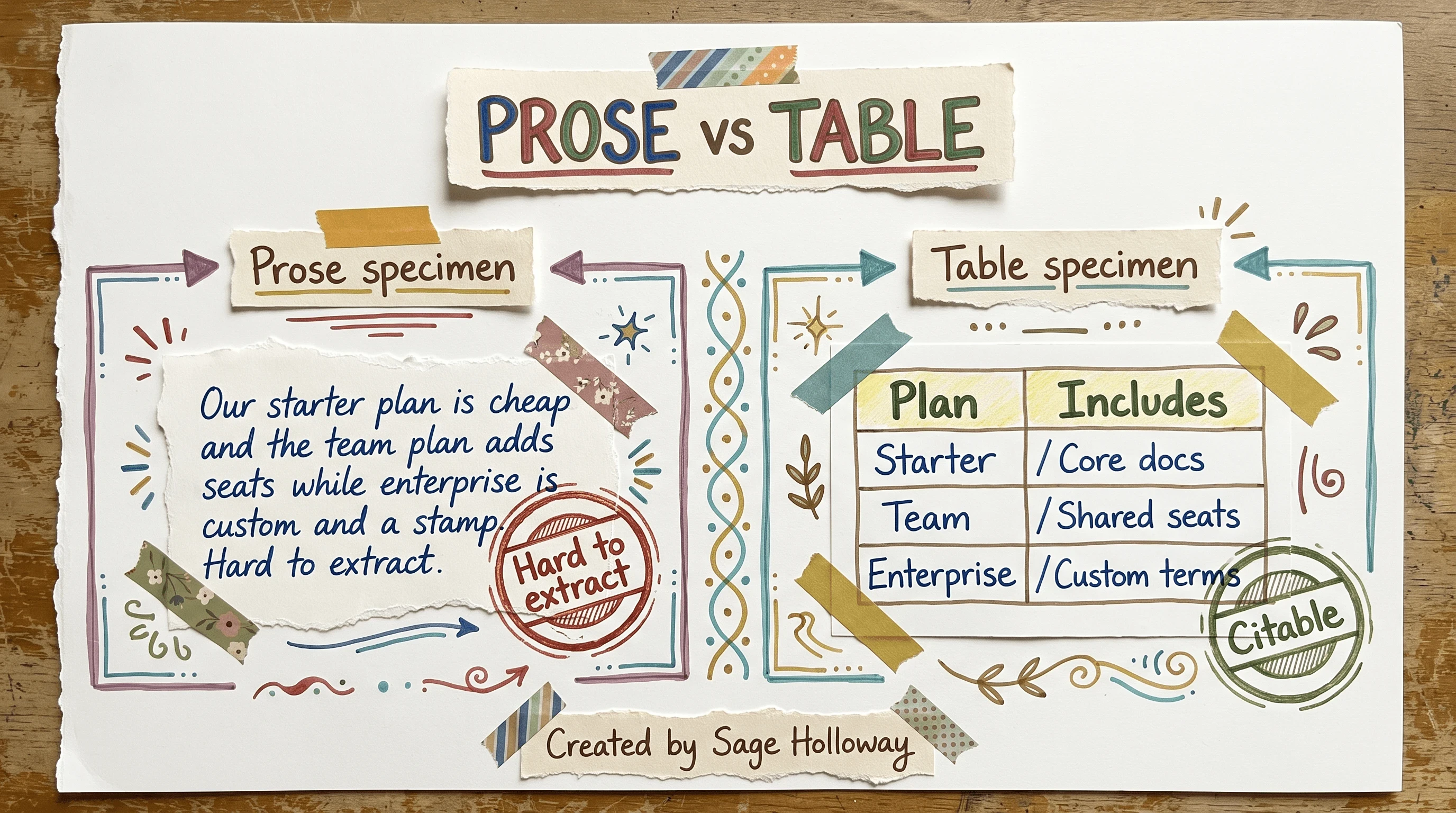
Same facts. Table form is what models cite.
This will not work if you only rename the H2s and leave the body as a single 400-word warm-up. Headings without extractable bodies are new labels on the same unmarked stack.
Optional academic aside (not the B2B default): dense PDFs fail parsers often enough that research packs recommend parallel Markdown. One ledger command is pandoc paper.tex -o paper.md, with a paper-bundle layout that includes llms.txt, paper.md, data/, and code/. Full treatment belongs on LLM-friendly academic papers, not as a second H2 here.
Scale restructuring with agency workflows
Theory guides stop at "write modular sections." Agencies hit the labor wall: hundreds of client pages, narrative intros, and writers who still think in essays. The gap this page owns is operational scaling.
Capture real buyer questions at scale
Do not invent the FAQ bank from a keyword tool alone. Capture the questions buyers already ask. The Hygraph / Masooma pack path quoted in research is concrete: pull ICP questions from Gong transcripts into Slack through an n8n workflow. Gong is call recording. n8n is workflow automation. Slack is where editors see the queue.
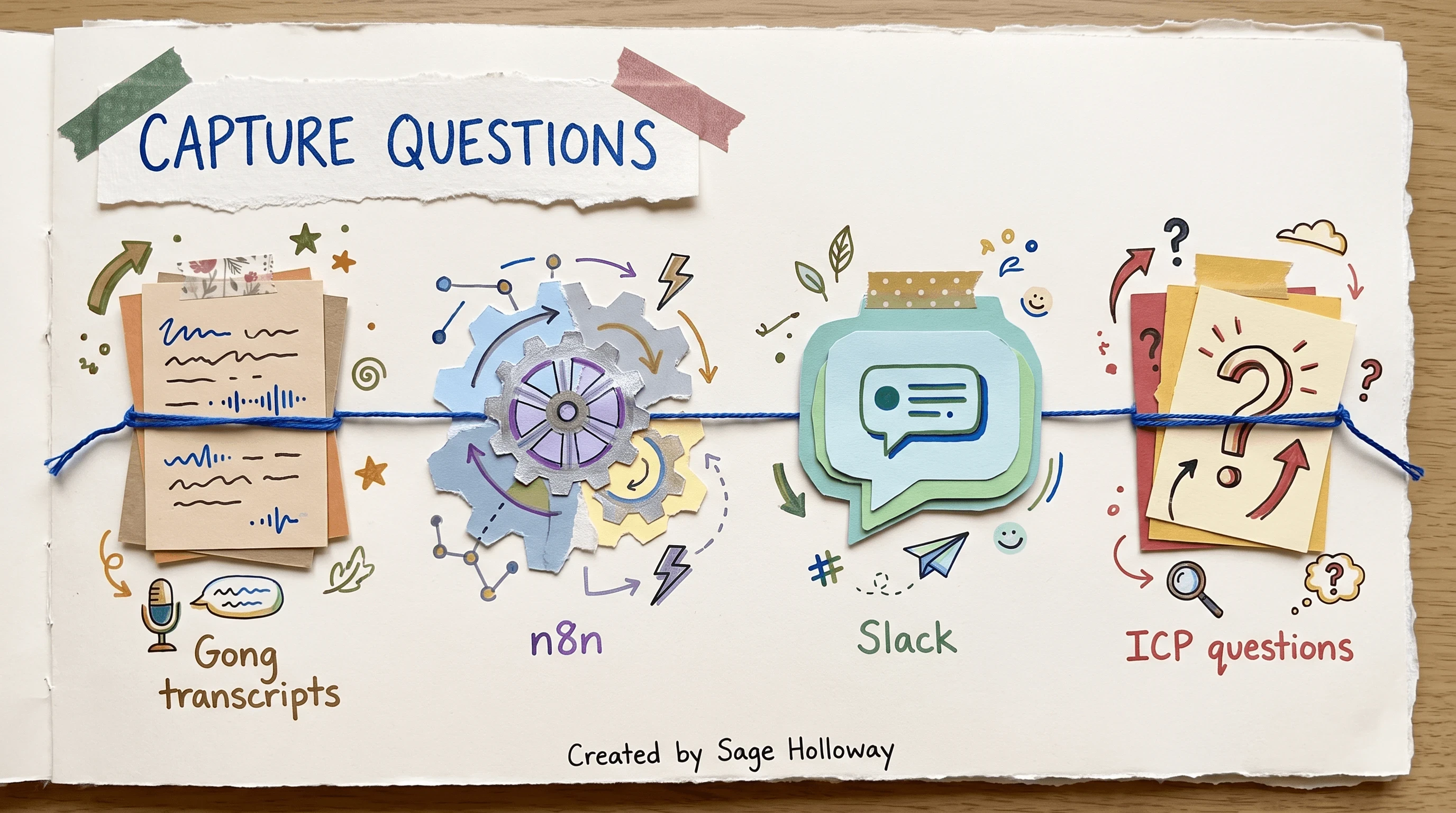
Capture real buyer questions before writers rewrite pages.
Those questions become H2s, FAQ entries, and comparison criteria. The writers stop guessing what "clear outcomes" means because the call transcript already said it.
Bulk entity and clarity audits
Before a human rewrites, run entity and clarity passes with tools named in the sources: Google's Natural Language API, InLinks Entity Analyzer, and Ahrefs AI Content Helper. The job is to flag missing entities, ambiguous pronouns, and thin sections. The job is not to auto-publish the tool's rewrite without an editor.
Prompted rewrite packs for writers
Give writers a repeatable pack, not a vibe:
Convert this H2's first paragraph into a 40 to 75 word answer-first block.
Turn every multi-attribute comparison into a semantic HTML table.
Replace pronouns with product and plan names.
Add one negative-qualification bullet list where claims overreach.
Stop when the copy-paste test passes; do not "enrich" the chunk with throat-clearing.
Reddit's r/SEO thread on whether agencies actually tweak content for LLM visibility is mixed: skepticism sits next to practitioners who report real structural rewrites (intros into lists and tables) and IndexNow setups. Treat community claims as medium confidence. Treat the workflow as the durable part.
Measure citations without a fake AI Search Console
There is no single official AI Search Console that covers ChatGPT, Gemini, Perplexity, Claude browse paths, and Google AI Overviews in one login. Measure with proxies across engines, not with a fake dashboard title.
Crawl access and IndexNow
Do not block AI crawlers in robots.txt by accident. Implement IndexNow to speed Bing indexation for ChatGPT browse paths that lean on Bing. That helps one important slice. It does not replace multi-engine structure work.
Multi-engine visibility proxies
Use a short inventory, not an affiliate tour:
Google Search Console AI Overview / AI Mode impressions where available
GA4 for on-site outcomes after AI-assisted visits
IndexNow and robots.txt allow rules for crawl access
Named GEO / visibility tools cited in sources: KIME, Profound, Semrush AI SEO Toolkit, Brand24, Peec AI, LLMrefs, Dataslayer
Manual citation checks for exact quotes (slow, still useful)
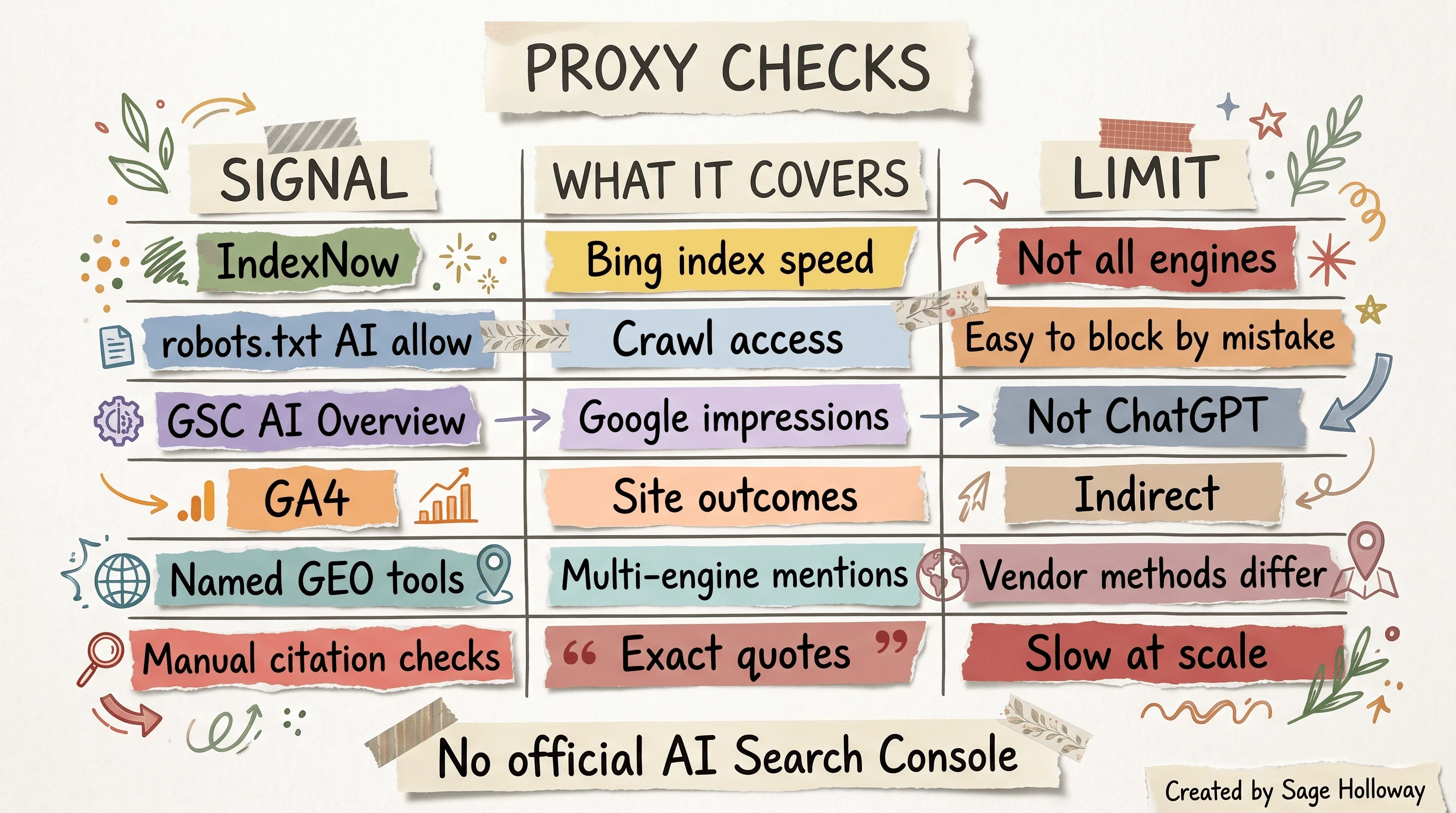
There is no official AI Search Console. Use proxies across engines.
Bing-only strategy is short-sighted. ChatGPT, Gemini, Perplexity, and Claude pull from different crawl schedules and partnerships. Structure the page for extractability once. Measure wherever your buyers actually ask.
Expect directional movement in about 30 to 45 days after a serious rewrite, not overnight vanity spikes. If a vendor dashboard shows a 40-point "AI score" with no method, treat it as marketing chrome.
FAQ
How to optimize content for LLMs?
Shift from page-level narrative flow to modular, self-contained extractable blocks. Lead major sections with a concise 40 to 75 word answer-first definition, write headings as natural-language questions, put relational facts in comparison tables, and add Schema.org types such as FAQPage or HowTo only after the visible layout is clear.
How to structure content for AI search?
Satisfy parseability, chunkability, and citability: logical H1 → H2 → H3 hierarchy, short paragraphs of about 2 to 4 sentences on one idea, and explicit entity names instead of pronouns that lose meaning when a chunk is lifted. AI search retrieves passages; it does not grade your whole URL the way classic ranking does.
How to make content extractable for LLMs?
Apply the extractability rule: any paragraph or section must remain understandable when copy-pasted alone. Cut transitions like "as mentioned above," keep a consistent brand definition across pages, and convert multi-attribute prose into semantic tables and lists.
Are agencies actually tweaking content for LLM visibility?
Some community voices stay skeptical, but agency practitioners report hands-on structural rewrites: clearer intros, numbered lists, tables, and visibility dashboards across ChatGPT, Claude, and Gemini. Treat forum confidence as medium; treat the rewrite workflow as the part you can run Monday.
Why does traditional thought leadership fail the LLM reuse test?
Models hunt reusable reasoning (definitions, mechanics, constraints, comparisons), not visionary essays or launch announcements. Thought leadership often buries definitions, softens risks, and skips side-by-side criteria, so it loses to duller, denser formats.
Do comparison tables outperform prose for AI citations?
Industry analyses of citation patterns put comparison tables near about 4.2x more citations than prose for the same multi-attribute facts, when the table uses real semantic HTML. Treat that multiplier as directional analysis, not a universal constant, and still prefer tables for pricing, features, and criteria.
Should LLM content strategy focus only on Bing and IndexNow?
No. IndexNow helps Bing-linked browse paths, including important ChatGPT routes, but Gemini, Perplexity, Claude, and Google AI surfaces pull from different slices. Optimize crawl access, then measure with multi-engine proxies.
How quickly do content updates affect LLM citation visibility?
Many brands see measurable citation shifts in about 30 to 45 days after restructuring. Pages updated within roughly the last two months are associated with about 28% more citations in source-backed analyses; run an about 90-day refresh cycle for stats, definitions, and FAQs.
Is schema markup required or optional for LLM visibility?
Optional booster after layout. FAQPage, HowTo, Table, and DefinedTerm help machines classify clear blocks; they do not rescue messy narrative. If the copy-paste test fails, fix the prose before you ship more JSON-LD.
The next year of "AI SEO" will keep inventing scoreboards. Some will be useful proxies. Some will be theater with a progress bar. What I would watch is quieter: whether teams can take one revenue URL, pass the copy-paste test on every H2, and still sound like themselves.
Whether citation multipliers hold at the same ratios across every niche is genuinely not settled. The filing rule is settled enough to ship this week.
Pick one live URL that already ranks. Rewrite a single H2 into a 40 to 75 word answer-first block. Add one semantic comparison table for a multi-attribute fact you currently bury in prose. Run the copy-paste extractability test out loud. Only then validate FAQPage markup. If you manage agents rather than public pages, start from context engineering best practices instead; if you are sorting prompt craft from context craft, use prompt engineering vs context engineering. For API input shapes, use best structured prompt formats for LLMs. For research PDFs, use LLM-friendly academic papers.
Until then...
Sage
PS. Fun fact: newspaper morgues used to file clippings under the subject that would still make sense if the rest of the paper burned. Editors learned that the hard way after a fire. Your H2 is that subject label. Write it like the rest of the page might not survive the retrieval.
Author
Practical guides, tool teardowns & AI engineering workflows.
Related Articles