Context Engineering
What Is the Difference Between Prompt Engineering and Context Engineering?

Sage Holloway
19 min read
Go back to blog
SHARE
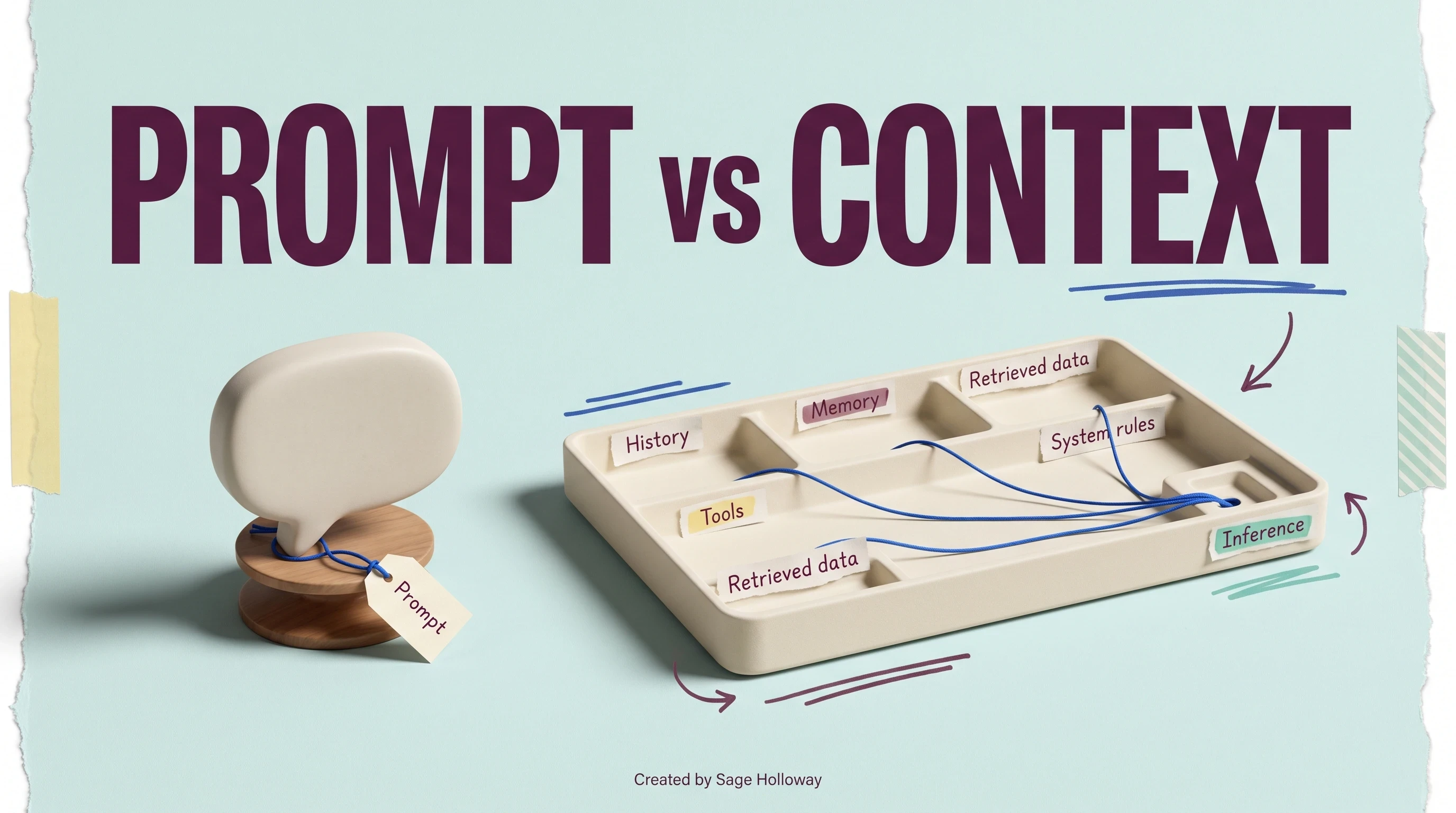
The demo worked on turn one. Turn fourteen, the agent quoted a policy from a doc you never uploaded. Same model. Same API key. The prompt had not changed. The workspace had.
The difference is scope and system state: prompt engineering optimizes instructions, persona, and formatting for a single stateless turn, while context engineering is the programmatic architecture that gathers, filters, and structures live data, short-term history, tools, and long-term memory to compile the optimal workspace before each inference cycle. Prompting shapes how the model is asked; context engineering curates what it knows when asked.
Last verified: 22 August 2026 (NotebookLM sources; no live CLI run on this pack).
You paste a perfect system prompt. You add three examples. You tune the temperature. The prototype ships. Two weeks later, the same prompt fails in staging because the model now sees forty tool schemas, six retrieved PDFs, and a transcript where attempt two defended the wrong fix from attempt one.
If you have ever blamed the model when the real problem was what you stuffed into the window, you are already doing context engineering badly. You just have not named the job yet.
This page owns the comparison: what is the difference between prompt engineering and context engineering, including context engineering vs prompt engineering as a decision frame, not a hype ladder. For the practitioner checklist on healthy agent design, see context engineering best practices. For deep troubleshooting when bad data enters history, see context poisoning. Those siblings cover different primaries. Here we stay on scope, attention limits, curation patterns, and the token math most vendor comparison blogs skip.
On this page
Decision criteria: prompt engineering vs context engineering
Why prompt-only systems break at enterprise scale
Attention budget, context rot, and lost in the middle
Curation techniques: compaction, JIT retrieval, and memory
Security, permissions, and structured output contracts
Debugging with the four context failure modes
Vector RAG, GraphRAG, and hybrid retrieval
Token economics: pre-retrieval vs just-in-time latency math
From manual context files to code-driven context compilers
FAQ
Prompt engineering shapes how you ask; context engineering curates what the model knows when asked.
Decision criteria: prompt engineering vs context engineering
Picture a hotel concierge. One guest asks for directions in perfect French. That is prompt engineering: tone, clarity, formatting, constraints inside one exchange. Another guest arrives with a dossier of preferences, loyalty status, dietary notes, and yesterday's complaint ticket already on the desk before they speak. That is context engineering: assembling the information surface the model (or concierge) reasons over before the question lands.
Prompt engineering, in plain language, is the craft of writing instructions the model reads in a single turn: persona, output format, few-shot examples, chain-of-thought scaffolding. Context engineering is the broader system design that decides which documents, tool definitions, memory snippets, and conversation history get compiled into the window before inference runs. Anthropic's effective context engineering for AI agents guide treats the second job as the production discipline; the first remains necessary but insufficient once agents loop.
Reddit's r/ClaudeAI community states the split cleanly: prompt engineering is how you talk to the model; context engineering is what the model knows. That framing is not poetry. It is an architectural boundary.
How you talk vs what the model knows
Prompt engineering owns wording inside the window: task instructions, JSON shape requests, refusal boundaries, and the Goldilocks altitude between brittle if-else rules and vague hand-waving. Context engineering owns everything else: retrieval pipelines, memory stores, tool loadouts, session history, and the compaction rules that decide what survives the next turn.
When teams argue prompt engineering vs context engineering as if one replaces the other, they are comparing a sentence to a supply chain. Both matter. They operate at different layers.
Single-turn instructions vs multi-turn system state
Large language models are stateless functions. Each API call receives a fresh context bundle; the model does not remember your last chat unless you send history back in. Prompt engineering alone treats every turn as isolated instruction writing. Context engineering assumes continuity: unresolved bugs, open tickets, prior tool outputs, and long-horizon goals must be re-injected deliberately.
That is why Abstracta and Firecrawl both map prompt engineering as a supporting subset of context engineering, not a rival skill. You still prompt. You stop pretending the prompt is the whole system.
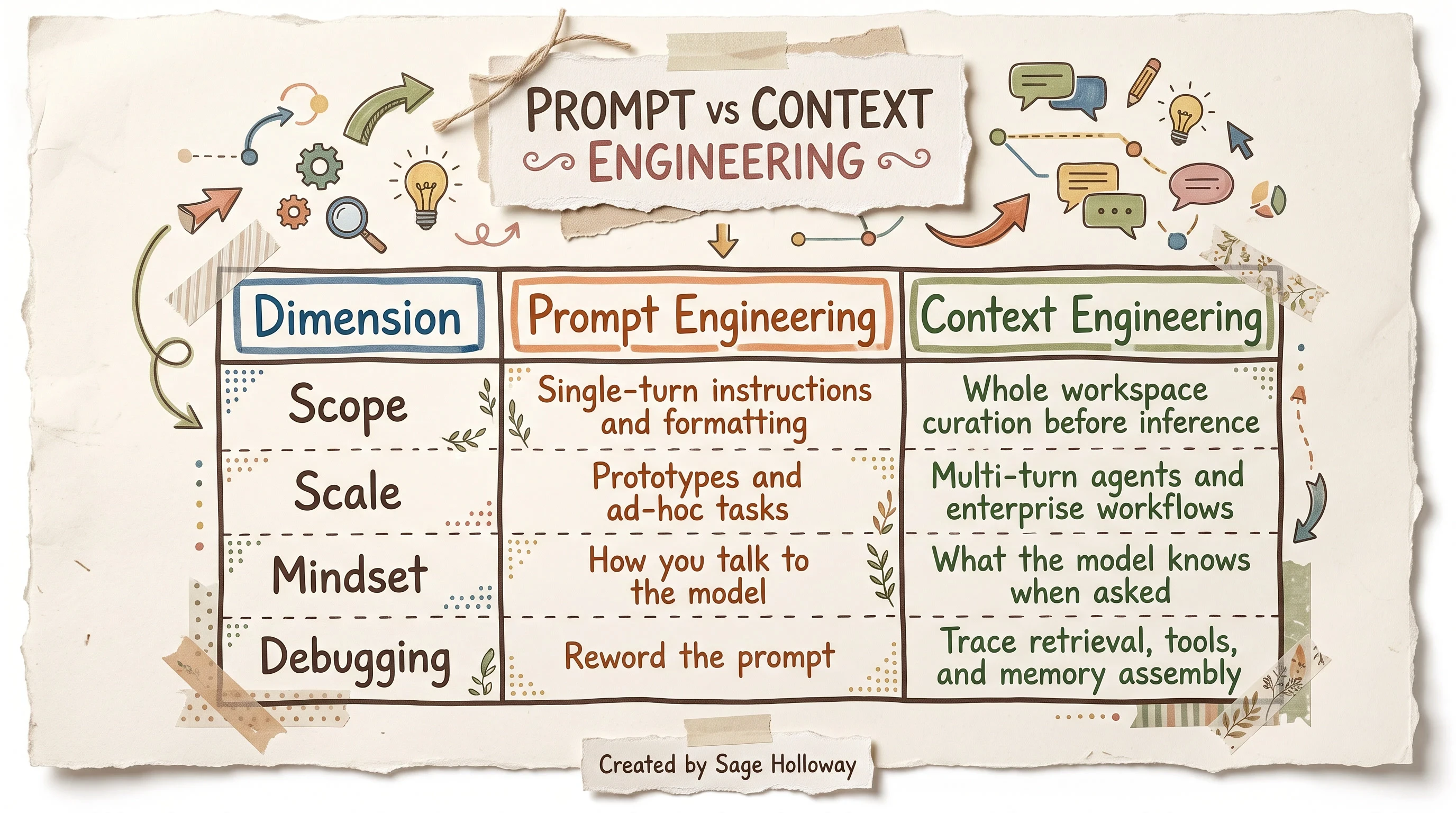
The vs job is scope and system state, not better wording alone.
https://www.youtube.com/watch?v=vD0E3EUb8-8
IBM Technology's overview walks through how context engineering differs from prompt engineering in agent and RAG systems. Use it as a second lens on the matrix above, not as a substitute for the attention limits in the next sections.
Why prompt-only systems break at enterprise scale
The prototype lied to you. Single-turn demos hide the failure mode because nobody measures turn fourteen.
Enterprise workflows assume three things prompt-only stacks rarely satisfy: all necessary facts fit in one instruction block, each user turn is independent, and a human operator manually supplies correct context every time. Production violates all three within a week.
Stateless prompts vs workflow continuity
A support agent that must reference account tier, open incidents, and policy exceptions cannot encode that state in a static system prompt. The prompt grows until someone shards instructions across messages, files, and ad-hoc prefixes. Firecrawl documents a 39% performance drop when instructions shard across multi-turn conversations. The model still runs. The task success rate does not.
Context engineering exists to maintain workflow continuity without inflating a single mega-prompt: structured memory, selective retrieval, compaction, and tool-gated access to live data.
Sharded instructions and measurable multi-turn drops
Sharding feels like progress. You move billing rules to billing.md, security rules to security.md, and hope the model reads the right file. In practice you create conflicting sources, duplicate constraints, and attention competition before the user asks anything.
The 39% figure is a useful alarm bell, not a universal constant. Your stack will differ. The direction will not: fragmented instructions without a compilation layer degrade multi-turn reliability.
When prompt engineering still wins
Prompt engineering still wins for prototyping, ad-hoc generation, and isolated tasks where the entire job fits one well-formed instruction. Summarization, translation, single-shot classification, and demo scripts do not need a retrieval graph on day one.
One industry survey cited by enterprise blogs claims 82% of IT leaders find prompt engineering alone insufficient to scale AI. Treat that as sentiment, not physics. The underlying fact is narrower: once tools, memory, and external data enter the loop, instruction tuning alone cannot manage the window.
This will not work if you skip the compilation step and expect prettier prompts to substitute for state management. Pretty prompts on a poisoned window still fail.
Attention budget, context rot, and lost in the middle
Bigger context windows did not fix reasoning. They raised the ceiling on how much noise you can afford to inject before recall collapses.
A context window is the maximum text a model can process in one request, measured in tokens (roughly word fragments). An attention budget is how much effective focus the transformer architecture can allocate across those tokens. The two are not the same number.
Transformer attention scarcity and minimum viable context
Transformers relate every token to every other token. Cost scales quadratically with sequence length. More tokens means diluted attention per fact, not free recall. Anthropic frames the design goal as minimum viable context: the smallest high-signal set that completes the task.
Everything competes inside one bar: system prompt, conversation history, tool schemas, long-term memory, retrieved chunks, and the current user message.
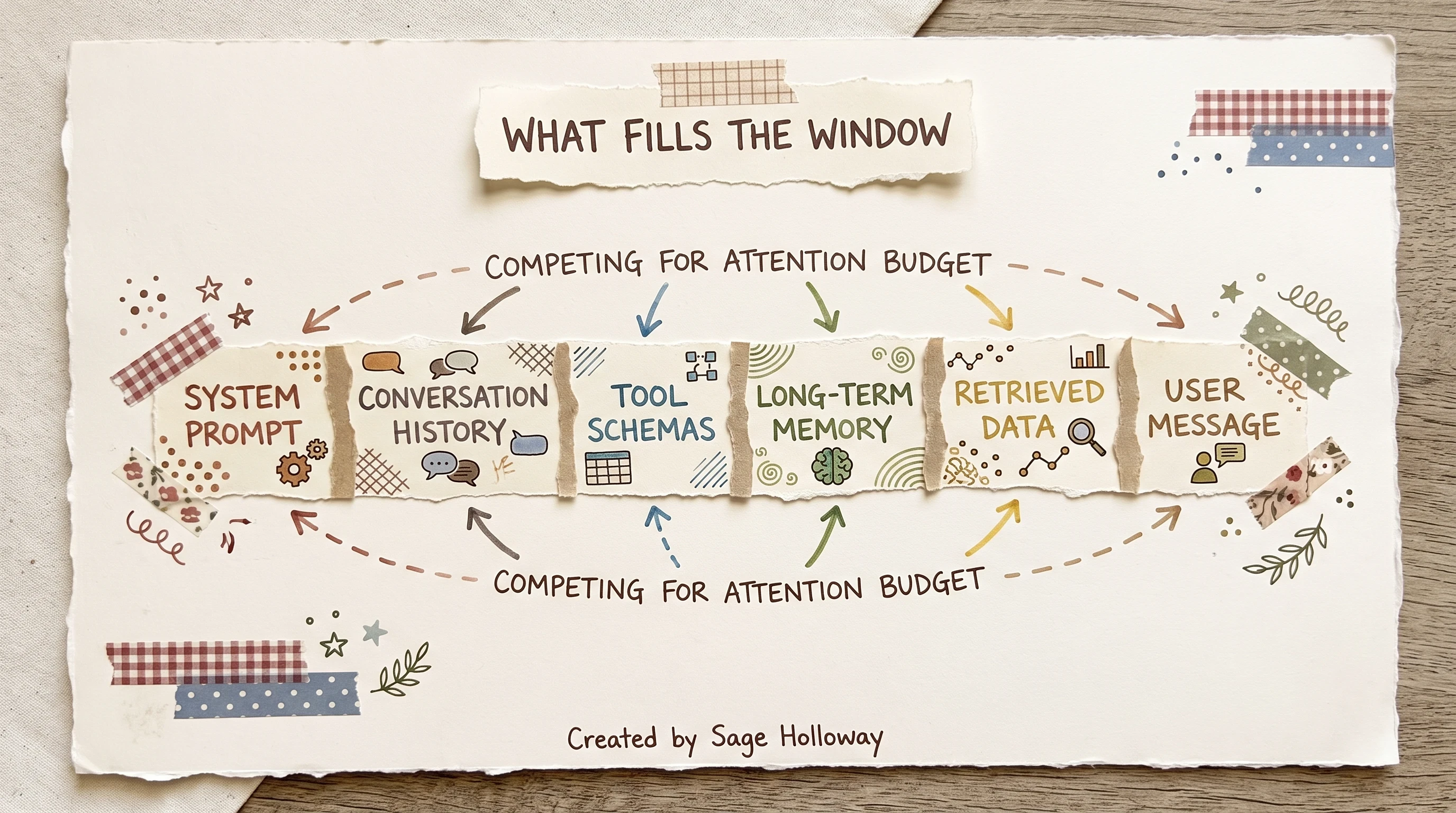
Everything competing for the same finite attention budget.
Positional recall degradation (lost in the middle)
Stanford's lost-in-the-middle research showed recall accuracy degrades when target facts sit in the center of long contexts. Models favor the beginning and end. Firecrawl cites a 24.2% accuracy drop in long contexts even when irrelevant tokens are masked out. Irrelevant tokens still consume attention machinery.
That is the punchline competitors bury under "200K context!" marketing. Length is not focus.
Context rot before physical window limits
Chroma's context rot benchmarks show performance falling before you hit the hard token cap. Accuracy curves decline on simple retrieval tasks as sequences grow. Neo4j and Memgraph use the same research to pitch GraphRAG; the rot phenomenon itself is independent of any graph vendor.
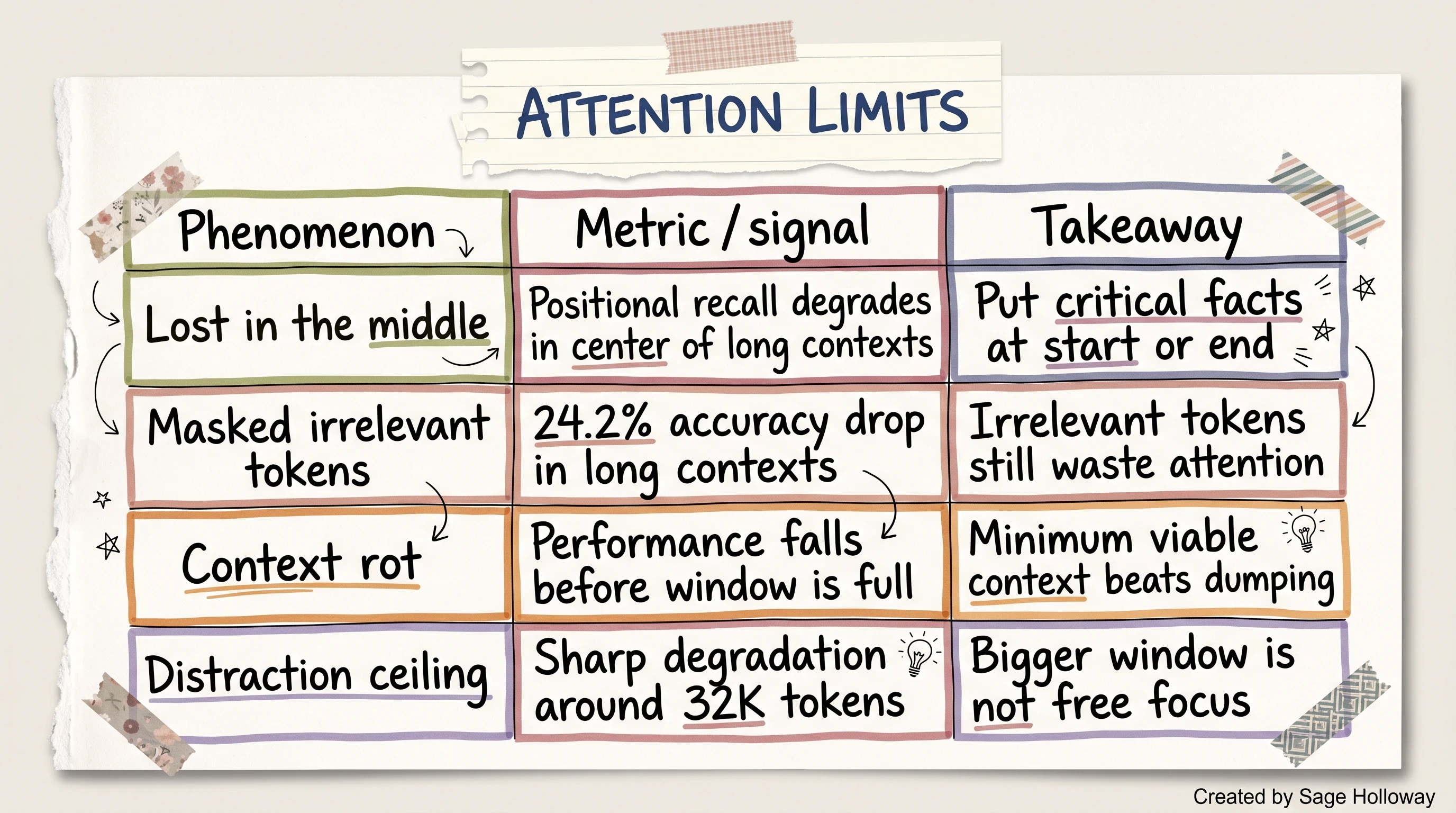
Larger windows do not fix reasoning degradation when attention is wasted.
Databricks research adds a distraction ceiling: sharp degradation around 32K tokens in tested setups even when the model accepts far more. Dumping "everything we might need" pre-retrieval is how teams buy rot early.
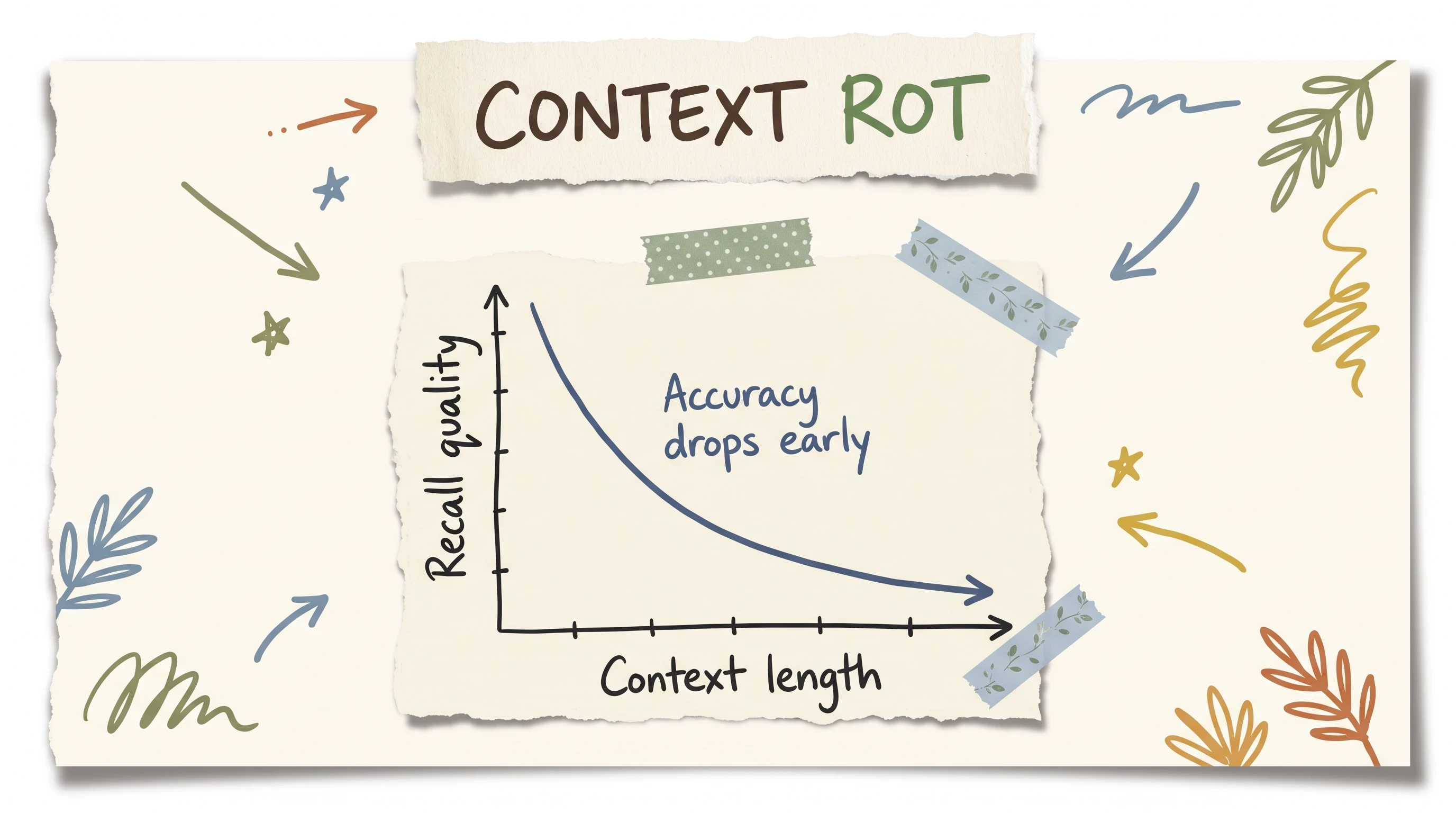
Context rot starts long before you hit the hard token limit.
https://www.youtube.com/shorts/SVdcBAo_470
That short video restates why scale alone does not rescue reasoning when the middle of the window becomes a junk drawer. Pair it with the table, not instead of it.
Curation techniques: compaction, JIT retrieval, and memory
Once you accept the attention budget, curation becomes the job. Not flashier prompts. Smaller, fresher, task-aligned windows compiled each turn.
Compaction and session re-initiation
Compaction summarizes conversation history when the window fills, then re-initializes a clean workspace while preserving unresolved state. Anthropic documents Claude Code's pattern: keep unresolved bugs and architectural decisions; drop redundant tool logs and raw execution noise.
That is session re-initiation without amnesia. The model gets a shorter transcript that still points at open work.
For IDE-specific token hacks like trimming local CLAUDE.md files, see the planned guide on Claude Code token optimization. That spoke owns desktop tricks; this page stays platform-agnostic.
Tool result clearing and static vs dynamic context
Tool result clearing removes raw tool payloads from history after summaries exist. Static context (system rules, stable schemas) should stay prefix-stable for caching benefits. Dynamic context (retrieved docs, live query results) belongs behind retrieval gates you open per task.
Splitting static and dynamic layers is how you stop yesterday's SQL output from competing with today's user question.
ReAct just-in-time retrieval loops
ReAct (Reason + Act) lets the model call search tools during the loop instead of pre-loading every chunk. Elasticsearch Labs models the trade-off in a book-recommendation agent over 103,063 indexed titles: pre-retrieval is faster; JIT preserves the window at the cost of extra API rounds.
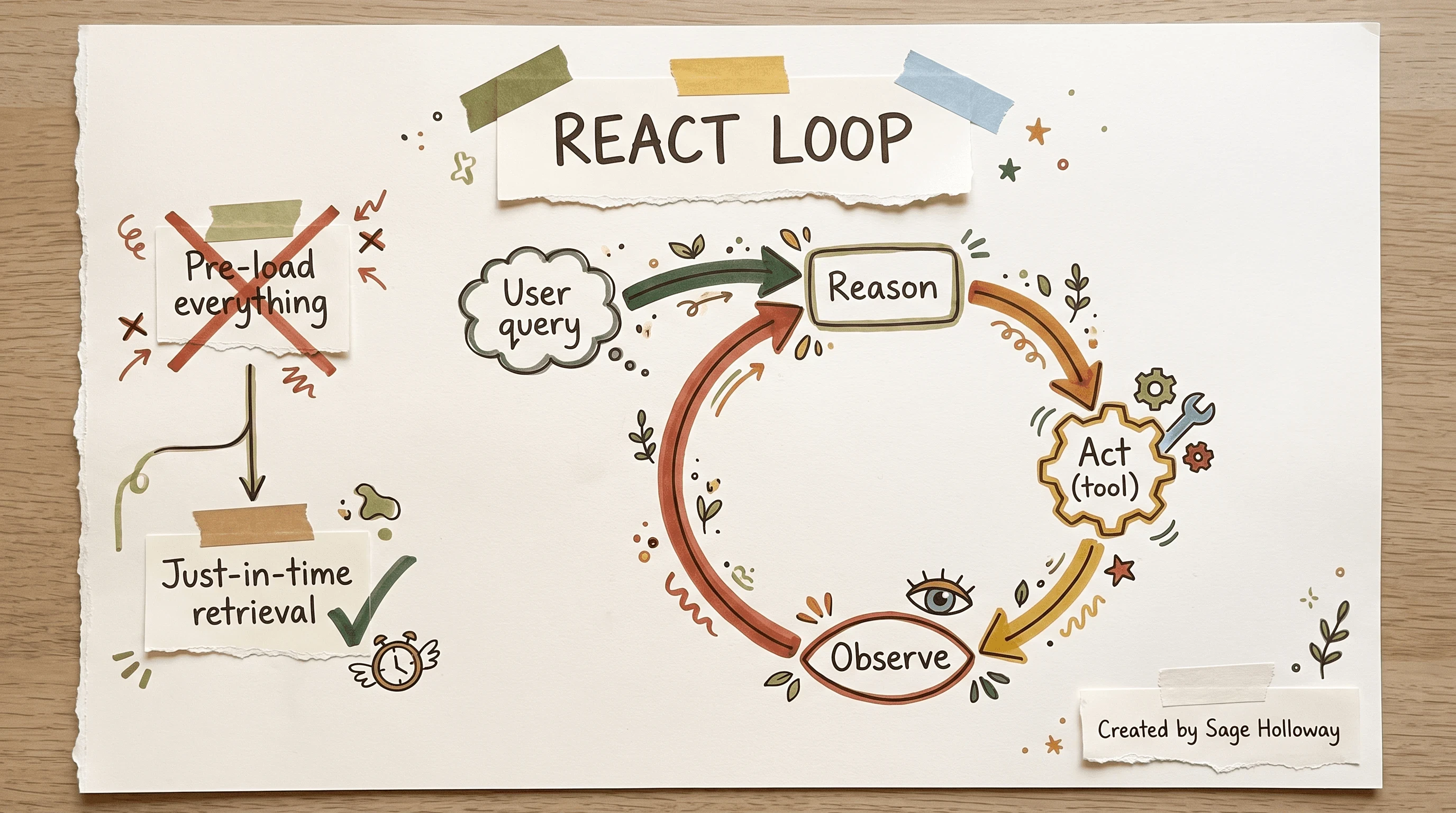
ReAct preserves the window by fetching context on demand instead of pre-loading everything.
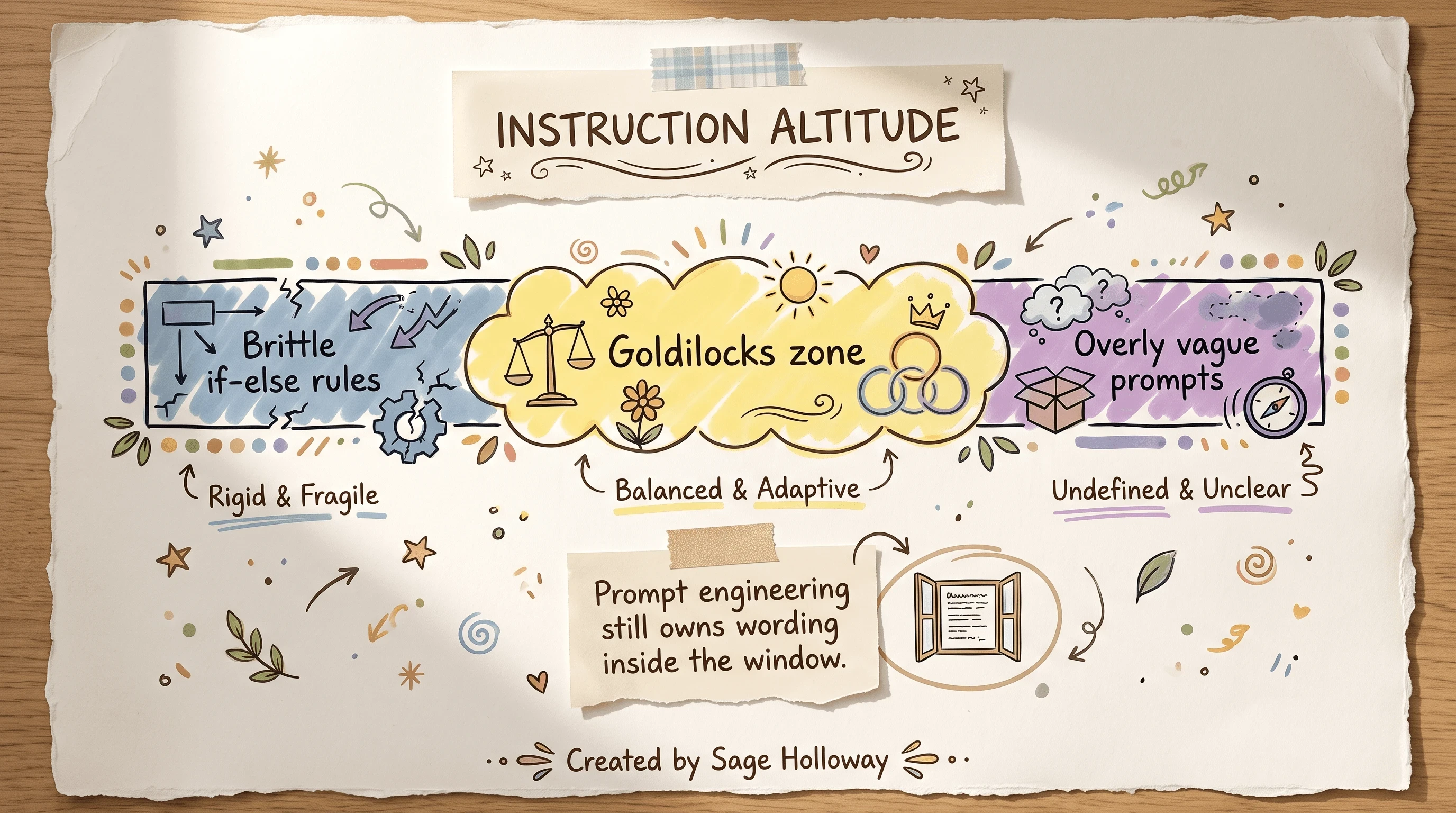
Prompt wording still matters; the altitude must match task complexity.
Everyone optimizes the prompt. The prompt was never the bottleneck once tools and history entered the chat.
Security, permissions, and structured output contracts
Context engineering without security is a faster way to leak data and amplify injection.
Injection and leakage in document and tool pipelines
Prompt injection smuggles instructions through user input. Context poisoning (see the context poisoning guide) persists bad material in retrieval indexes, tool logs, or memory. Document pipelines that ingest web pages, tickets, and PDFs are injection surfaces even when the chat box looks clean.
Sanitize upstream sources. Filter retrieval by permission tags. Never treat tool stdout as trusted prose.
JSON and Pydantic output contracts
Structured output decay happens when models drift from requested formats across long sessions. JSON contracts and Pydantic schemas (Python data validators) lock shape at the API boundary.
Firecrawl recommends specs-not-prose prompting plus schema enforcement for agent pipelines that must survive logging and replay.
Upstream metadata vs runtime context compilation
DataHub's "Context Management" category describes enterprise metadata catalogs, lineage, and governance. That upstream layer is not the same job as developer runtime context assembly. Clean catalogs reduce garbage-in-garbage-out risk; they do not replace the code that compiles prompts.
If you need the enterprise split spelled out, see the planned spoke on context management vs data catalogs. Do not merge catalog marketing with the compiler patterns below.
Debugging with the four context failure modes
Stop calling every agent mistake a hallucination. Name the failure mode first.
Firecrawl's taxonomy maps four structural context failures. Only one primary overlaps a sibling article; the rest belong here as comparison context.
Context poisoning (spoke tease)
Context poisoning is when bad data enters history or retrieval and corrupts future turns. Symptoms look like confident repetition of wrong fixes. Mitigation starts with quarantine, temporal filters, and dual-context handoffs. Deep troubleshooting lives on the context poisoning page; here we only flag it as mode one in the grid.
Context distraction, confusion, and clash
Context distraction is oversized history that causes the model to repeat past steps instead of synthesizing new ones. Context confusion appears when tool loadouts grow large; practitioners report degraded tool selection accuracy once schemas exceed roughly thirty entries in discussed setups. Context clash is conflicting sources gridlocking decisions, such as mismatched API specs in retrieved docs.
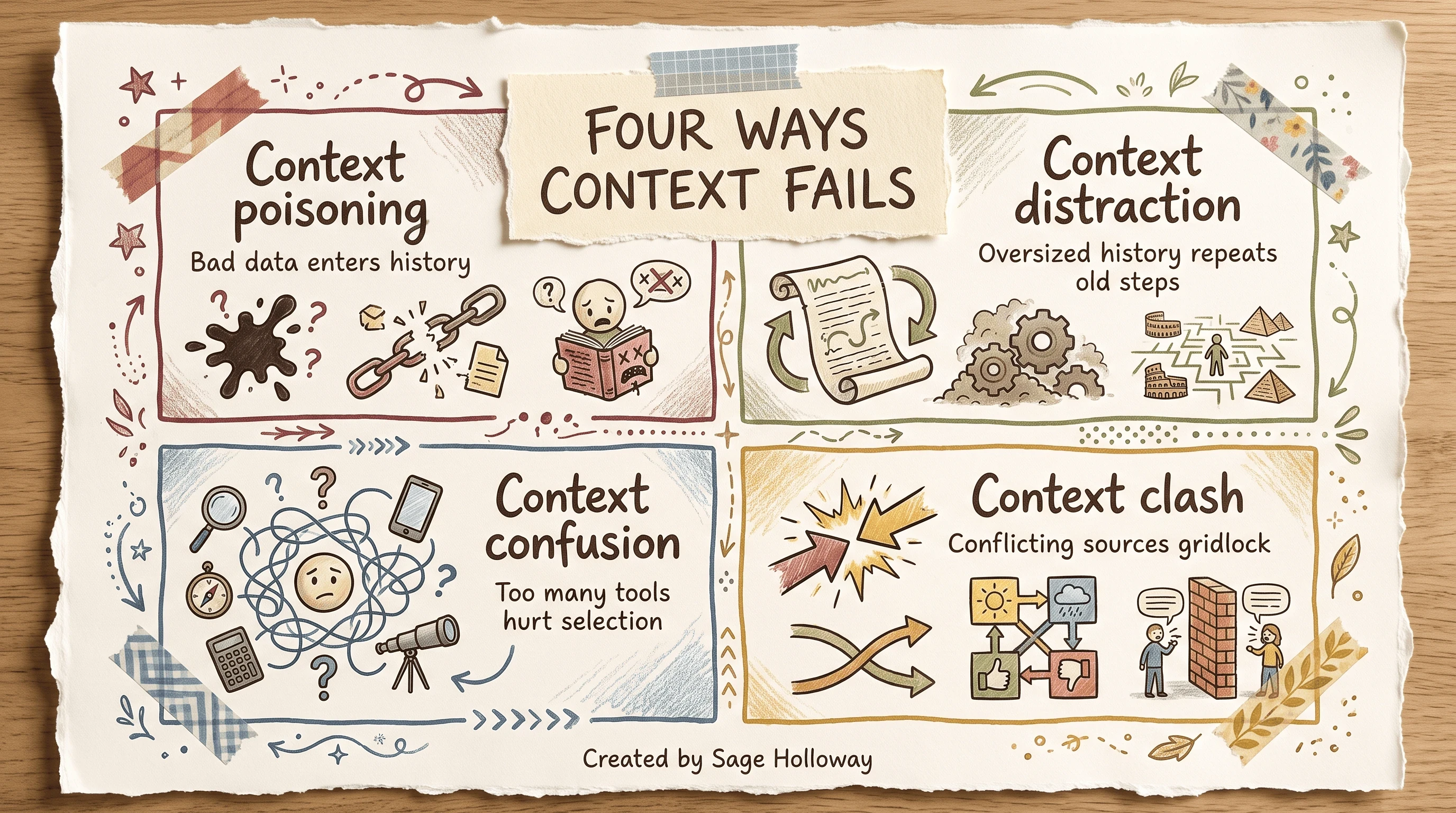
Debug context failures by name instead of blaming generic hallucinations.
Mitigation pipeline by mode:
Poisoning: isolate source, purge index rows, reset reasoning session with a fact ledger.
Distraction: compact history, clear tool results, drop redundant logs.
Confusion: prune tool loadouts to task-minimal sets; split sub-agents by domain.
Clash: reconcile specs upstream; single source of truth per fact class.
I tried classifying failures as "model drift" for a month. The fixes got faster when I started labeling the quadrant first.
Vector RAG, GraphRAG, and hybrid retrieval
Retrieval is one compiler input, not the whole context engineering stack.
When flat vector search is enough
Vector RAG (retrieval-augmented generation) embeds text chunks and returns semantically similar passages. It wins on simple lookup: FAQs, policy snippets, single-hop questions with clear keywords. Setup cost stays lower than graph infrastructure.
GraphRAG for multi-hop reasoning
GraphRAG models entities and relationships so agents traverse connected paths instead of isolated chunks. Neo4j and Memgraph pitch multi-hop explainability and auditable retrieval paths. Vendor claims that GraphRAG makes agents "80% more truthful" are marketing opinions, not universal metrics. The mechanism claim is stronger: flat chunks drop relational context needed for chained questions.
Hybrid retrieval without vendor lock-in
Practical hybrid pattern: vectors for fast semantic lookup, lightweight graph edges for entity wiring (user → account → policy). You do not need a flagship graph database on day one to preserve relationships in structured fields.
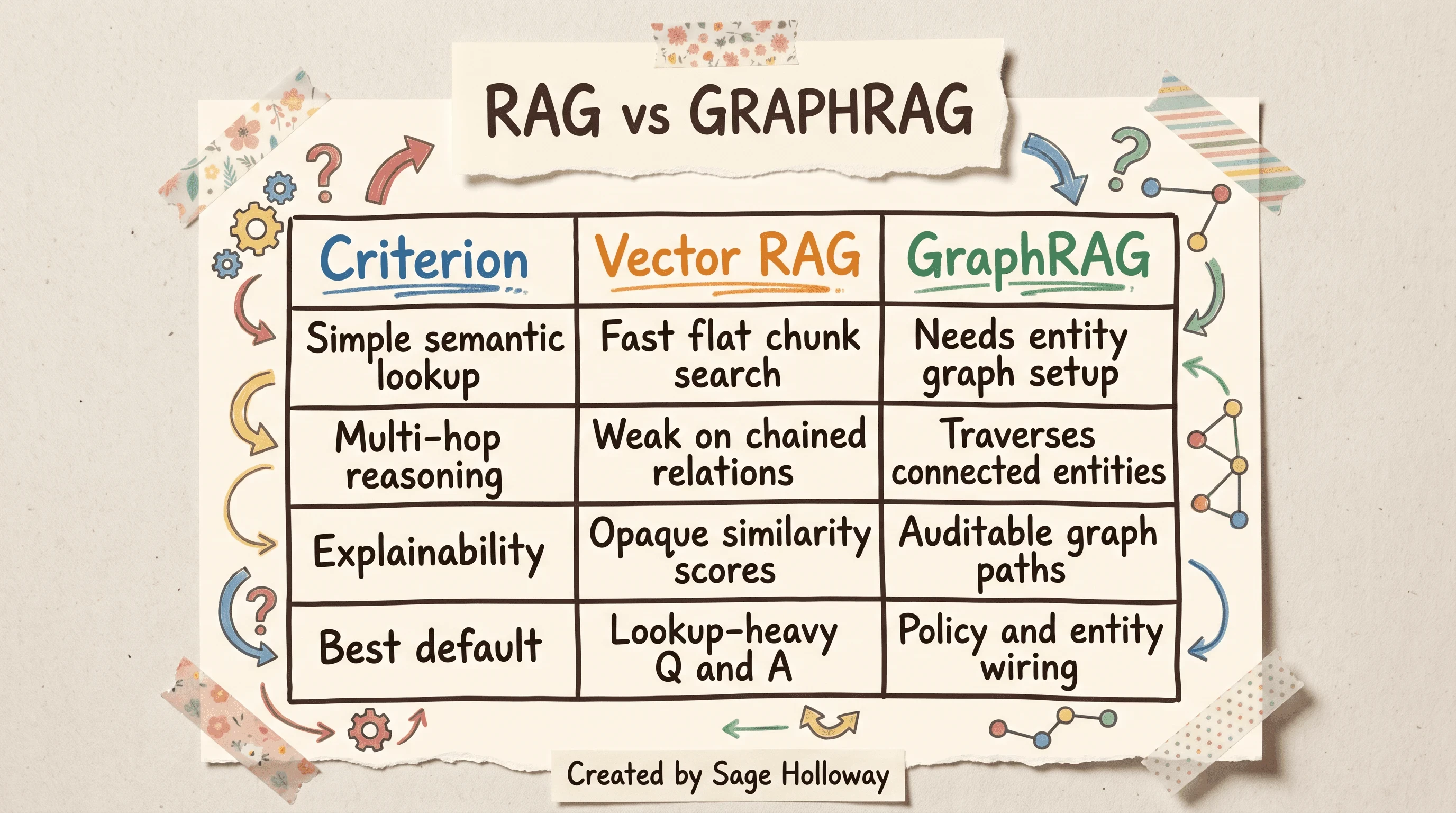
Flat chunks for lookup; graphs for entity wiring and multi-hop paths.
For implementation depth, see the planned guide on GraphRAG knowledge graph implementation. This comparison page stops at decision criteria.
Token economics: pre-retrieval vs just-in-time latency math
Vendor blogs describe pre-retrieval vs JIT in prose. Engineering leads need a worksheet.
Speed-to-precision and attention waste
Pre-retrieval loads candidate chunks before the model answers. First-token latency stays lower because retrieval runs once upfront. Attention waste rises when many loaded chunks are irrelevant; context rot arrives earlier.
JIT retrieval (ReAct-style tool loops) preserves window compactness. Each step adds an API call. Latency compounds linearly with exploration depth.
Latency and API cost compounding under JIT
Model a simple agent task:
Pre-retrieval: 1 retrieval call + 1 generation call.
JIT with three tool steps: 3 tool rounds + 1 final generation, often 4+ model calls total.
If each call averages 2 seconds and $0.01, pre-retrieval costs ~$0.01 and ~2 seconds wall time. Three-step JIT costs ~$0.04 and ~8 seconds before quality advantages appear. Your pricing tier will differ; the shape will not.
Token-budget worksheet for engineering leads
Use this attention altitude worksheet when choosing a strategy:
Estimate task-critical tokens
T(instructions + must-have facts).Estimate candidate retrieval pool
R(chunks you might load).Compute waste ratio
W = (R - T) / max(R, 1).If
W > 0.6and latency SLA is tight, prefer JIT or reranking over bulk pre-load.If
Tis known-small and stable, pre-retrieval with hard top-k caps often wins.
Anthropic's progressive disclosure pattern aligns with step 4: expose tool metadata lightly, fetch details on demand.
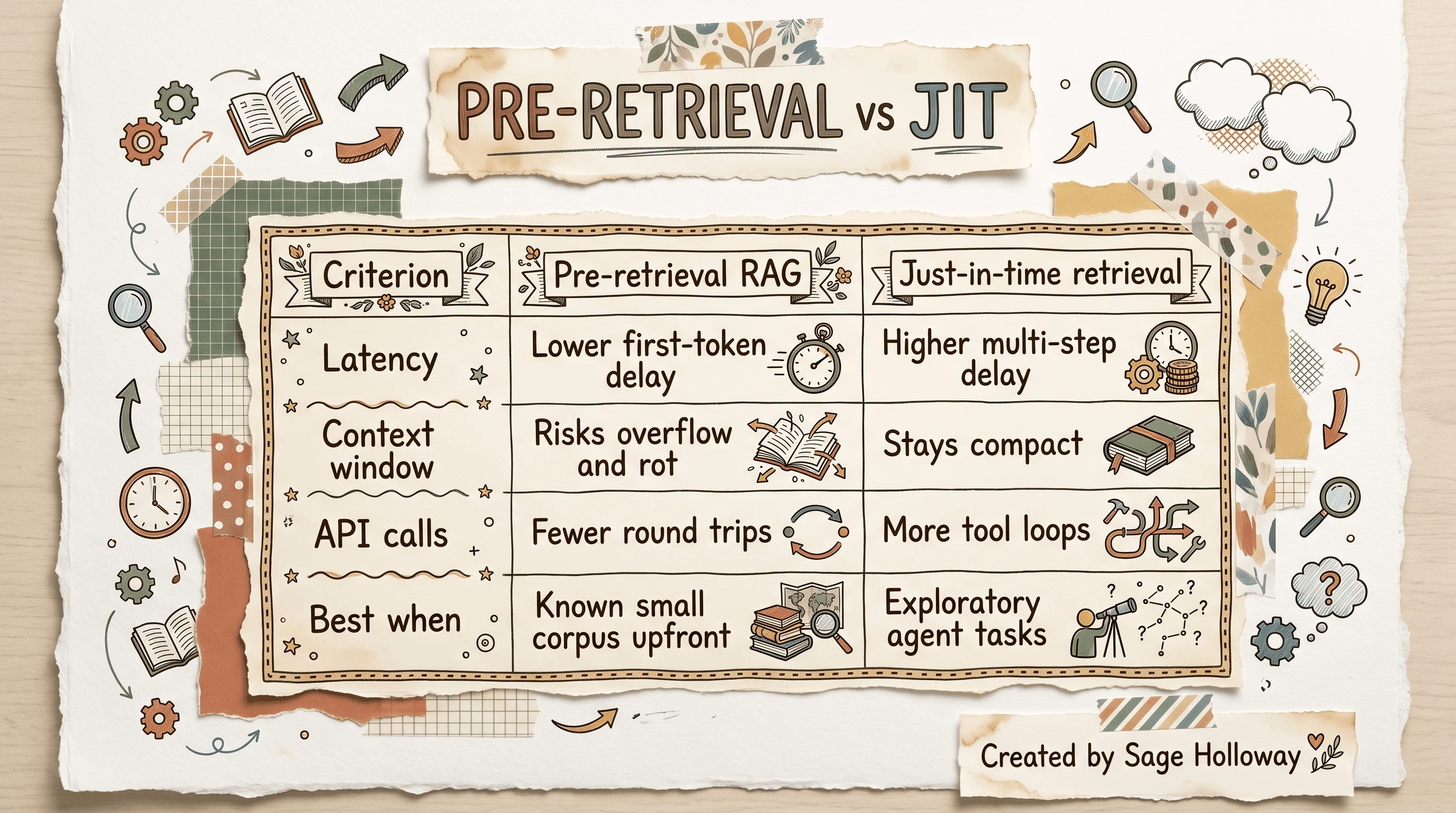
Pre-retrieval is faster; JIT keeps the attention budget compact at higher call volume.
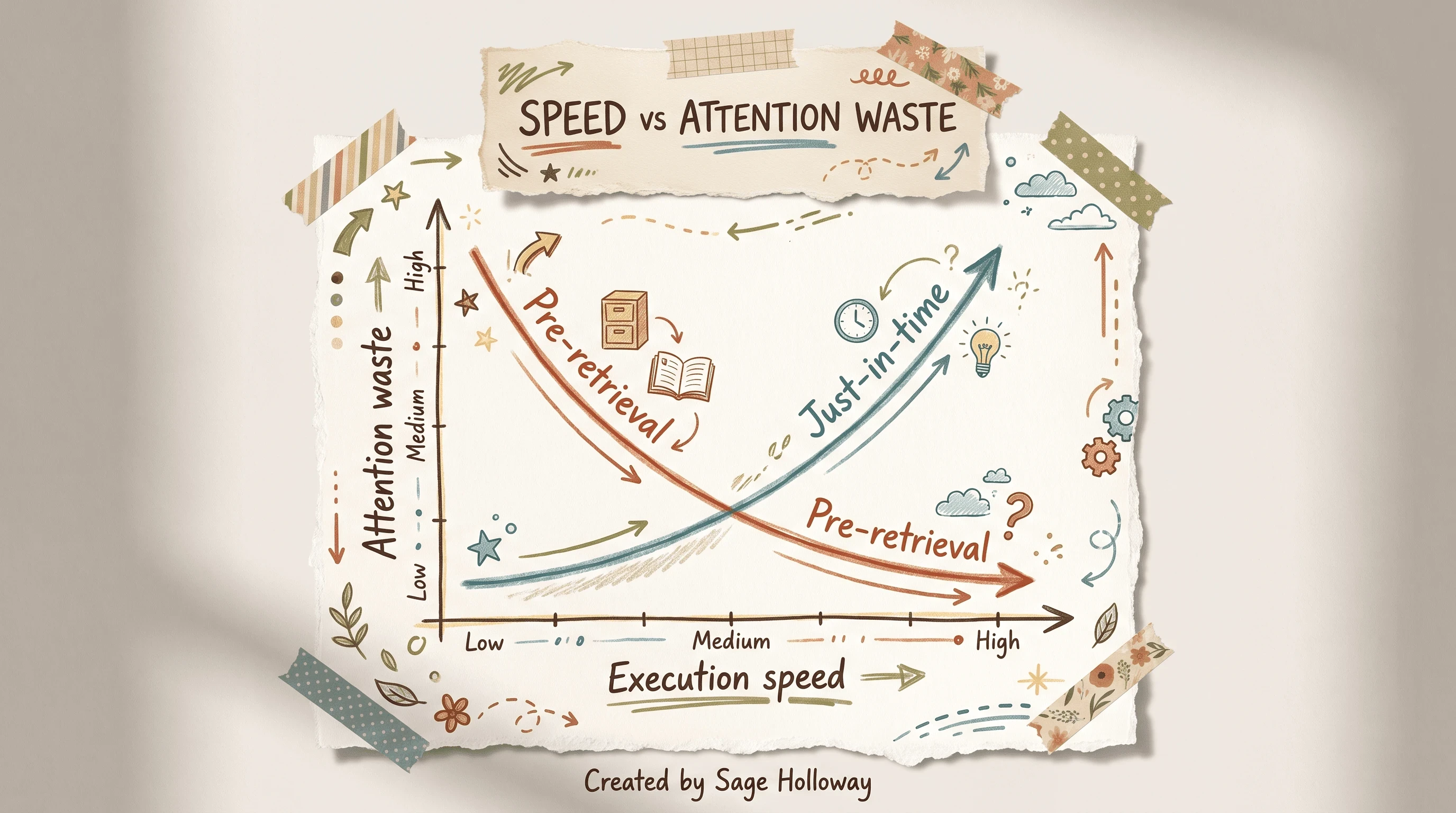
The missing developer math competitors skip: attention waste versus call latency.
The difference is boring. It is also the whole game when finance asks why the agent bill tripled.
From manual context files to code-driven context compilers
Hand-trimmed markdown was a bridge, not a destination.
Manual file trimming as a brittle precursor
Reddit developers report keeping CLAUDE.md under roughly 500 tokens and maintaining separate notes.md files to force context resets. Firecrawl cites similar community benchmarks. These hacks help local IDE sessions; they do not scale to microservices where schemas, permissions, and business rules change daily.
Treat manual trimming as a precursor pattern with medium confidence, not production architecture.
Schema introspection and runtime compilation
OpenAI Developer Community threads argue manual context curation is already obsolete for serious practitioners. The alternative: automated workflow architecture where code introspects live databases, emits JSON schemas, and compiles task-specific context at runtime. Medium confidence, forum-sourced, but directionally aligned with Elasticsearch's dynamic agent examples.
When workflow architecture replaces hand curation
Automated compilation wins when business rules change faster than docs, when multiple agents share data sources, and when permission boundaries must be enforced programmatically. Hand curation wins when you are solo, prototyping, and the task surface fits one screen.
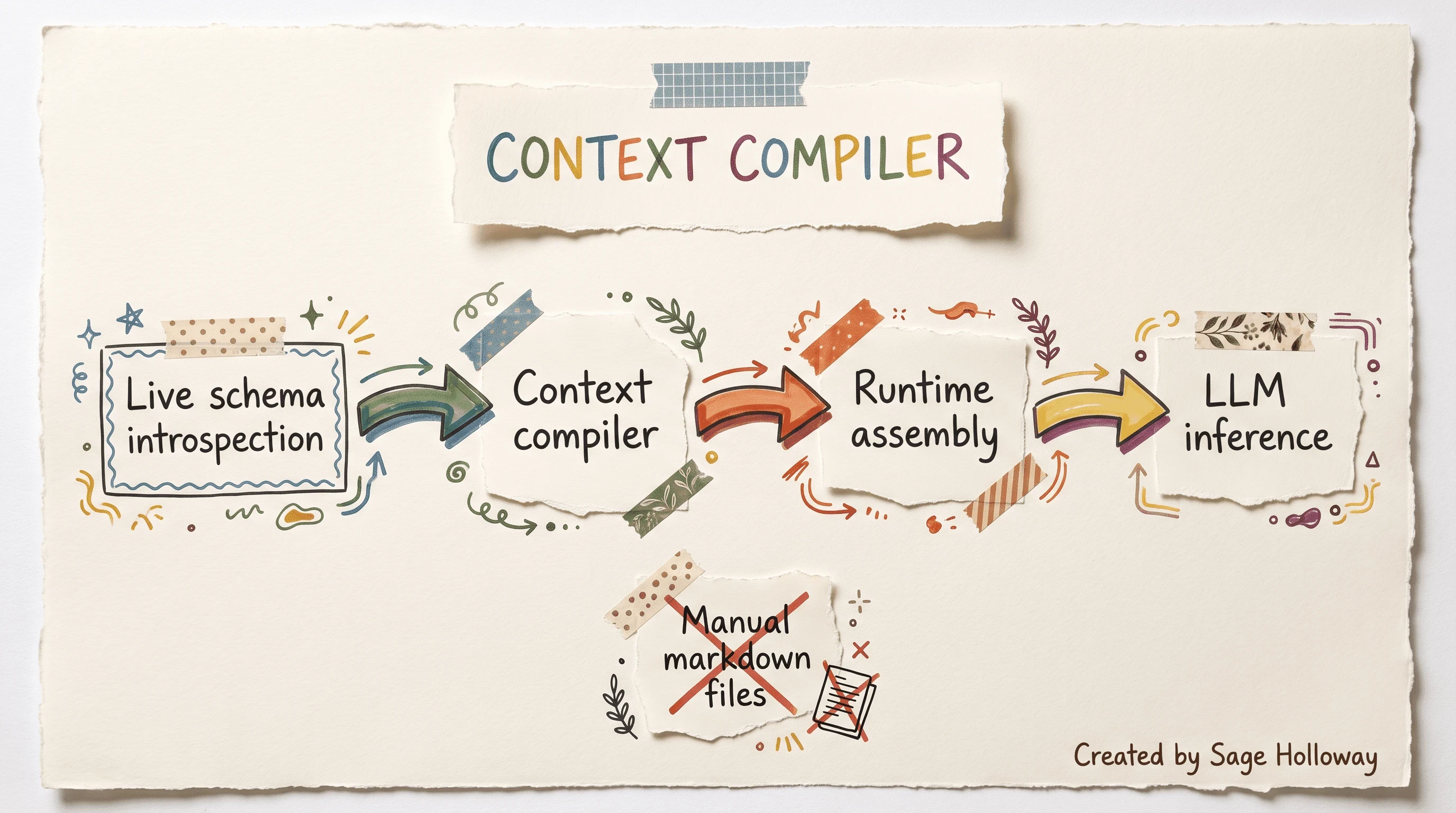
Production context should compile from live schemas, not hand-trimmed markdown files.
https://www.youtube.com/shorts/0ffaUSD_yg4
That optional short reinforces the shift from static prompt files toward programmatic workflow architecture. Watch it after you sketch your compiler step, not before you understand compaction.
For a deep dive on state machines and runtime compilers, see the planned guide on automated workflow architecture.
FAQ
Is context engineering just prompt engineering with a new name?
No. Prompt engineering optimizes instructions inside a single turn. Context engineering designs the pipeline that assembles memory, tools, retrieval, and history before inference. Prompting is a subset of the larger curation job, not a rebrand.
What does prompt engineering still own after you adopt context engineering?
Prompt engineering still owns instruction altitude, output formatting, persona boundaries, and task framing within the compiled window. Context engineering does not remove the need for clear specs. It removes the fantasy that specs alone manage state.
Does context engineering replace RAG?
No. RAG is one retrieval mechanism inside context engineering. Compaction, tool gating, memory hierarchies, and permission filters still matter after you embed chunks.
Is context engineering only for agents?
It shows up most visibly in agent loops, but any multi-turn system with external data benefits: copilots, support bots, research assistants, and batch pipelines that replay history. Single-turn classifiers can ignore most of this page.
Prompt vs context vs memory: how do the three differ?
Prompt is the instruction text you send now. Context is the full window compiled for this inference, including prompts, history, tools, and retrieved data. Memory is durable state stored outside the window and re-injected selectively (notes files, vector stores, graph entities).
Which should I learn first?
Learn prompt engineering first if you are prototyping single-turn tasks. Move to context engineering when you add tools, retrieval, or multi-turn continuity. Skipping straight to agents without prompt basics produces verbose, brittle specs.
Can I do context engineering without an agent framework?
Yes. Context engineering is patterns (retrieval gates, compaction, schema compilers), not a single product. You can implement compilers in plain Python behind any API client.
Does Anthropic's "effective context engineering" post mean prompting is dead?
No. Anthropic's post elevates curation for long-horizon agents; it still documents instruction altitude and structured note-taking inside the window. Prompt craft remains; prompt-only architecture does not scale alone.
What are the four main ways context can fail?
Context poisoning (bad data persists in history or indexes), context distraction (oversized history repeats old steps), context confusion (too many tools degrades selection), and context clash (conflicting sources gridlock decisions). Name the mode before you tweak temperature.
Pick one failing agent loop from your backlog. Label its failure mode using the four-quadrant grid. Run the token worksheet: estimate waste ratio for your retrieval pool and decide pre-retrieval vs JIT for the next sprint. Then sketch one compiler step that pulls live schema instead of a static markdown file. Ship the smallest version that measures task success rate, not vibe.
Whether manual markdown trimming survives another year in IDE workflows, genuinely not sure yet. The compiler direction already wins in data-heavy production paths. Watch which pattern your team reaches for when staging breaks on turn twelve, not turn one.
Until then...
Sage
PS. I once deleted a 6,000-token "project overview" prompt and watched accuracy jump on the next run. The model did not get smarter. The middle of the window finally had room to breathe.
Author
Practical guides, tool teardowns & AI engineering workflows.
Related Articles