Context Engineering
What Are Context Graphs? Decision Traces, Event Clocks, and Enterprise AI Memory

Sage Holloway
21 min read
Go back to blog
SHARE
The agent approved the credit line increase. The audit team asked why. The CRM row said "approved." The Slack thread with the exception rationale lived somewhere else entirely. Nobody stitched them. That gap is not a prompt problem. It is a memory architecture problem.
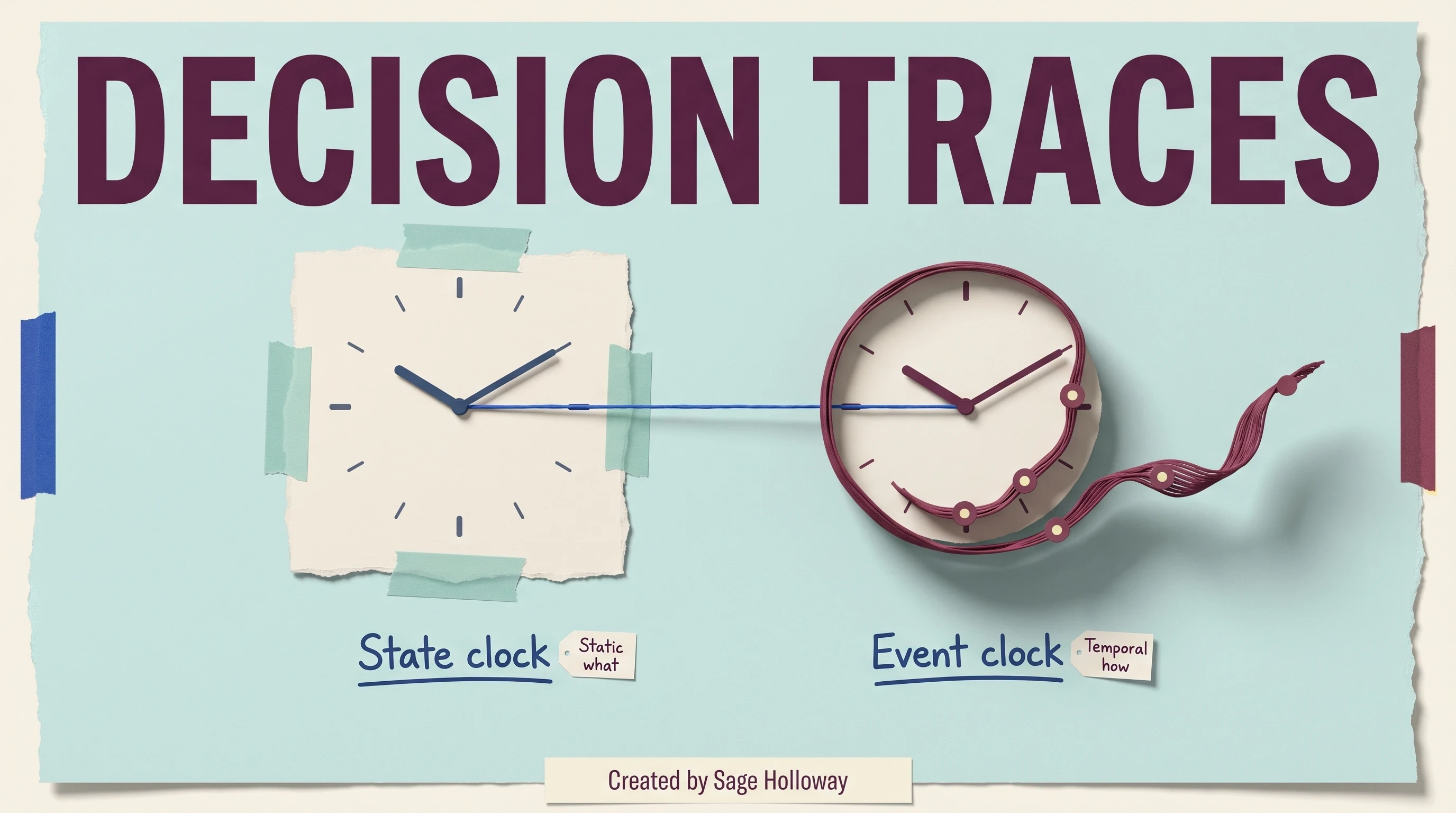
A context graph is an active, chronological memory layer that records decision traces: the sequences of events, context inputs, policy versions, exceptions, and human approvals behind enterprise actions. Unlike traditional knowledge graphs that represent static what relationships (the state clock), context graphs model the temporal how and why of processes (the event clock), allowing AI agents to evaluate historical precedents, adapt to edge cases, and perform compliant, multi-system workflows safely.
Last verified: 22 August 2026 (NotebookLM sources; no live CLI run on this pack).
Six months ago I treated "context graph" as marketing vocabulary for a fancier knowledge graph. Then I watched an agent repeat a pricing exception that human reviewers had already rejected twice for the same customer profile. The model was not hallucinating. It was working from a state snapshot that never recorded the rejection chain.
If you have ever shipped an agent that technically followed policy documents but violated operational precedent, you already know why this topic matters.
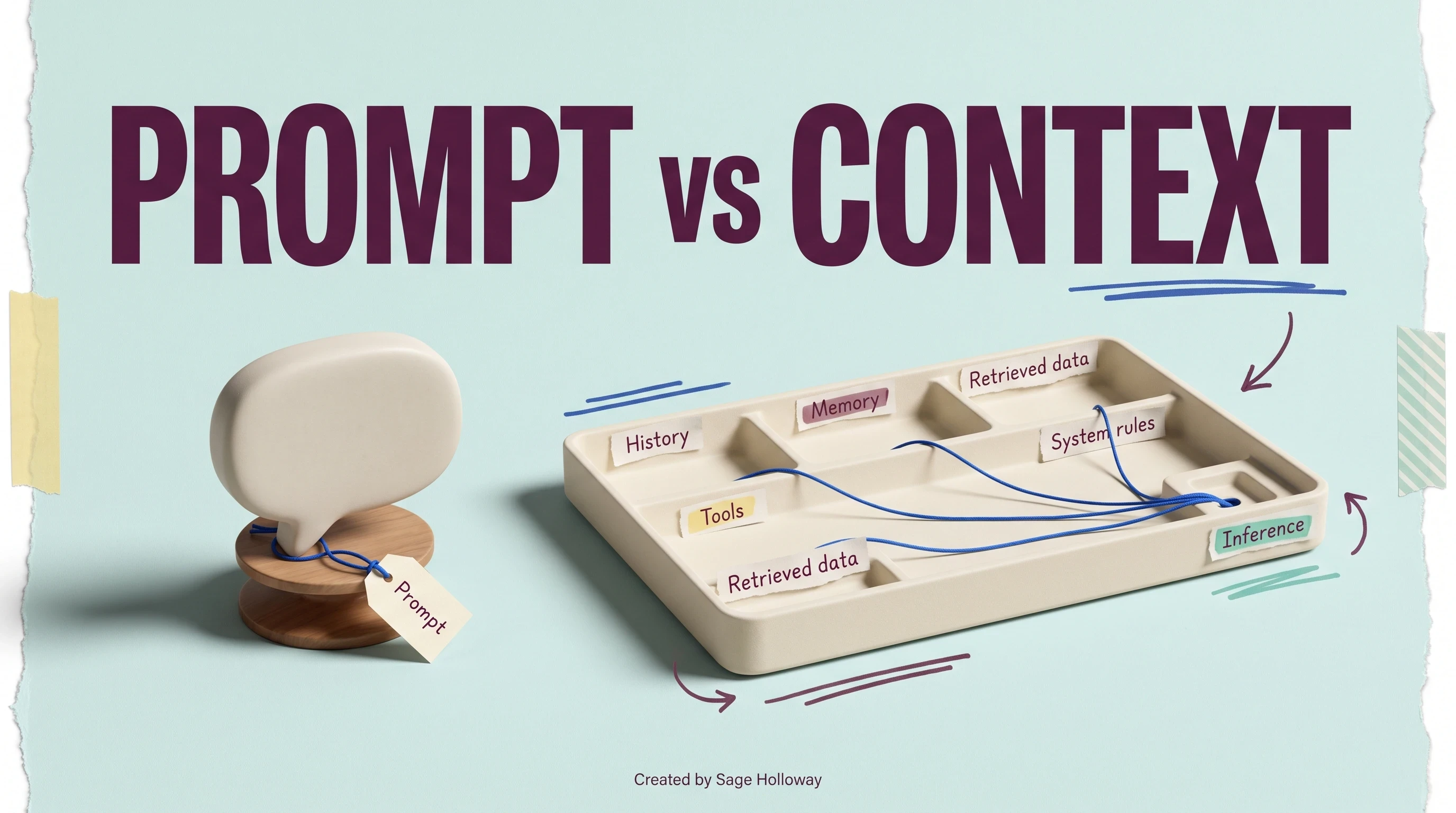
This page owns definitional depth for context graphs: what they are, how they differ from knowledge graphs and RAG, and how teams actually stitch events across fragmented toolchains. For the broader craft of filling agent windows and tool context, see context engineering best practices. For the definitional split between prompt craft and durable context layers, see prompt engineering vs context engineering. Those sibling pages cover different primaries. Here we answer what are context graphs in full.
On this page
What context graphs are: state clocks, event clocks, and decision traces
How context graphs differ from knowledge graphs, RAG, and process mining
Why vs how: two valid ways to model enterprise decisions
How a context graph gets built: connectors, stitching, and feedback loops
Stitching cross-system identities and events without siloed agent memory
Hands-on patterns: TrustGraph CLI, Cypher paths, and GDS over decision networks
Where context graphs show up in production workflows
Enterprise readiness: hype, schema debates, and privacy thresholds
FAQ
Context graphs record how decisions unfold, not just what the database says right now.
What context graphs are: state clocks, event clocks, and decision traces
Picture two clocks on the same office wall. One is frozen at 3:47 p.m. on the day your CRM last synced. It shows account status, open opportunities, and ticket counts as they existed in that instant. The other clock keeps moving. Each tick adds a card: who opened the deal-desk channel, which policy version was active, which manager overrode the default, what the outcome was.
The frozen clock is useful for reporting. The moving clock is useful for judgment.
That is the core paradigm shift behind a context graph, which is a dynamic graph database layer that treats enterprise decision history as queryable structure rather than scattered chat logs and audit PDFs.
Decision traces as first-class graph nodes
A decision trace is the structured record of everything that fed a specific action: inputs, versioned policies, human approvals, exceptions, and outcomes. In a context graph, those traces become first-class nodes you can traverse, not footnotes buried in application logs.
Foundation Capital's thesis on context graphs as AI's next enduring layer frames the gap bluntly: systems of record store what happened (discount granted, credit line raised, ticket closed) but rarely preserve the execution trail that explains why the outcome diverged from the written rule.
TrustGraph's Understanding Context Graphs guide maps the same idea into a three-layer stack: a system of intelligence (agents), a system of records (the graph), and a temporal feedback loop that writes query traces back into storage.
Do not confuse this with chain-of-thought text inside a single chat session. CoT is private reasoning that evaporates when the session ends. A context graph is durable, cross-tool, and meant to be queried by the next agent run next week.
Process mining is also not the same job. Process mining analyzes bounded event logs inside one platform (often ERP or BPM) offline. Context graphs target heterogeneous, unstructured toolchains (Slack, docs, CRM, ticketing) as a runtime substrate for live agent decisions.
Six metadata dimensions every assertion carries
Every assertion in a mature context graph carries operational metadata, not just a subject-predicate-object triple. Graphwise's fundamentals page lists six dimensions practitioners should expect:
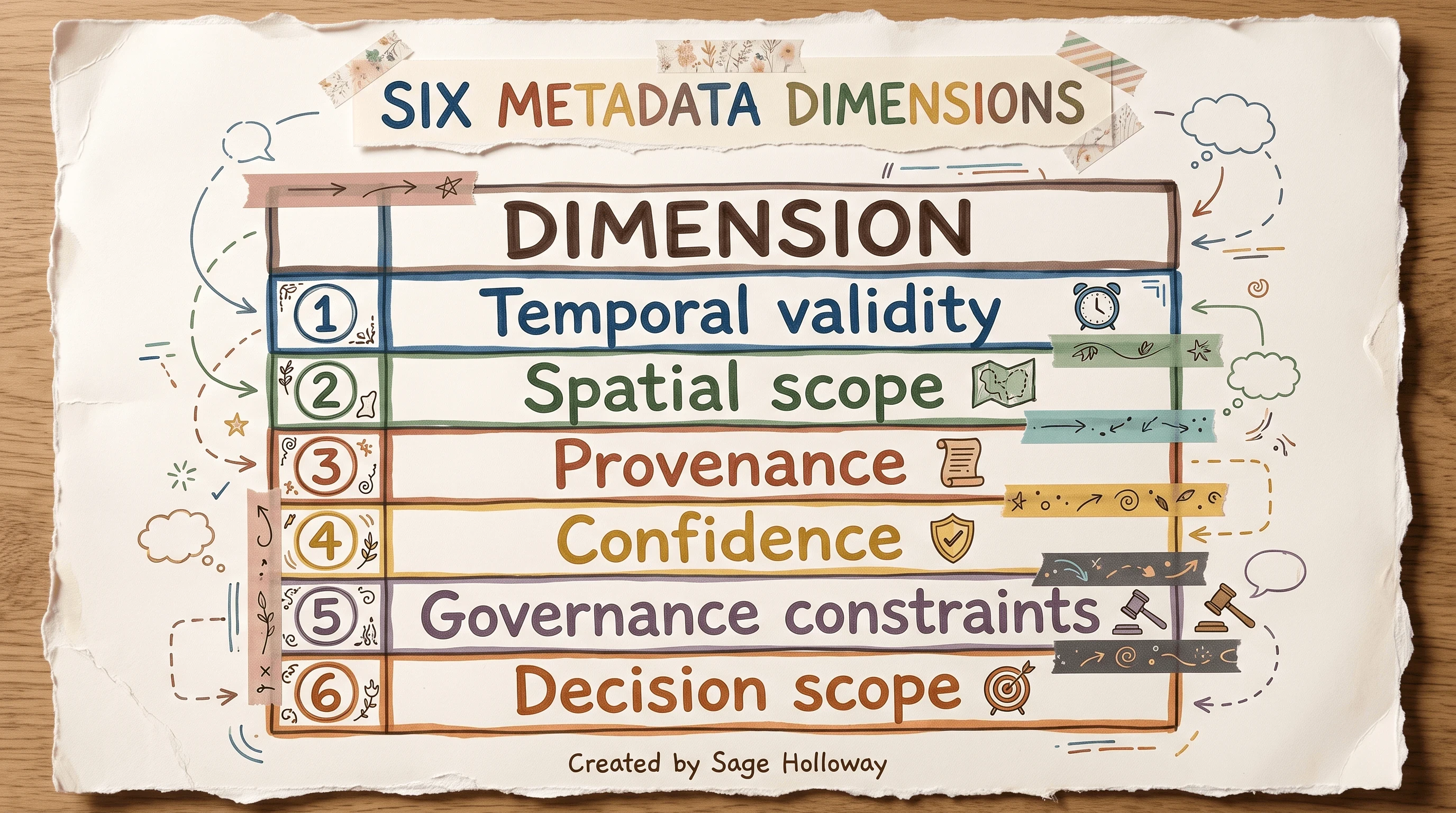
Every assertion needs scope, provenance, confidence, and governance metadata.
Those six fields are what let you answer "was this true when the decision happened?" instead of "is this true in the database right now?"
RDF-Star and Turtle for statement-level context
In RDF (Resource Description Framework, the W3C standard for graph facts as triples), classic triples struggle to attach metadata to a specific assertion. RDF-Star fixes that by letting you quote a triple and annotate the quote.
Kurt Cagle's Ontologist series walks through journalistic and board-meeting scenarios where temporal validity, reporter credentials, and approval roles ride on the statement, not just on the entity.
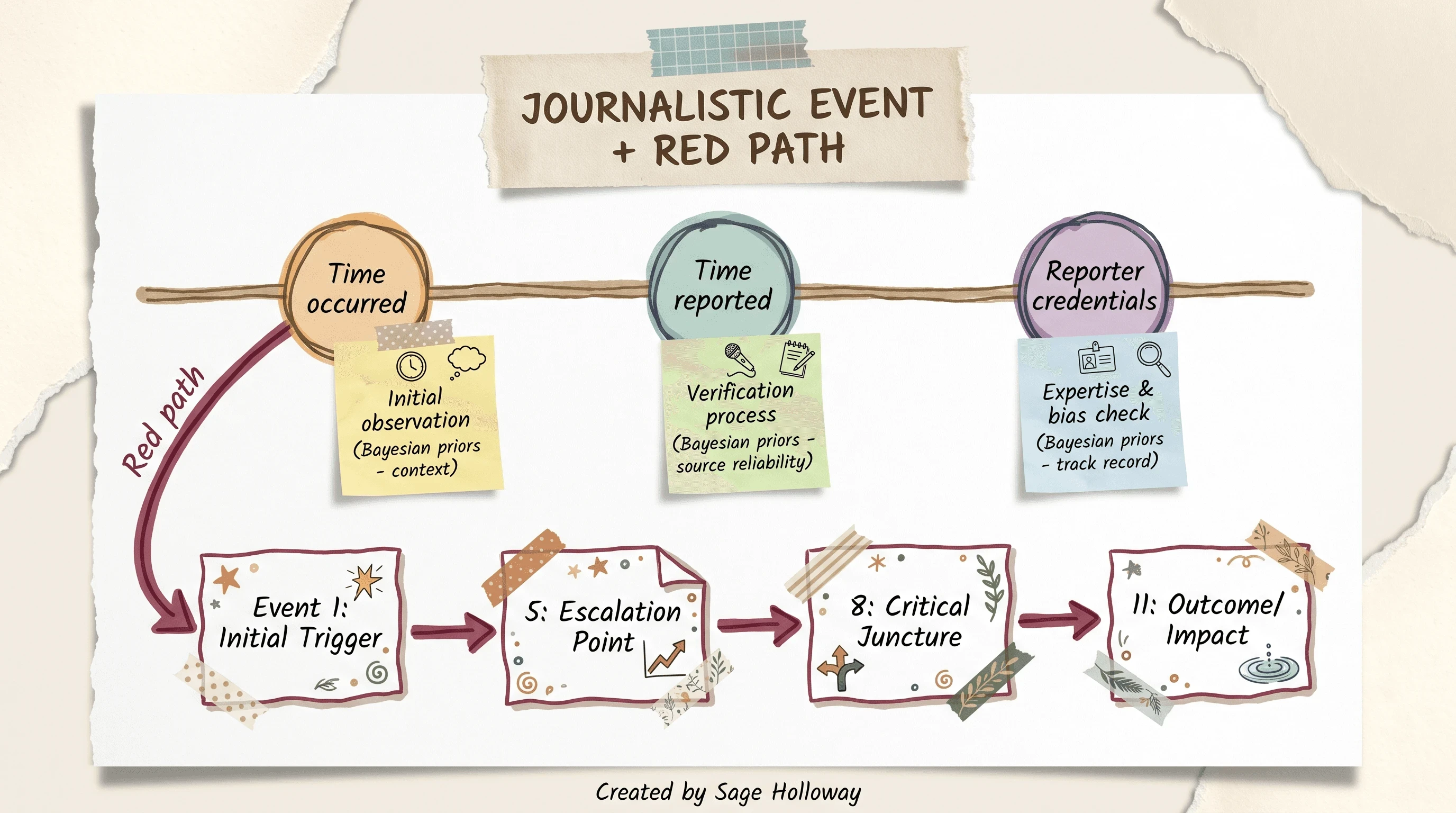
Statement-level metadata turns flat news events into auditable influence chains.
A minimal board-decision pattern in Turtle might look like this:
For a deeper thread on RDF-Star annotations, see this TrustGraph walkthrough on X.
Named graphs and reification are the two semantic-database patterns that make precedent queryable at statement level: named graphs partition provenance (source vs retrieval traces), while reification (or RDF-Star quoting) attaches metadata to individual assertions.
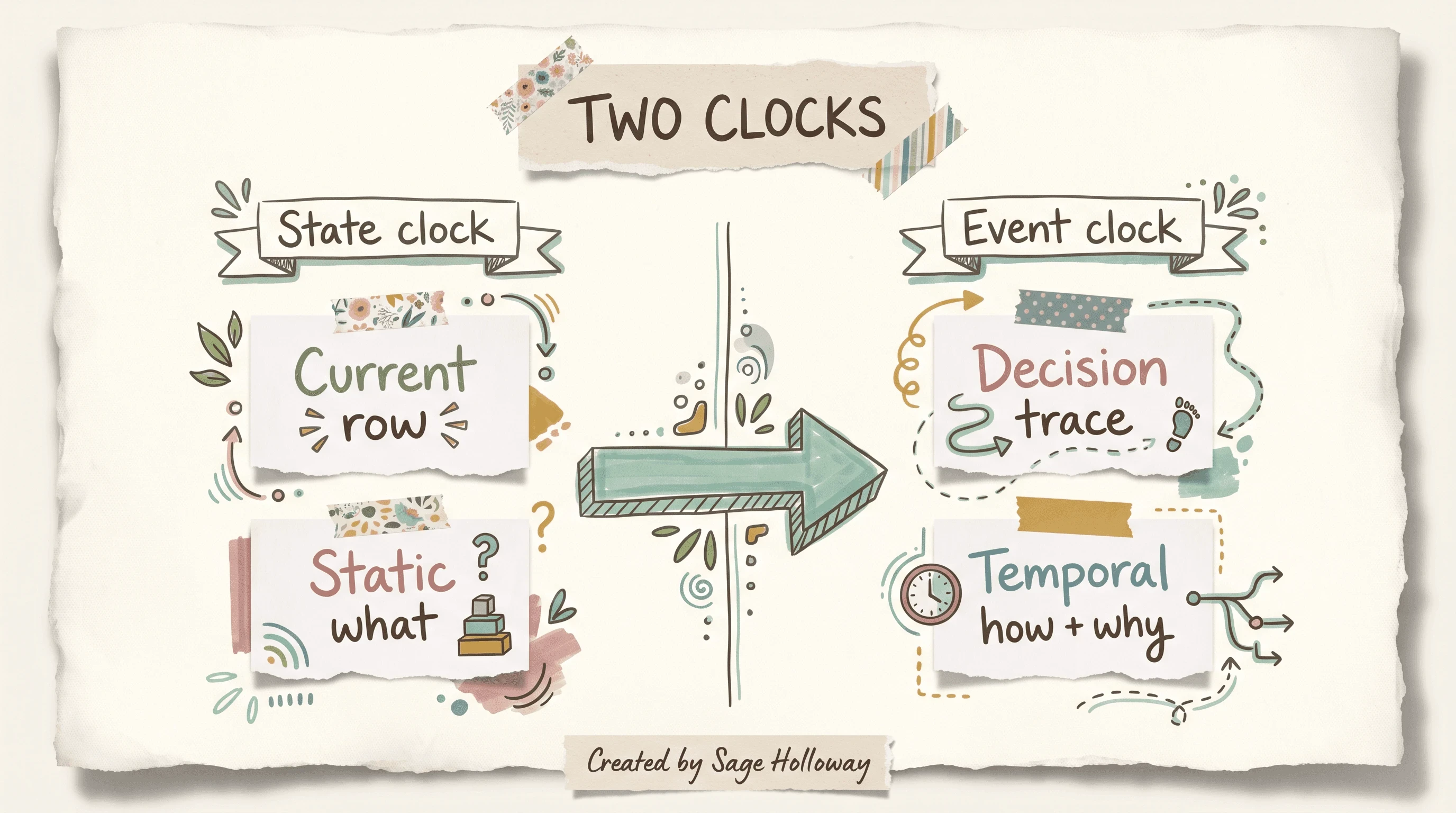
Knowledge graphs freeze what is true now. Context graphs log how it got there.
https://www.youtube.com/watch?v=qMV64p-4Deo
That Neo4j-led overview frames the systems-of-record gap and why agents need event-clock memory, not just entity lookups. Worth ten minutes if the state-clock vs event-clock split is still abstract.
How context graphs differ from knowledge graphs, RAG, and process mining
A knowledge graph is a structural map of entities and relationships: who reports to whom, which drug interacts with which, which SKU belongs to which supplier. It answers what and who with high precision. It is trapped in the state clock unless you bolt on temporal extensions.
A context graph is behavioral and temporal. It records how actions unfolded, which policies were active at decision time, and which human overrides shaped the outcome.
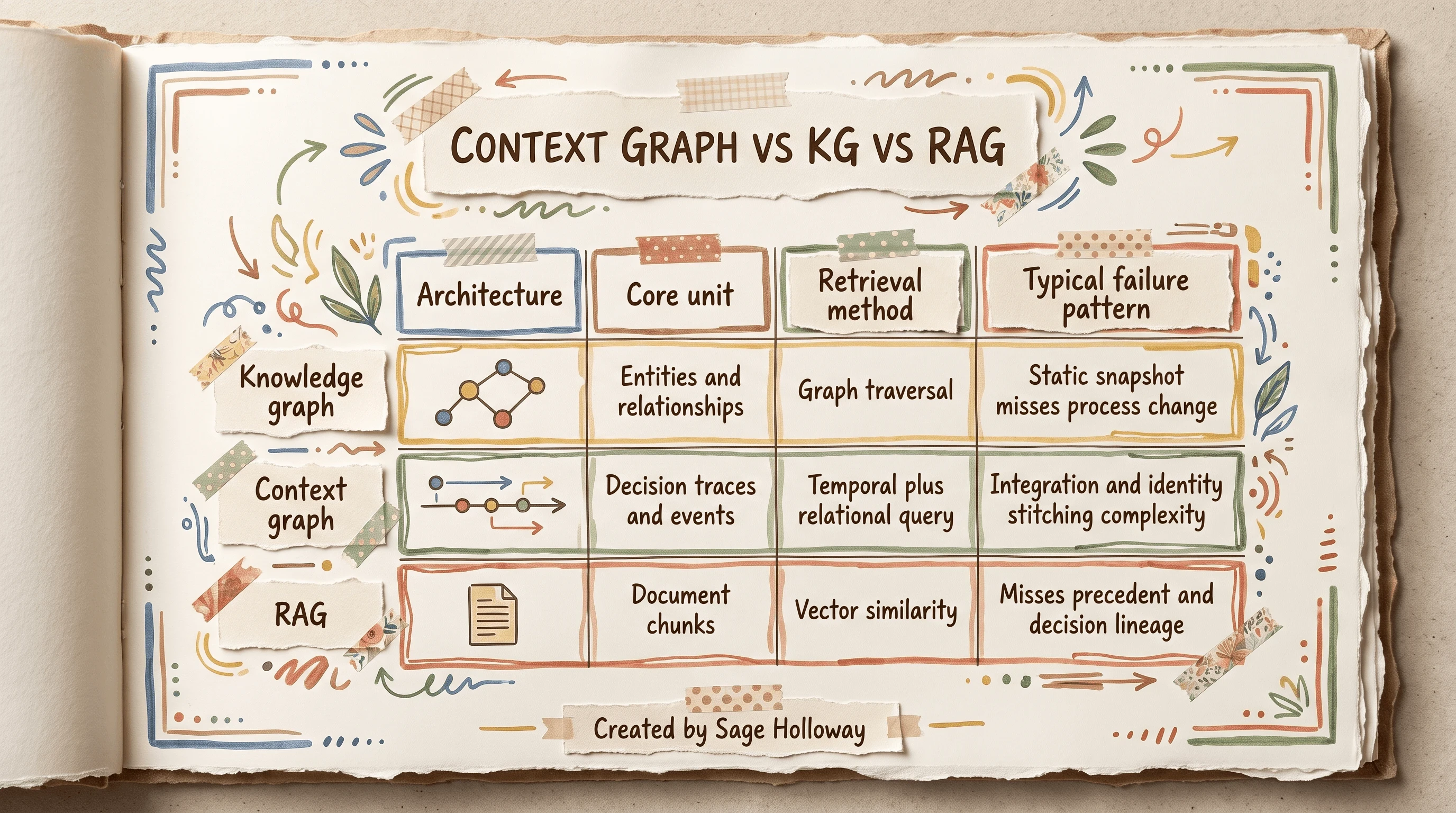
RAG tells you what the policy says. Context graphs show how it was applied.
Retrieval-Augmented Generation (RAG) is document-centric: chunk text, embed it, retrieve similar passages, inject them into the prompt. RAG excels at telling an agent what the employee handbook says. It weakens when the right answer depends on precedent ("how did we handle this edge case last quarter for a similar account?").
Context graphs are decision-centric. They use relational and temporal queries to surface how policies were applied, overridden, or interpreted in production.
Simply put: RAG improves what the model knows. A context layer improves how the agent decides on edge cases.
When RAG and a context layer complement each other
You rarely pick one. The durable pattern is hybrid: RAG for policy language, graph traversal for precedent and lineage, vector search for semantic similarity when labels are messy.
Graphwise claims GraphRAG built on contextual knowledge graphs can be over three times more accurate than standard vector RAG in enterprise settings. Treat that as a vendor-sourced directional claim, not a universal constant. The mechanism still holds: structure plus semantics beats flat chunks alone. For a dedicated architecture page on hybrid vector-graph retrieval, see our future spoke on GraphRAG hybrid retrieval.
Do not conflate Glean's personal graph (a per-user chronological action stream with strict local privacy boundaries) with an enterprise aggregate context graph. Personal graphs feed the pipeline. The context graph emerges after normalization, anonymization, and cross-user pattern mining.
For RDF triple vs property graph framing, this TrustGraph manifesto thread is one of the clearest primary-source comparisons in the pack.
Why vs how: two valid ways to model enterprise decisions
Here is the architectural tension almost every vendor blog smooths over.
Foundation Capital and TrustGraph treat explicit reasoning as first-class graph data. The why behind a decision can be stored as reified nodes: policy inputs, exception rationales, approval roles. Precedent becomes searchable. Audit teams get a chain they can replay.
Glean's engineering leadership takes the opposite bet. You cannot reliably capture human why in a database. Thinking is subjective and often offline. What you can capture is the how: chronological tool usage, collaboration patterns, ticket transitions, document edits. Over many cycles, repeated how traces approximate why statistically.
Both camps are partially right. Both are incomplete alone.
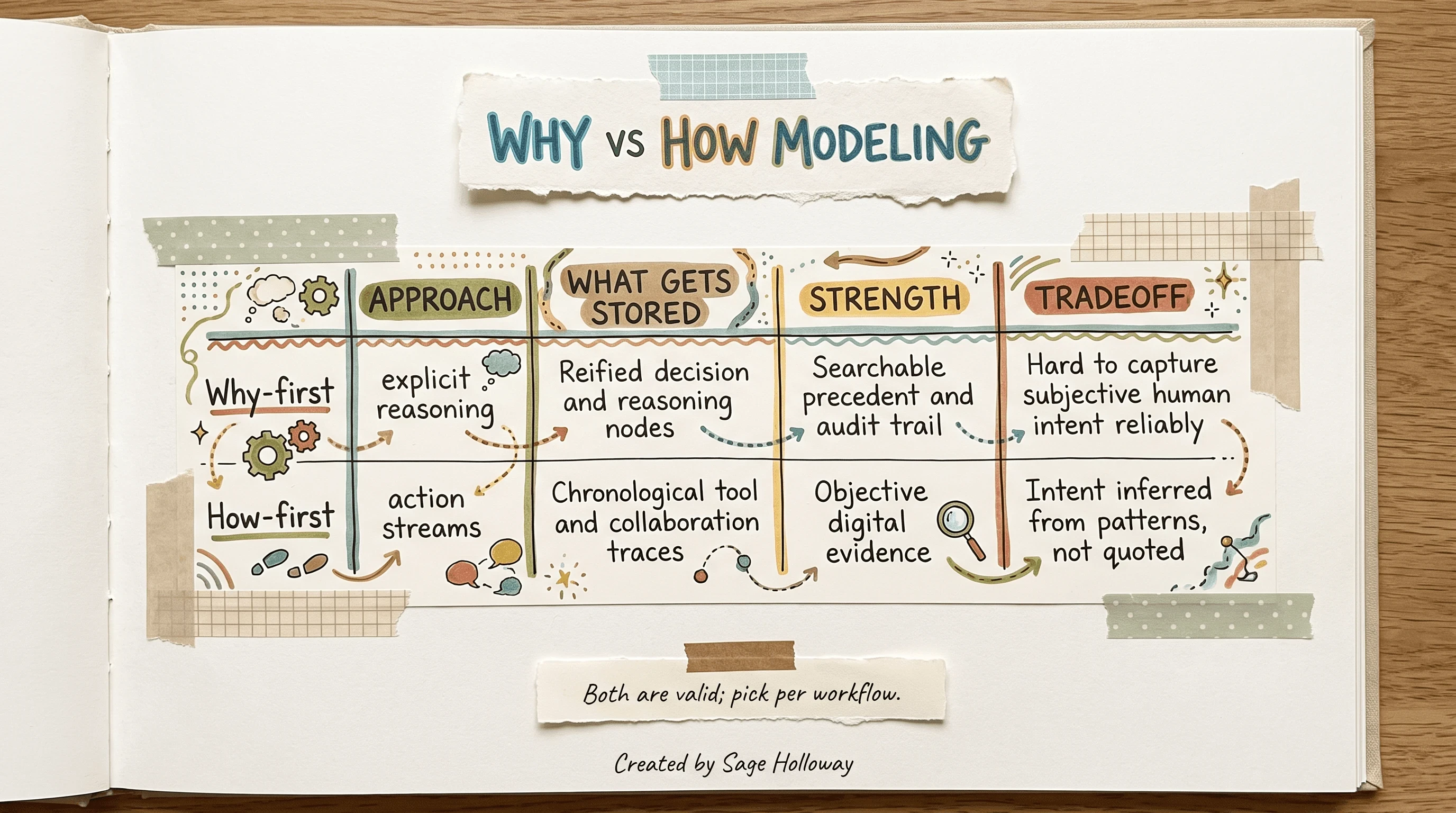
Foundation Capital stores reasoning nodes. Glean logs action streams and infers intent.
Explicit reasoning and reified decision nodes
Why-first modeling shines in regulated workflows where audit requires explicit rationale: credit committees, clinical protocols, safety sign-offs. The graph stores the reasoning artifact even when the human would rather not type it twice.
The cost is capture friction. If your UI does not force rationale at the moment of override, the graph fills with hollow approval nodes.
Action streams and behavior-inferred intent
How-first modeling shines when actions are digital and dense: SaaS toolchains with rich telemetry. You log what happened in order. Clustering and similarity find recurring playbooks.
Glean reports roughly 80% accuracy on automated task classification and clustering. That other 20% is not a rounding error. It is mislabeled workflow noise that will pollute pattern promotion if you skip human review gates.
The difference is boring. It is also the whole game: pick the model that matches how honestly your organization records decisions today, not how you wish it did.
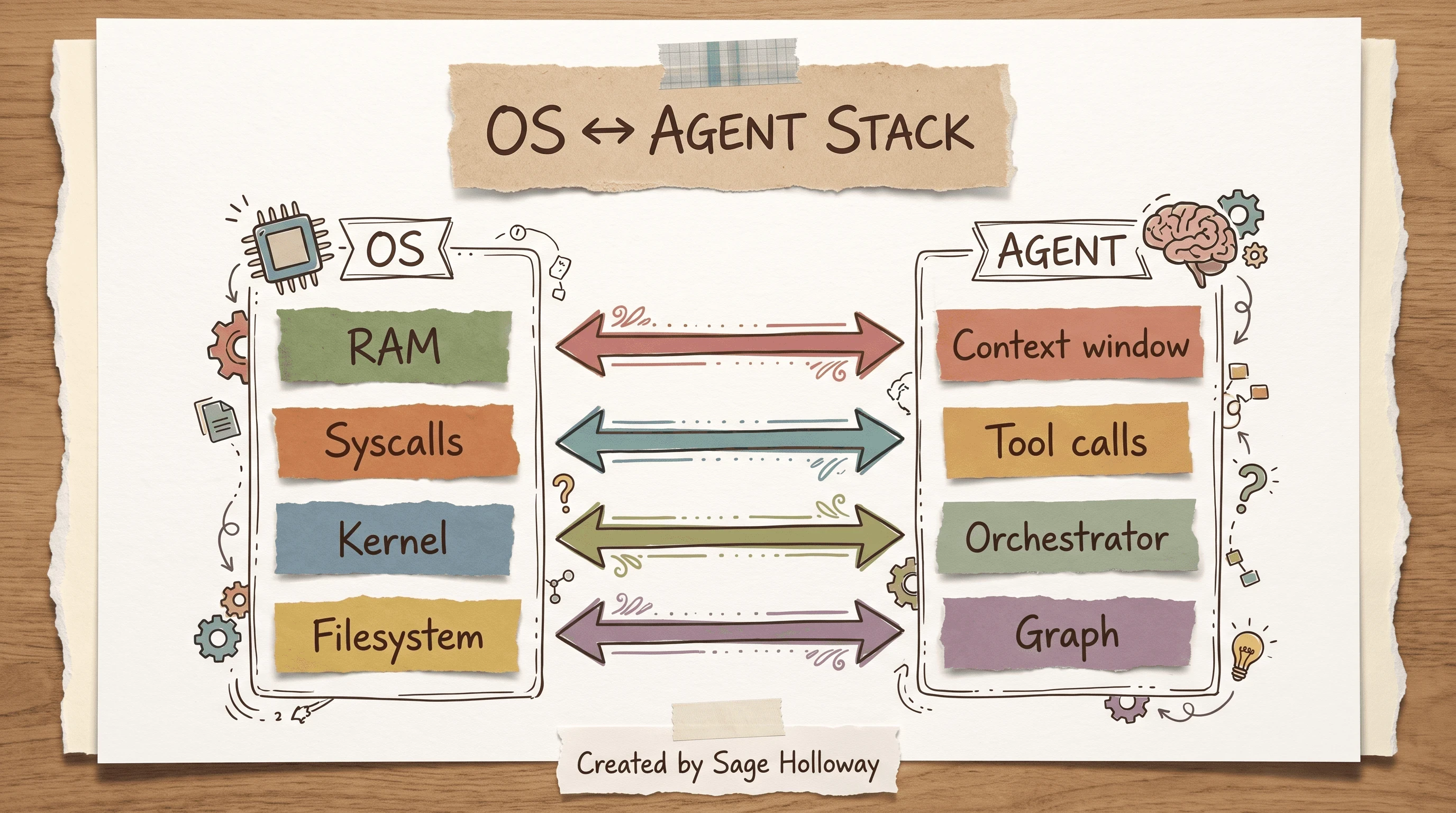
Treat the context graph like the agent filesystem for durable precedent.
Harness's engineering blog pushes the OS analogy further than most: context window as RAM, tool calls as syscalls, orchestrator as kernel, graph as filesystem. They also documented shrinking an agent server surface from 130+ endpoint-shaped tools to 11 generic verbs (list, get, create, update, execute, and similar). Tool-surface reduction matters because every endpoint description competes for the same finite context window. For MCP-standardized tool calling patterns, see our Model Context Protocol deep dive when that cluster ships.
How a context graph gets built: connectors, stitching, and feedback loops
Building a context graph is not a Docker install story. It is a pipeline: capture events, align semantics, stitch traces, mine patterns, store hybrid, feed back query logs. TrustGraph, Glean, Harness, and Graphwise all describe variants of the same six-component spine.
Connectors, semantic alignment, and trace stitching
Deep connectors ingest chronological activity from CRM, chat, docs, ticketing, and code systems. The semantic layer maps vendor-specific fields to shared entity types. Trace stitching segments continuous activity into tasks an agent can reuse ("credit review for account X," not 400 unrelated Slack messages).
Harness lists six components that matter: deep connectors, semantic layer, trace stitching and task segmentation, aggregation and pattern mining, hybrid storage, and the feedback loop.
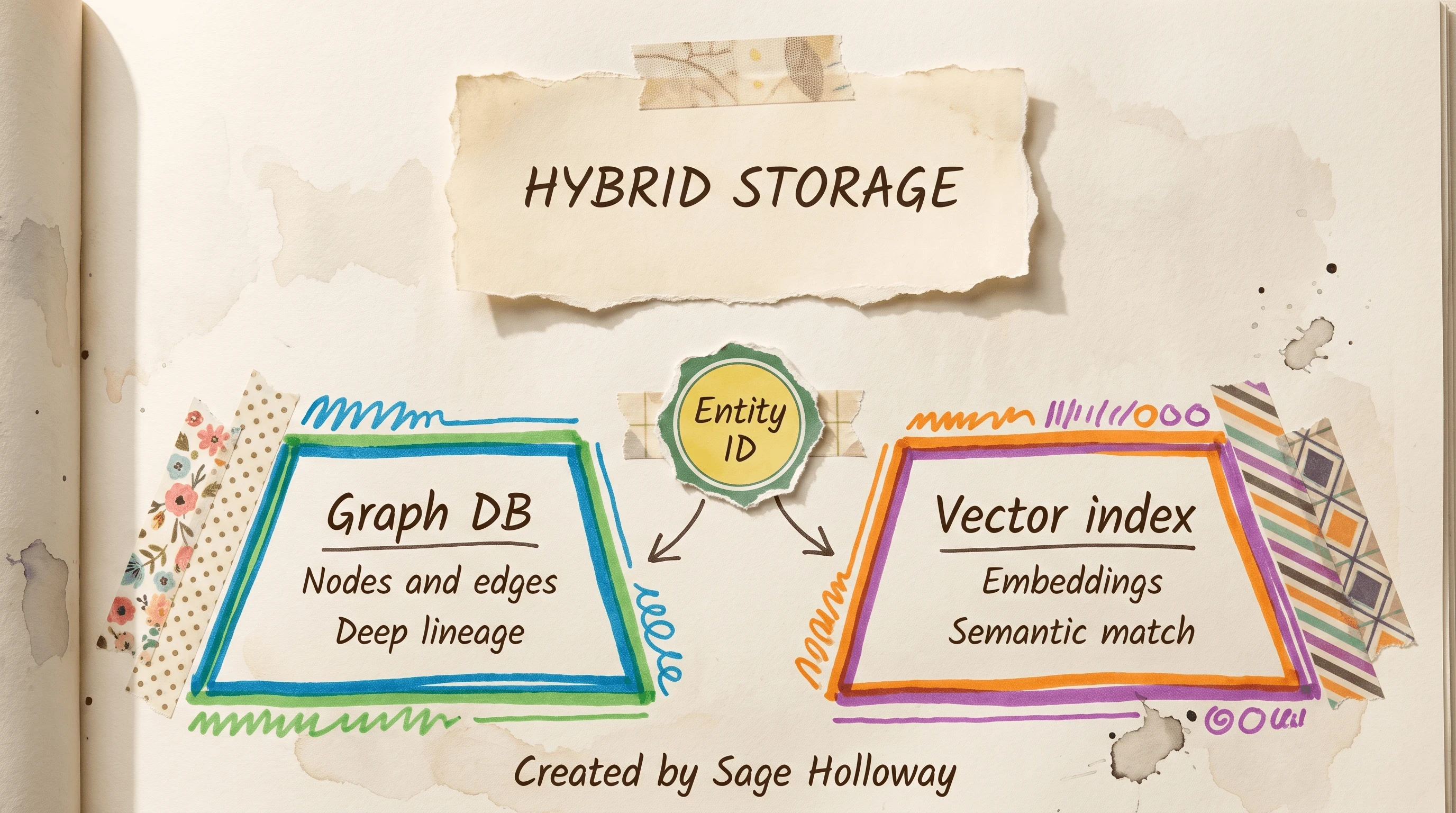
Structured lineage and semantic similarity share one entity key.
Temporal feedback loops and pattern promotion
TrustGraph splits named graphs by job: urn:graph:source holds provenance metadata for ingested knowledge, while urn:graph:retrieval holds query-time execution traces that power the temporal feedback loop.
Agents read precedent from source graphs. The platform learns which retrievals actually helped by inspecting retrieval graphs over time.
TrustGraph ships three agent execution patterns out of the box: ReAct, Plan-then-Execute, and Supervisor. The graph layer is what lets those patterns reference prior runs instead of starting cold.
Privacy filters before playbooks ship
Raw personal workflows must not become enterprise playbooks without anonymization. Glean's engineering blog specifies k-anonymity style thresholds: treat a workflow pattern as viable only if it appears across at least k distinct users and n independent traces. Rarer patterns drop automatically to reduce PII deanonymization risk.
That constraint is not optional polish. It is what separates a context graph from a surveillance log with better marketing.
Stitching cross-system identities and events without siloed agent memory
Every high-level context graph essay mentions "deep connectors." Almost none explain what breaks first in production: the same human arrives as three identities across legacy systems.
Your account executive is jane@company.com in Slack, jane.doe in GitHub, and Jane Doe in the HRIS. Your customer is account 001xx000003DGbQ in Salesforce, @bigco-deal in Slack, and BIGCO-441 in Jira. Without reconciliation, you do not get a context graph. You get three parallel graphs that never meet.
This is the integration challenge the SERP pack hand-waves and practitioners on r/KnowledgeGraph argue about in the open: strict ontologies meet messy business definitions where "Customer" means different things in Sales vs Product.
Identity resolution across legacy toolchains
Identity resolution is the unglamorous step before trace mining. Connectors must map varied profiles to one logical actor ID without leaking raw PII into aggregate layers. The research pack does not give vendor-specific field names or sync APIs for your stack. Treat connector schemas as implementation-specific. The invariant is the reconcile gate, not a magic .env key.
One timeline from CRM, chat, and ticketing events
The useful mental model is a stitch blueprint: Salesforce close events, Slack deal-desk threads, and Jira escalations flow through an actor reconcile step into one unified timeline per decision.
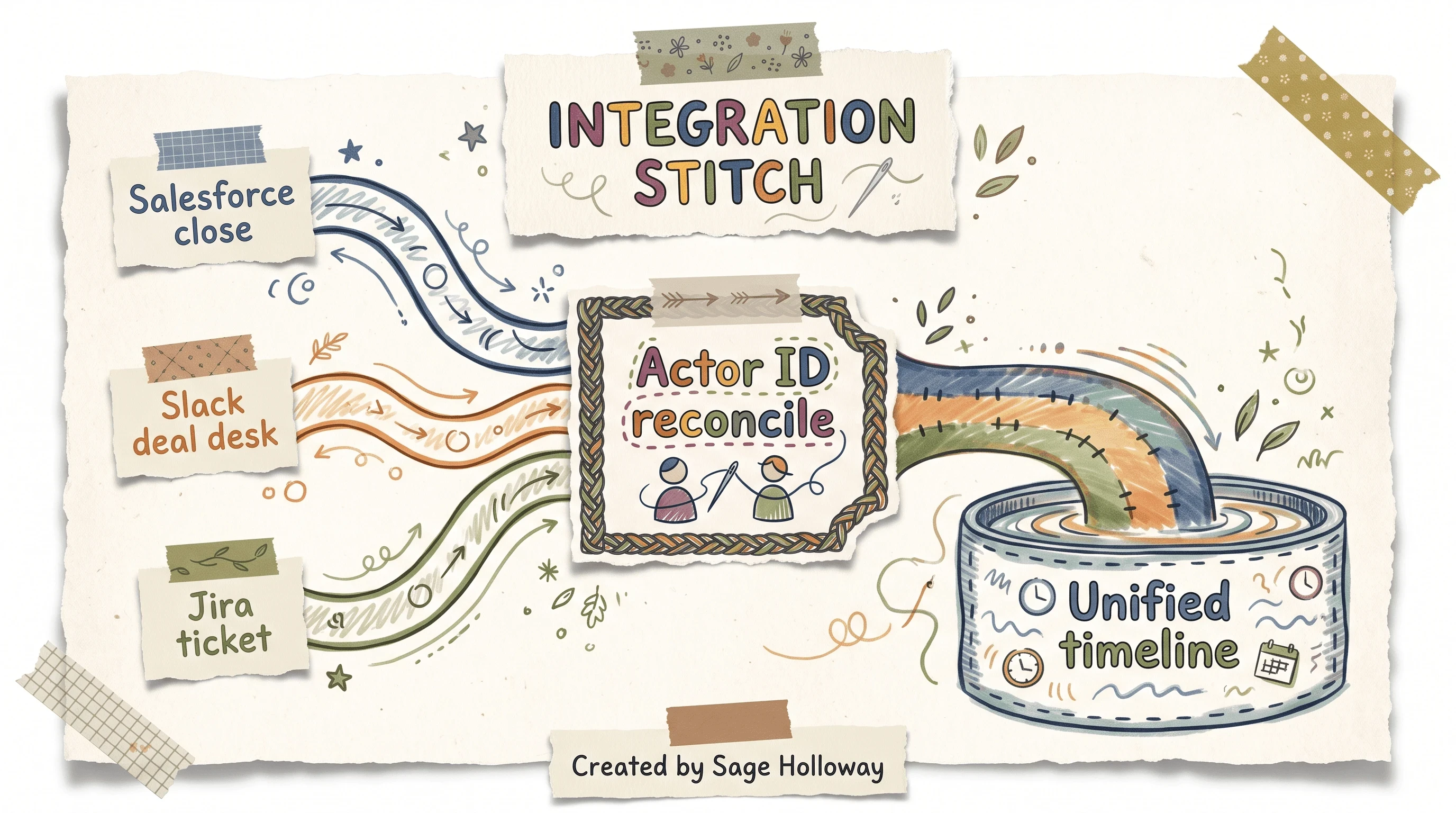
Deep connectors only work when identity resolution precedes trace mining.
When a credit exception happened, you want one traversable path: opportunity stage change, policy version active, Slack approval, ticket link, final CRM outcome. Not four searches across four admin consoles.
Avoiding isolated per-agent memory silos
Multi-agent deployments make this worse. If each orchestrator writes traces only to its private store, you recreate silos with extra steps. The context graph must be a shared substrate queried by every agent runtime, with write permissions scoped by role and anonymization rules.
Context graphs ai is not a separate product category. It is this job: making multi-agent systems read the same precedent layer instead of inflating token budgets with duplicated tool schemas.
Hands-on patterns: TrustGraph CLI, Cypher paths, and GDS over decision networks
Theory without copy-pasteable syntax still leaves engineers translating between RDF people and property-graph people. Here are patterns from the open-source TrustGraph repo and Neo4j's developer blog that you can run locally when you are ready to verify commands yourself.
TrustGraph three-layer stack and named graphs
Start from the TrustGraph GitHub repository. Configuration and deployment follow the documented CLI flow:
Load Fred-the-cat example knowledge and query it:
Inspect explainability and export:
The -v flag on tg-invoke-agent shows the agent's thinking process. The retrieval graph commands are how you inspect what the temporal feedback loop captured.
Docker Compose and CLI command reference
This will not work if you skip the ontology upfront. TrustGraph currently expects you to define schema using W3C RDF, OWL, and SKOS patterns before ingestion validates. That is a real constraint, not a footnote. We return to the schema debate in the readiness section.
Neo4j causal traversal and GDS algorithms
Neo4j's hands-on context graphs post models decisions as nodes with CAUSED, INFLUENCED, and PRECEDENT_FOR relationships. Recursive causal lookup:
Graph Data Science (GDS) adds structural analytics over those networks:
Hybrid search combines OpenAI text embeddings with structural vectors:
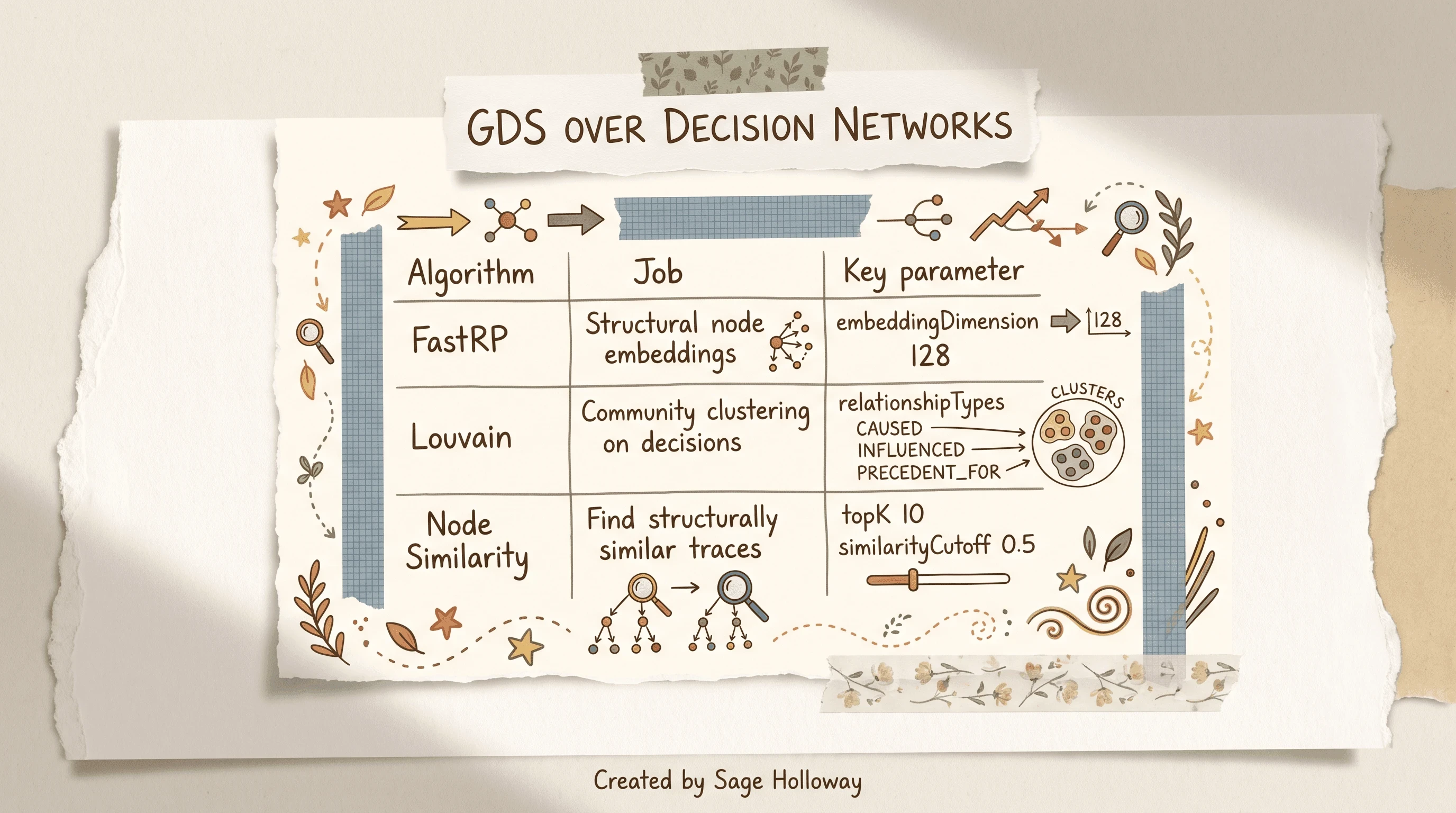
Structural embeddings and community detection find repeating decision patterns.
The same decision event in RDF-Star vs Cypher:
Two ecosystems, one job: attach metadata to the decision, not only to the entity.
https://www.youtube.com/watch?v=gZjlt5WcWB4
That TrustGraph walkthrough covers RDF ontologies, reification, and the temporal feedback loop in practice. Pair it with the CLI block above when you want to see the graph writes happen.
Where context graphs show up in production workflows
Context graphs are not a single industry product. They are a modeling discipline that shows up wherever agents must respect precedent.
Financial decision tracing
Neo4j's credit-line increase demo follows customer Jessica Norris through accounts, transactions, prior rejections, employer context, and employees who made past pricing calls. The published visualization references 31 nodes and 30 relationships in the populated graph.
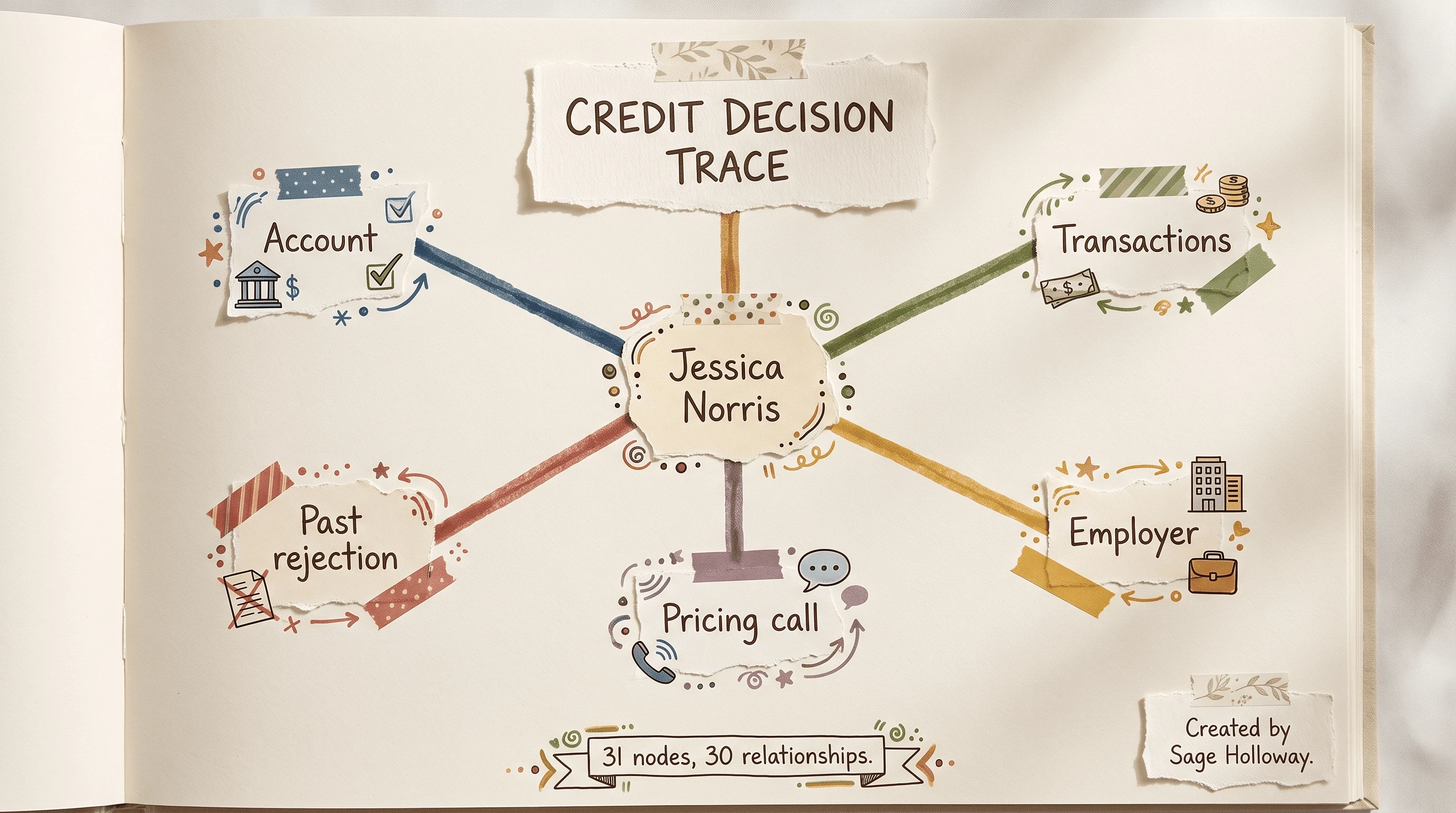
Production context graphs expose precedent paths agents can traverse.
That is the difference between "approve if score > 700" and "approve if score > 700 unless prior rejection pattern matches these structural neighbors."
Healthcare and operational event modeling
IBM's Think topic page walks patient-care scenarios where context graphs preprocess clinical events, care-team actions, and policy constraints before agents recommend next steps. Graphwise cites context-aware RAG reaching 81.3% QA accuracy in clinical settings in Nature Scientific Reports, a 6.8 percentage-point gain over baseline RAG in that study. Attribute clinical numbers to the study, not to your internal pilot.
Logistics and board-decision modeling appear in Ontologist's event-series examples: shipments, delays, committee votes, research milestones. The pattern repeats: event time vs report time, provenance, and decision scope as first-class metadata.
Kore.ai cites Gartner projecting that by 2029, 80% of AI agent platforms using reasoning models will have aligned context layers, up from under 10% in 2026. Forecasts are forecasts. They still signal where budget conversations are heading.
Enterprise readiness: hype, schema debates, and privacy thresholds
Foundation Capital's "trillion-dollar opportunity" framing kicked off the category in late 2025. By mid-2026 the better question is not whether context graphs are conceptually sound. It is whether your CRM, ticketing, and chat data are unified enough to feed one.
Schema-first vs agent-discovered ontologies
TrustGraph requires upfront ontology definition. Practitioners in the Reddit thread linked above agree that is the current open-source reality. Cogent Enterprise advocates the opposite: let agents discover organizational ontology dynamically by walking APIs during execution. That claim is medium-confidence in our pack and conflicts with TrustGraph's validated-upfront model.
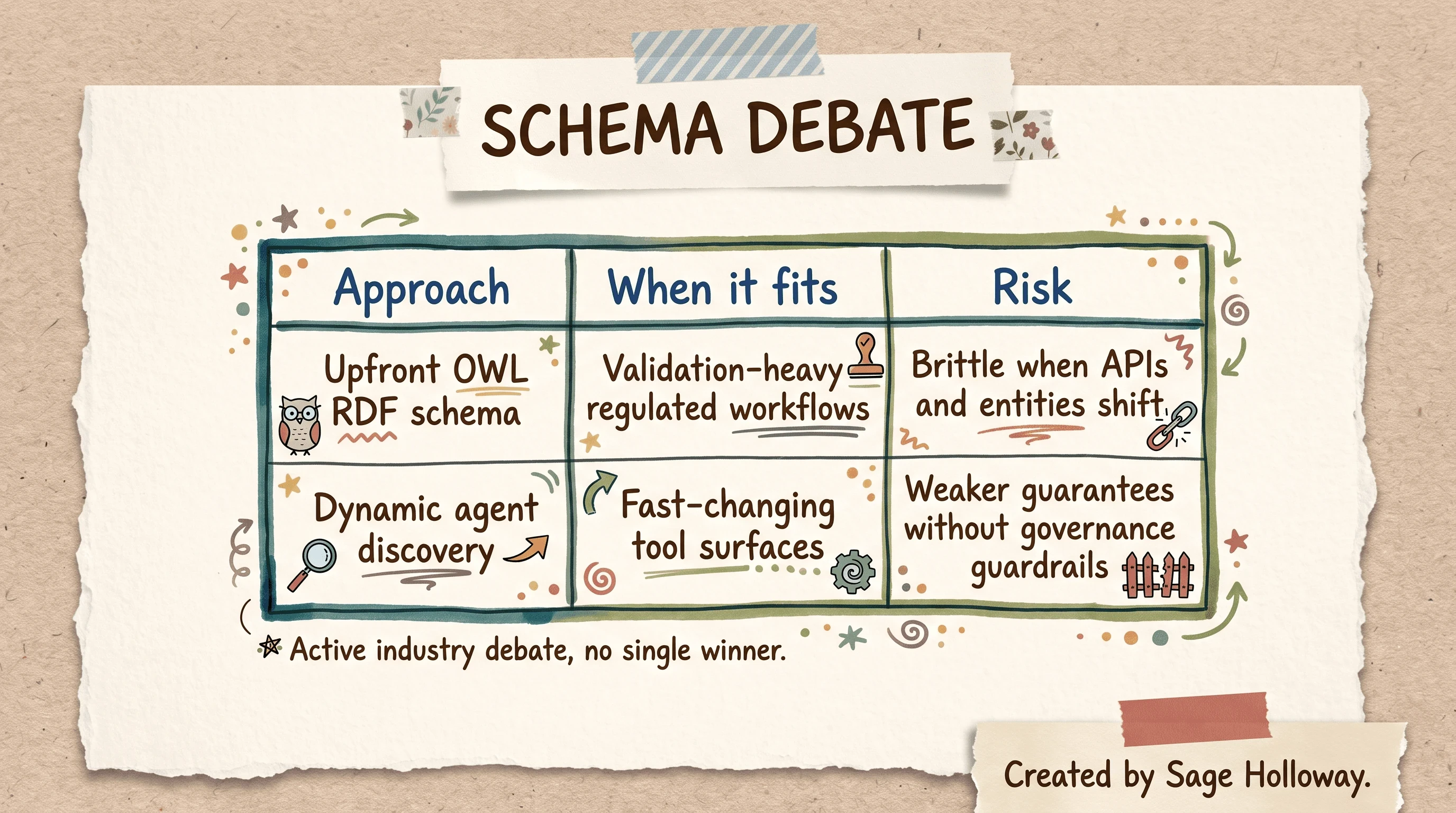
Strict schemas validate early. Dynamic discovery adapts when APIs shift.
A practical middle path many teams sketch internally: a small base schema for regulated entities plus extension slots agents can populate at runtime with governance review. No vendor ships that perfectly. You will compose it.
For OWL and SKOS management tutorials, see our spoke on ontology RAG and schema-driven extraction when live.
Adoption limits and token economics claims
Most enterprises still struggle with basic data hygiene. Customer means one thing in Sales, another in Product, and a third in Support. Context graphs do not fix that automatically. Connectors and identity resolution fix it, slowly, with arguments.
Kore.ai summarizes Gartner research claiming aligned context layers improve agentic reasoning accuracy by over 40% and reduce token consumption by approximately 70%. Treat those figures as analyst estimates tied to structured retrieval, not a guarantee on your first pilot.
There is no federated industry standard for context graphs equivalent to OpenTelemetry for distributed traces. W3C RDF-Star, OWL-Time, and PROV-O give you building blocks. Cross-vendor federation remains an open problem.
Reddit skepticism is useful here, not as a veto, but as a reminder: if your organization cannot agree on definitions in a workshop, an agent will not magically agree on them in production.
FAQ
What is a context graph?
A context graph is a dynamic, continuously updated data layer that extends traditional knowledge graphs by capturing decision traces: temporal flows, exceptions, and the reasoning context behind enterprise actions. It tracks the event clock of workflows rather than only the state clock snapshot of current records. That gives AI agents a queryable record of prior decisions to guide judgment and reduce unsupported overrides.
How does a context graph differ from a traditional knowledge graph?
A knowledge graph is structural and static: entities and relationships as they exist now. A context graph is behavioral and temporal: how actions and decisions unfolded over time with operational metadata on each assertion. Knowledge graphs focus on what and who. Context graphs add how and why at decision time, including temporal validity, confidence, provenance, and governance constraints.
How does a context graph differ from Retrieval-Augmented Generation (RAG)?
RAG is document-centric. It retrieves text passages so agents know what written policy says. A context graph is decision-centric. It uses relational and temporal logic to show how policies were applied, overridden, or interpreted in real cases. RAG improves what the model knows. A context layer improves how the agent handles edge cases against precedent.
Do you need to predefine a strict ontology schema upfront before building a context graph?
There is active debate. TrustGraph currently requires upfront ontology definition using RDF and OWL. Some practitioners argue agents should discover schema dynamically through API traversal. Most production teams need at least a validated base schema for regulated entities, even if they allow controlled runtime extensions.
Can an AI agent reliably capture the "why" behind human decisions, or should it only capture the "how"?
Architectures split. Foundation Capital and TrustGraph store explicit reasoning as graph nodes when capture UI supports it. Glean argues you cannot reliably model subjective why directly; you should log chronological how traces and infer intent from repeated patterns. Pick the approach that matches how honestly your tools record rationale today.
How do context graphs protect user privacy and prevent personal data leaks?
Raw identifiers and customer secrets are stripped when personal workflows normalize into aggregate traces. Patterns promote to playbooks only if they appear across at least k distinct users and n independent traces. Rarer sequences drop to reduce re-identification risk. k and n are policy parameters you set with legal and security review.
How does a context graph reduce the token consumption of AI agents?
An agent context window behaves like RAM. Loading entire tool catalogs and schemas into every run burns tokens fast. Context graphs store process logic externally so agents query small relevant subgraphs on demand. Gartner research cited by Kore.ai estimates roughly 70% token reduction when reasoning models align with structured context layers. Your mileage depends on query design.
What specific Graph Data Science (GDS) algorithms can be used to analyze context graphs?
On Neo4j property graphs, common calls include FastRP for 128-dimensional structural embeddings, Louvain for community detection over CAUSED and PRECEDENT_FOR relationships, and Node Similarity streaming to find structurally alike traces (useful in fraud and exception clustering). Hybrid search combines text embeddings with graph vector indexes for semantic plus structural recall.
How do we handle the "integration challenge" when a user has different identities across legacy systems?
Resolve identities before trace mining. Connectors must map varied emails, usernames, and HR identifiers to one logical actor ID, then stitch Salesforce, chat, and ticketing events into a single timeline per decision. Without that reconcile step, you build siloed agent memory with extra graph labels. For multi-agent orchestration patterns, see agentic workflow orchestration when published.
Whether context graphs become the default enterprise memory layer or remain a specialist pattern for regulated verticals is still genuinely open. The direction of travel is not: agents that cannot see precedent will keep repeating mistakes your humans already paid to learn.
What I would watch next is identity stitching in the wild, not another definitional essay. The teams that win will not have the prettiest ontology workshop slides. They will have one traversable timeline that survives a compliance ask without opening four admin tabs.
Try this on a real workflow you already operate: sketch one decision trace on paper (inputs, policy version, exception, approver, outcome). Choose why-first or how-first modeling based on how your tools actually record rationale. List three source systems and the three different IDs your main actor carries. Then run one TrustGraph query from the Fred example or one Neo4j causal path read from the Cypher block above. If the trace cannot be represented without hand-waving, your agent will not infer it either.
Until then...
Sage
PS. Interactive challenge: open your last approved exception in CRM and try to find the Slack thread that justified it in under 60 seconds without searching by hand. If you cannot, you already have a context graph problem, not a model problem.
Author
Practical guides, tool teardowns & AI engineering workflows.
Related Articles