AI Coding Tools
Claude Code vs OpenAI Codex: A Practical 2026 Comparison

Sage Holloway
26 min read
Go back to blog
SHARE

You keep opening two tabs and asking a winner question that neither product was built to answer. One plan feels generous until lunch. The other feels expensive before you have a diff. The comments are louder than the tests. Meanwhile the repository is still sitting there, waiting for someone to decide who is allowed to touch it.
Direct answer: Claude Code is the better fit for interactive codebase exploration, architectural planning, and work that needs frequent steering. OpenAI Codex is stronger for well-scoped tasks that can run independently or in parallel inside a sandbox. Neither wins every job. Choose by workflow, safety needs, and current plan limits, or use Claude Code to shape the change and Codex to implement or review it.
Last verified: 2 September 2026
This page is a claude code vs openai codex comparison for that choice. It is not an install walkthrough, a usage-dashboard explainer, or a VS Code setup guide. Those jobs live on their own pages. What follows is the decision, the evidence, and a tandem handoff you can copy.
Table of contents
Quick verdict: pick by task, not brand
The architectural difference that changes the workflow
Performance evidence: quality, speed, and benchmark traps
Pricing and limits: compare workload cost, not headline price
Instructions and extensibility without tool-name confusion
Safety, permissions, and execution boundaries
Cursor, Gemini, and Antigravity: when the comparison changes
Use both without configuration drift: the tandem handoff
Decision matrix: which agent fits each engineering job?
Frequently asked questions
What to try on your next repository
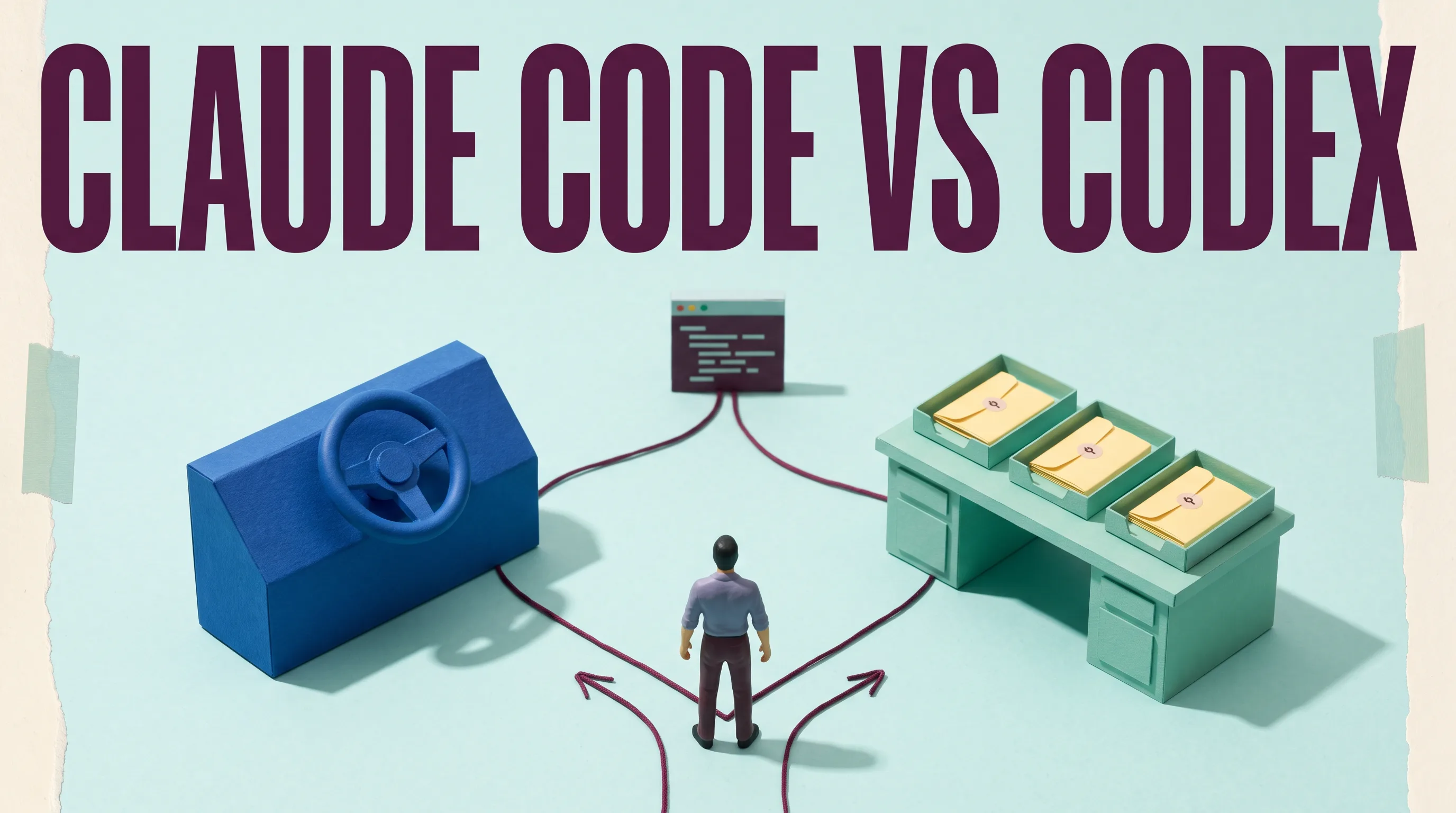
One agent helps you steer; the other rewards a clean handoff.
Quick verdict: pick by task, not brand
One reported Express.js refactor on CatDoes in August 2026: $155 on Claude Code, $15 on Codex for the same kind of run.
One Claude Pro report, repeated across r/ClaudeAI and comparison writeups: serious agent work lasting about 1.5 hours before the five-hour window felt spent.
Those two numbers are not a trophy. They are a working-style split wearing a price tag.
If you are searching openai codex vs claude code because you want a single champion, you will keep bouncing between Reddit threads and undated scoreboards. The useful version of codex vs claude code is simpler. Claude Code is the interactive pair you steer. Codex (including ChatGPT Codex and the Codex CLI) is the delegated worker you brief, then review.
The dotted twin people type as codex vs. claude code is the same job. So is the suffix people add when they want a codex vs claude code comparison in one sitting. Codex or Claude Code is the wrong first question. The first question is whether the next hour of work needs a conversation or a ticket.
When the work is fuzzy (a codebase you do not yet understand, an architecture decision, a bug whose cause is still a story), start with Claude Code. When the work is bounded (a test file, a CI fix, a pull request review, a backlog item with a written spec), start with Codex. When the work is both, sequence them. Do not let them edit the same files at the same time.
I spent a month trying to pick a side so I could cancel a subscription. I cancelled nothing. The repository kept splitting into two jobs: one that needed me in the loop, and one that punished me for staying in it.

The practical split is interactive steering versus bounded delegation, not a universal winner.
Use that matrix as a default, then prove it on your tree. Brand loyalty does not compile.
The architectural difference that changes the workflow
Saturday brunch does this to kitchens. One person stands at the pass with a spoon, tasting the sauce, sending a plate back because the herb is wrong, holding the next ticket until the last one is actually ready. Another person never looks up from the flat-top. Tickets clip onto the rail, eggs hit the heat, and a bell rings. Conversation is a luxury that station does not have.
You would not ask which of those jobs is the better cook. You would ask which station the work is sitting on.
That is the real split in a Claude Code vs Codex argument, including the short searches people type as codex vs claude or claude vs codex for coding. Claude Code is the pass: local, interruptible, talkative. Codex is the rail: a scoped ticket, often sandboxed, reviewed after the run. The shorthand claude codex (and the reverse, codex claude) usually means that pairing, not a third vendor product. If you are choosing codex or claude as if they were the same station, you are about to burn a shift.
Interactive steering in Claude Code
Claude Code is Anthropic's terminal-native coding agent. It runs against your local repository with direct filesystem access, and it is built for a developer who stays in the conversation. Official overview docs describe a local, agentic loop: read the project, propose edits, run tools, wait for you when the next move is ambiguous. Claude Code overview
The practical texture is checkpoints. You can continue the last session with claude -c. You can pipe a diff or a log into a one-shot review with claude -p. You can lock Plan mode as the default in .claude/settings.json with permissions.defaultMode: "plan" so the first move is a plan, not a write. Auto Mode, cycled with Shift+Tab after claude --enable-auto-mode, uses a classifier to inspect tool calls instead of approving every keystroke by hand.
That is why Claude Code feels expensive and why it feels indispensable on the same afternoon. You are paying for presence. The model explains, backtracks, and asks. Reddit threads on reddit codex vs claude code (and the reverse, codex vs claude reddit) keep circling the same anecdotal split: Claude for the hour you need to understand the tree, Codex for the hour you need the tree to move without you narrating it. Treat those threads as texture, not as a benchmark.
This will not work if you want an unattended overnight run on a crisp ticket. Steering needs a human at the pass.
Delegated execution in Codex
OpenAI Codex, in the current product sense, is a software-engineering agent inside the ChatGPT account: CLI, cloud tasks, and IDE surfaces sharing the same family of models. It is not the 2021 autocomplete API. Official product pages live at OpenAI Codex. A Codex CLI vs Claude Code comparison is usually this: Claude stays in a local conversation; Codex accepts a bounded task and comes back with a result you review.
The config lives in ~/.codex/config.toml. Typical keys in the ShakaCode integration notes are approval_policy and sandbox_mode. Cloud execution can add --attempts (1 to 4) for a best-of-N run. The workflow rewards a clean brief. If the ticket is vague, Codex will still run. It will just run the wrong job with great confidence.
Ken Imoto's August 2026 writeup is blunt about routing: send work that depends on local Docker, databases, or machine quirks to Claude Code; send self-contained tests and PR reviews to Codex. That is not romance. That is where each harness is allowed to be wrong.
Local access, cloud tasks, and sandbox boundaries
Do not write "Codex is cloud-only" and walk away. The Codex CLI can run locally inside a sandbox. Codex can also clone a repository into an isolated cloud environment and return a reviewable change. Those are different lanes. Claude Code's default lane is the local repository in front of you.
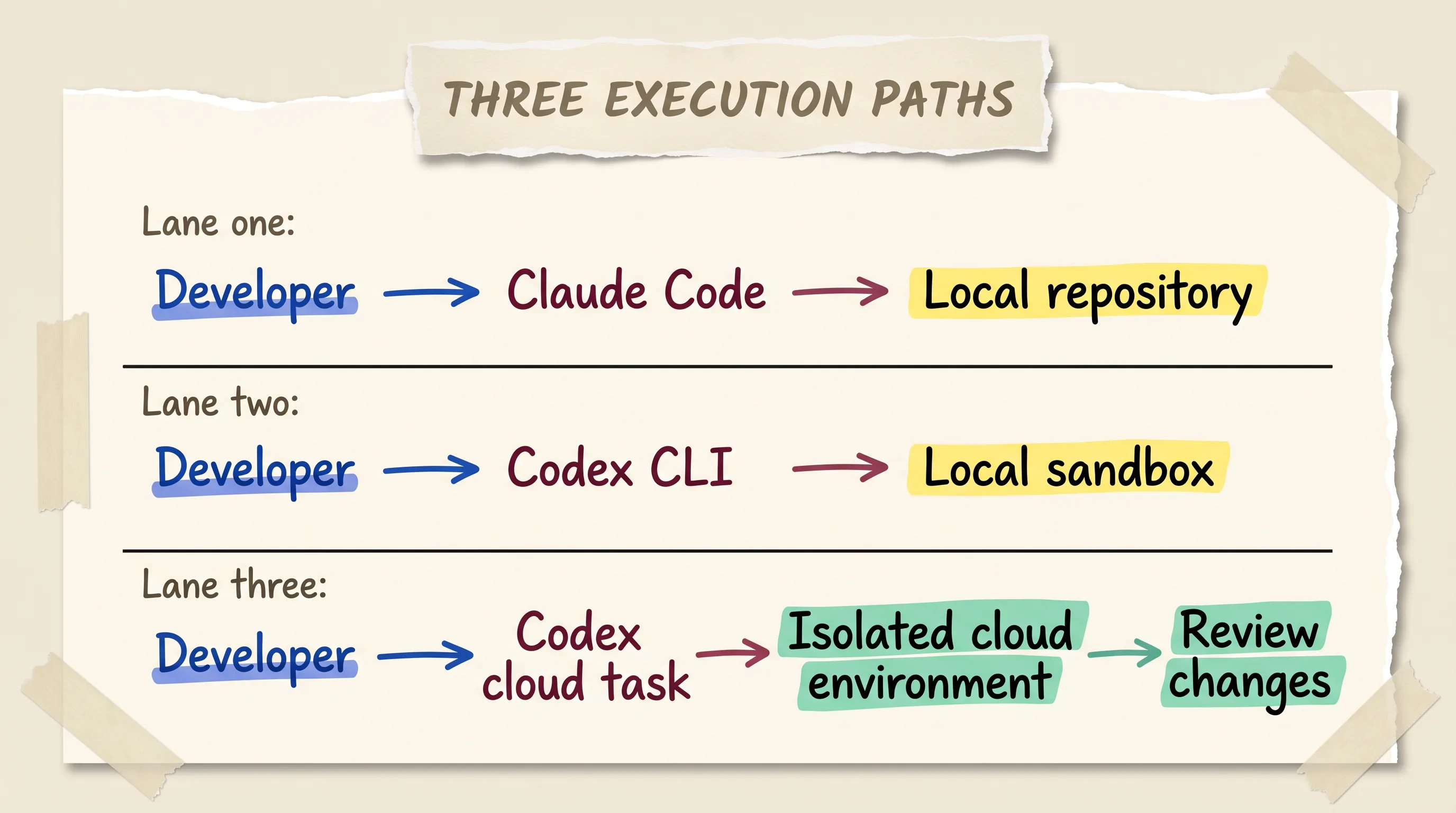
The meaningful architectural difference is how work is steered and isolated.
Three paths, one developer:
You, Claude Code, local repository.
You, Codex CLI, local sandbox.
You, a Codex cloud task, an isolated cloud environment, then review.
A Claude Code vs Codex CLI fight that ignores lane two will make Codex sound like a remote intern who never sees your laptop. Sometimes that intern is exactly what you want. Sometimes the bug only exists on your machine.
The honest constraint, the one neither landing page loves: a cloud-verified change can still break the moment it hits your local Compose file, your private CLI, or the database that was never in the container. Codex can be right in the sandbox and wrong in your working tree. Claude Code can be right in your working tree and reckless about the blast radius. Architecture is not a winner badge. It is a map of where the mistake will land.
Performance evidence: quality, speed, and benchmark traps
GPT Codex vs Claude Code threads love a score. GPT 5 Codex vs Claude threads love a generation name. Both go stale in a quarter.
A same-prompt demo is useful as a failure-mode story. It is not a league table. Watch one, then refuse to promote it into a law.
https://www.youtube.com/watch?v=lcNra74BbG0
That short is a single prompt, two generations, one memorable miss (a platformer that cannot find the floor). It teaches you to look at first-pass correctness. It does not tell you what happens on your 400-file service on a Tuesday.
What comparable tests can establish
A comparison is evidence when five things match: the repository, the prompt, the exact model versions, the tool access, and the date. Mix any of those and you have theater.
DataCamp's comparison is careful about the landscape: different harnesses, different permissions, different benchmark definitions. Termdock's March 2026 matrix is a warning label in disguise, because it places Claude's SWE-bench Verified number next to Codex's SWE-bench Pro number. Those are not the same exam. SWE-bench is a GitHub-issue coding benchmark with more than one variant. If a post does not name the variant, treat the winner column as decoration.
What like-for-like tests can establish, when they actually are like-for-like:
Whether the agent finished the named task without a human mid-course correction.
How many tokens it burned to get there (a cost input, not a quality medal).
Whether tests passed in the same harness.
What they cannot establish: that your frontend, your monorepo, or your compliance review will prefer the same side.
Where subjective output reviews help
Blind preference studies still matter, and they are still opinion with a clipboard. Independent writeups in the 2026 comparison set report developers preferring Claude's structure and comments more often than Codex's shorter patches (one commonly cited split is 67% to 25%, with the remainder uncommitted). That is a taste test, not a compiler.
I have had days where Claude's extra comments were the only reason a later reviewer understood the change. I have had days where those comments were a 400-line apology for a two-line fix. Codex's shorter patches feel surgical until they skip the logging you actually needed.
Label subjective findings as subjective. If a YouTuber "can tell which output is nicer," believe their eyes for their repo. Do not paste their preference into your architecture review as a score.
Freshness and model-version rules
Ken Imoto records a hard date: GPT-5.4 and 5.4 mini were pulled from ChatGPT-authenticated Codex sessions on 31 August 2026, with swaps toward gpt-5.6-terra and gpt-5.6-luna. Any gpt-5-codex vs claude code chart printed before that swap is a historical artifact. So is a March 2026 Termdock page that still treats GPT-5.4 as the default.
Claude's side moved too. Mid-2026 comparison posts talk Opus 4.6, then Opus 5. If the model string is missing, the article is comparing product names. Product names are not versions.

A comparison is useful only when task, model, harness, settings, and date are comparable.
The number that surprised me most was not a SWE-bench point. It was how often a "Codex wins" post and a "Claude wins" post were both internally consistent, and still incomparable, because nobody had lined up the harness.
You are not paying for a smarter logo. You are paying for how long you can stay in the conversation before the meter ends the session.
Pricing and limits: compare workload cost, not headline price
ChatGPT Codex vs Claude Code pricing arguments usually start at $20. That is the wrong unit. The unit is accepted changes per exhausted window.
Claude Code vs ChatGPT Codex on paper: both have a $20 front door (Claude Pro, ChatGPT Plus) and a much more expensive serious-use floor. The asymmetry is behavioral. Claude's agent loop explains itself. Codex's loop, across multiple audits in 2026, burns fewer tokens on the same class of task.
CatDoes and related writeups repeat a 4x token-efficiency claim for Codex on multi-file work. Builder.io's Steve has a pricing short that puts GPT-5 Codex in a 3x to 10x cheaper band than Claude Sonnet and Opus for equivalent developer work, depending on the model pairing. Those ratios are sourced, dated, and volatile. They are not a 2027 invoice.
Codex vs ChatGPT is a product distinction, not a vendor fight. Codex is the coding agent inside a ChatGPT plan. ChatGPT vs Codex in a forum title usually means "plain chat versus the agent that can edit a repo." If you already pay for Plus, Codex is bundled. Claude Code is a separate Anthropic subscription or API bill.
For the plan tables, seat math, and API modeling, leave this page. Use Codex pricing plans, Codex CLI pricing, OpenAI Codex pricing, OpenAI Codex API pricing, and Codex Plus vs Business. This section only teaches how to compare a workload.
Subscription access and variable quotas
As of 2 September 2026 research, the pattern in high-confidence community reports is consistent even when the exact remaining-message count is not. Claude Pro under Opus-class agent load can feel spent in a couple of hours. ChatGPT Plus Codex, helped by shorter traces and cheaper model tiers (Terra and Luna after the 5.4 retirement), often lasts through ordinary weekday coding. Composio's roundup still quotes the ugly version: never more than about 1.5 hours of Claude Code before the five-hour limit. Treat that as a reported failure mode, not as your allotment.
Limits move. OpenAI and Anthropic both change windows without asking your sprint board. Verify current official pages before you budget a team around a screenshot from June.
Token efficiency and long-context multipliers
Token efficiency is how much of the model's paid context a task consumes. Verbose self-talk is a tax. Claude's planning loops pay it. Codex usually does not, which is why the $20 Plus plan can look "unlimited" until you feed it a novel.
The trap on the Codex side is long context. CatDoes documents 2x and 1.5x price multipliers once Codex input crosses 272K tokens. Cheap per task becomes expensive per epic if you paste the whole monorepo into one run. Claude's prompt caching can blunt rereads of the same tree; that is a different billing shape, not a promise that Claude is cheaper.
Cost scenarios by workload
Do not hunt a winner price. Fill the worksheet for the work you actually ship.

Compare the workload you can finish, not a headline subscription price. Verify limits as of 2026-09-02.
Four scenarios, no invented invoices:
Exploratory afternoon, lots of questions, few commits. Claude Code is the right tool and the expensive one. Budget interruptions.
Six similar test files, each with a spec. Codex parallel runs are the cheaper shape. Measure completed runs, not minutes of chat.
A 300K-token context dump. Check Codex multipliers before you assume the efficient model stays efficient.
A single refactor that must be accepted. Cost per accepted change beats cost per session. CatDoes' $155 versus $15 story is one data point from August 2026, on one Express.js task, from a writer who also sells a router. Use it as a warning, then measure your own PR.
Claude Code vs Codex pricing, as a tertiary phrase, belongs in that worksheet row. It does not deserve a separate heading, because the number will be wrong next month.
Instructions and extensibility without tool-name confusion
Two instruction files, two config trees, two ways to register tools. Mix the names and you will think the agents disagreed when they were just reading different paper.
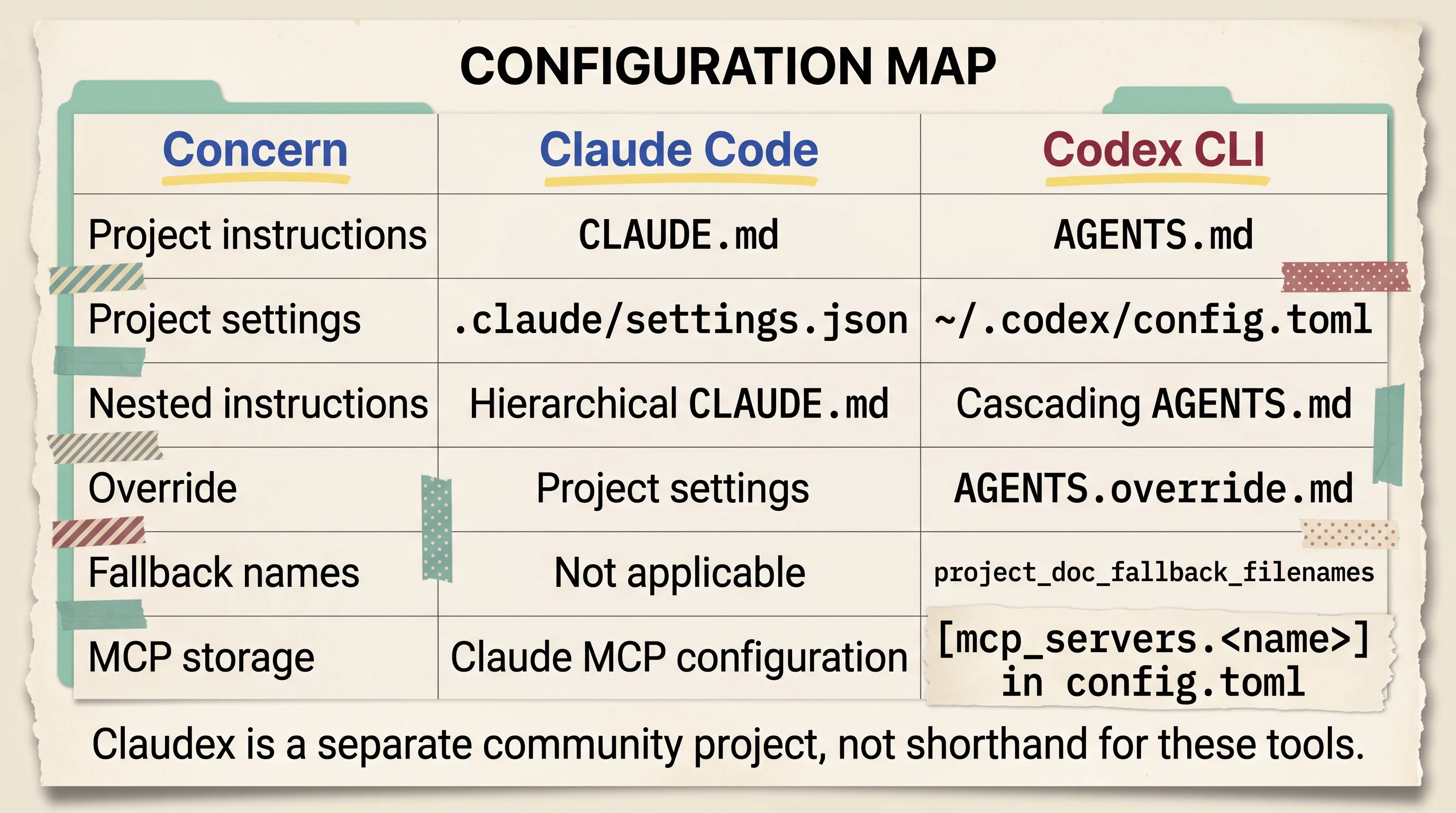
Keep each tool's instruction hierarchy explicit, then choose one shared source for a tandem workflow.
CLAUDE.md and project settings
CLAUDE.md is a Markdown file Claude Code reads at the top of every session: standing orders for the repo. It is hierarchical. Nested directories can add their own file. You can import other files with @path.
Project settings sit in .claude/settings.json. Specialized subagents live under .claude/agents/. Skills, in the Composio comparison, are discovered under .claude/skills/ as JSON.
Plan mode as default is the settings key already named: permissions.defaultMode: "plan". Agent Teams, where available, is an environment flag: CLAUDE_CODE_EXPERIMENTAL_AGENT_TEAMS=1. Skills and subagents are how Claude Code grows extra jobs without stuffing the root file until it is a novel.
Compact install evidence, not a walkthrough: Anthropic's native installer is curl -fsSL https://claude.ai/install.sh | bash (Windows: irm https://claude.ai/install.ps1 | iex). DataCamp records the npm global path as deprecated. Older blogs that still lead with npm install -g @anthropic-ai/claude-code are dated.
AGENTS.md, overrides, and Codex configuration
AGENTS.md is the open instruction file Codex walks. ShakaCode's Claude Code with Codex notes describe a cascade: home ~/.codex/AGENTS.md, then one file per directory from project root toward the current folder, then AGENTS.override.md taking priority. Fallback names can point at other files:
The same config.toml is where you set approval_policy = "untrusted" and sandbox_mode = "workspace-write". Codex skills, per Composio, are discovered under .agents/skills/ as TOML. MCP servers (Model Context Protocol servers: extra tools the agent can call, like a browser or a tracker) live in [mcp_servers.<name>] tables. Claude registers MCP with claude mcp add .... Do not copy one syntax into the other file and expect it to parse.
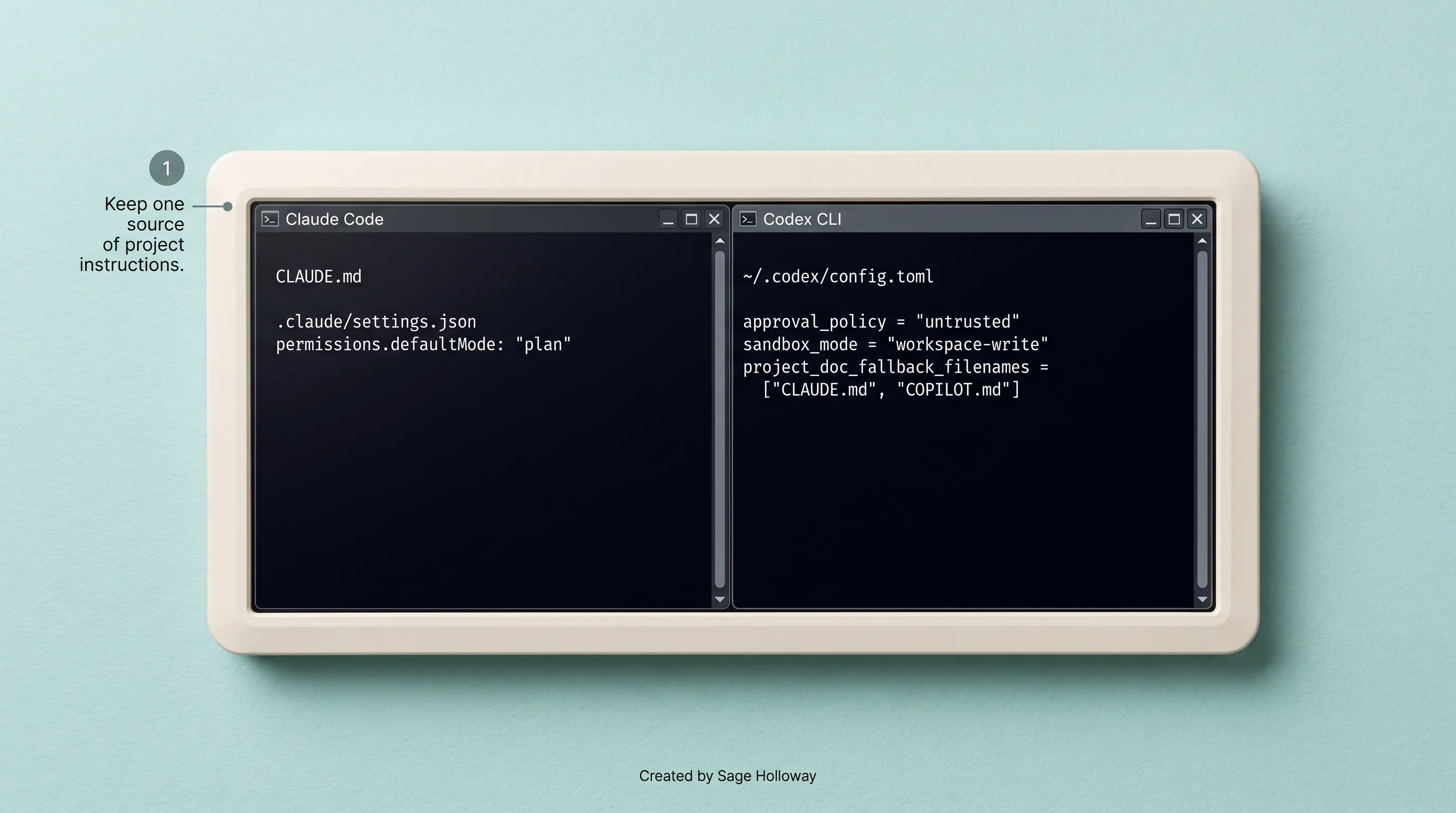
Evidence-backed configuration labels in a side-by-side terminal view.
If you run both agents, pick one canonical instruction source. The usual pattern in the integration notes is: keep the real rules in AGENTS.md, then point Claude at them from CLAUDE.md with a short fallback such as See @AGENTS.md. Two full copies will drift. Drift is how you get Claude enforcing a test command Codex never saw.
MCP, skills, and the separate Claudex projects
Claudex is not Claude plus Codex. It is not Anthropic's name for the tandem workflow. It is a community name that currently refers to at least two GitHub projects: kunwar-shah/claudex (an npm package @kunwarshah/claudex that views Claude session history, with PROJECT_ROOT and PORT in a local .env) and tct68/claudex (npm install -g claudex, which scaffolds a .claude/ workspace). If a search result titled claudex looks like a visual workspace or a memory viewer, it is that ecosystem, not a hidden official merge.
MCP and skills are the actual extensibility layer for both CLIs. They consume overlapping ideas (HTTP or stdio tools, per-project skill files) through different storage. Treat the configuration map as the source of truth, then keep one human-readable rule file.
Voice (/voice, March 2026 in Termdock), --worktree, and the /ultracode rename (Firecrawl: the old workflow trigger became /ultracode in v2.1.160) are Claude-side surface details. They do not change the file rule: one source of instructions, two readers.
Safety, permissions, and execution boundaries
Both tools can delete the wrong directory. They fail at different layers.
A Codex CLI vs Claude Code safety comparison is not "who is nicer." It is application-layer permission prompts versus kernel-enforced sandbox modes. MindStudio's enterprise notes are useful here: Claude's blast radius is your local disk; Codex's default story is isolation, then a reviewable change. Neither story is automatic virtue. A sandbox you disable is not a sandbox.
Claude Code permission controls
Claude Code asks. Tool calls can be allowed or denied. Auto Mode classifies risky calls. Project settings can whitelist tools. CLAUDE.md can tell the agent what not to touch. That is application-layer control: the harness is the guardrail, and the model is still a participant.
The escape hatch exists and I am not going to dress it up as a productivity tip. Comparison posts document --dangerously-skip-permissions as the flag that turns the prompts off. Do not make it a default alias. If a Windows permission popup loop is driving you mad, fix the environment (WSL2 is the usual cited path) or narrow the tool whitelist. Skipping the guard because the guard is annoying is how a local agent earns the OpenClaw-style horror stories that comparison blogs keep recycling.
Codex sandbox modes
Codex sandboxing is described as kernel-level. Firecrawl's comparison is the clean version: macOS sandbox-exec with Seatbelt, Linux and WSL2 bubblewrap (bwrap), three modes. read-only cannot write. workspace-write (the replacement default in late-2026 notes) can write inside the project. danger-full-access is the mode whose name is already the warning.
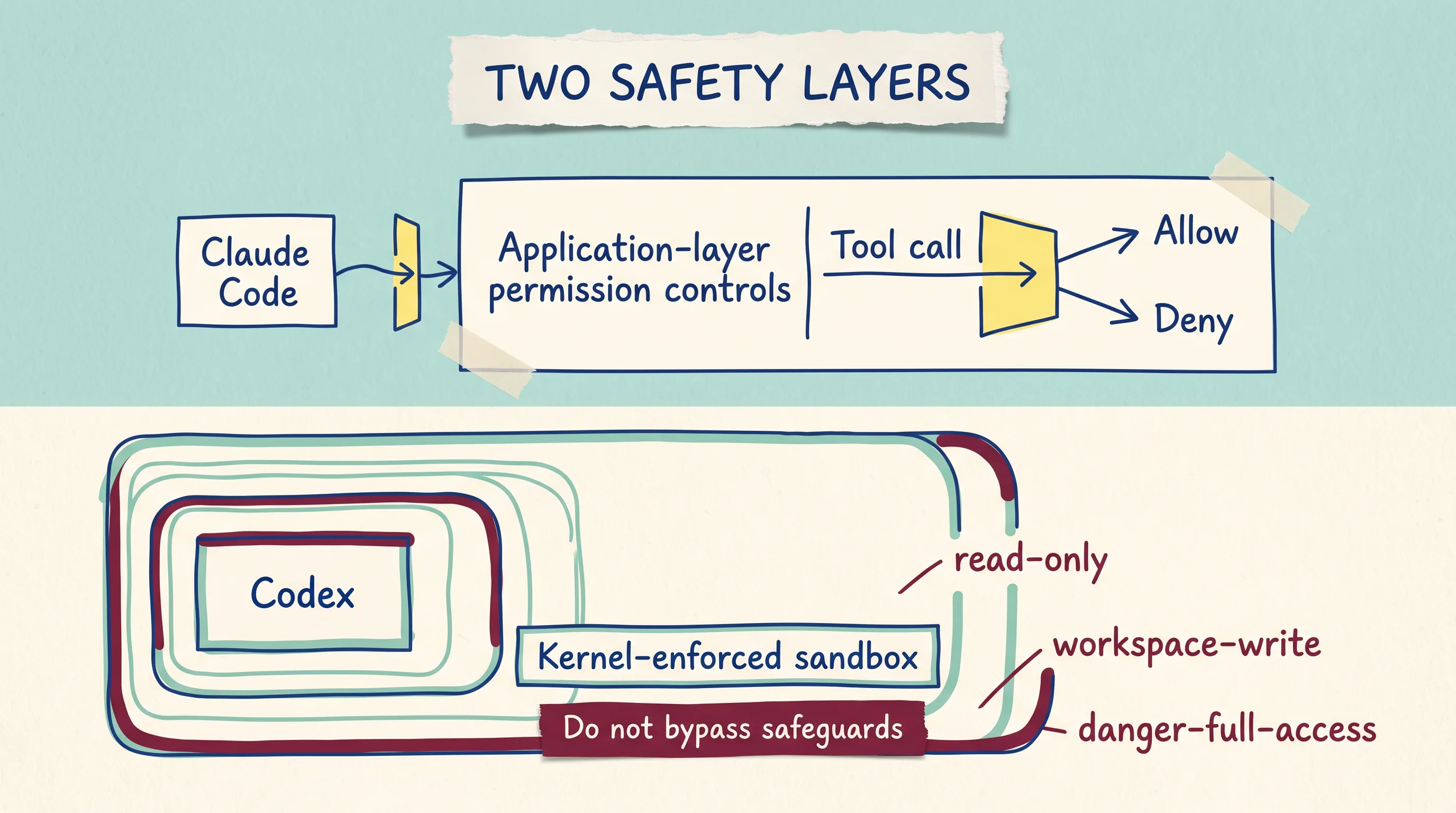
Permission prompts and sandbox boundaries solve related safety problems at different layers.
Kernel isolation is more deterministic than a model's good manners. It is also easier to misunderstand. Local sandbox write is not the same as cloud isolation. Cloud isolation is not the same as "safe for a regulated environment" until your security team says the data residency story matches the paperwork.
Unsafe shortcuts and deprecated flags
Ken Imoto, August 2026: OpenAI removed codex exec --full-auto. The replacement is --sandbox workspace-write. Old scripts print a deprecation notice and exit. DataCamp and DeployHQ pages written earlier in 2026 still show --full-auto. If your CI "succeeds" with exit code 0 and does nothing, look at that flag before you blame the model.
Community aliases that map a cute name onto --sandbox danger-full-access and never-ask approval are the other trap. They exist because Windows prompt fatigue is real. They are still a loaded gun with a nickname. Do not copy them into a shared dotfiles repo as if they were hygiene.
Large tool output on Claude's side has a different failure: Composio says oversized output is saved to a file after about 25K tokens (up to 500K characters) instead of being truncated in the transcript. A medium-confidence Reddit report also describes a 25K-token-per-file read limit that breaks huge single-file refactors. Slice the file. Do not raise the blast radius to compensate.
Cursor, Gemini, and Antigravity: when the comparison changes
This page owns the two-tool choice. Cursor vs Claude Code vs Codex is a three-surface question, and the surfaces are not interchangeable.
Cursor is an editor: a VS Code fork with its own agent loop. Claude Code and Codex CLI are terminal-native agents. Putting Codex inside Cursor is an IDE plugin job; that setup lives on How to use the Codex plugin in Cursor. Putting Codex inside VS Code is a different surface; that setup lives on How to use Codex in VS Code and VS Code Codex.
A list item that shuffles the same three names (codex vs claude code vs cursor, claude code vs cursor vs codex, codex vs cursor vs claude code) is still that editor-versus-terminal distinction. If you need keybindings and a sidebar, you are not deciding Claude versus Codex anymore. You are deciding where the agent is allowed to sit.
Codex vs Claude vs Gemini, and the CLI-shaped twin Codex vs Claude Code vs Gemini CLI (plus claude code vs Codex vs Gemini CLI), add Google's terminal agent. DataCamp-style notes: Gemini CLI installs with npm install -g @google/gemini-cli and reads hierarchical GEMINI.md. It is a third instruction file, not a tie-breaker between the first two.
Codex vs Claude Code vs Antigravity is the 2026 naming hazard. Community threads treat Antigravity as the successor brand Google is moving Gemini CLI toward. That wording is still a transition story, not a reason to declare a winner on this page. If your team is already on Antigravity, compare its working style (editor-ish vs terminal-agent) the same way you compare Cursor: is this a place to sit, or a worker to dispatch?
Keep the scope box small. If the job is still "which of these two agents should touch this repository," come back to the two-tool matrix. If the job is "where should I live all day," you are shopping editors, and this page should not pretend to be that catalog.
Use both without configuration drift: the tandem handoff
Here is the thing. Using both tools without a written handoff is how you get two cooks grabbing the same pan. Each one is competent. The sauce still splits.
The gap most comparison posts leave is not philosophical. It is a file. Sequential handoffs with a changes.log (sometimes change.claw in one Substack writeup) are how people actually share a tree. The Codex plugin-inside-Claude-Code path is a different spoke; that setup lives on Codex plugin for Claude Code. This section is the boring protocol that does not need a plugin: one planner, one executor, one log, one human gate.

Sequential handoffs keep context, edits, and review responsibility visible.
Assign one agent to plan and one to execute or review
Pick roles in writing. The default that shows up in r/ClaudeAI workflow comments and in professional writeups is: Claude Code plans or diagnoses; Codex implements or reviews. You can reverse it for a Codex-authored patch that needs a Claude design critique. You cannot skip the assignment.
Rules:
Only one agent may write files during a slice of work.
The other agent may read, comment, and append the log.
If you need a second writing pass, it starts after the log says the first pass ended.
Keep one source of project instructions
Put durable rules in AGENTS.md. Point Claude at that file. Do not maintain a second complete constitution in CLAUDE.md unless you enjoy silent forks.
Minimal pointer, adapted from the ShakaCode fallback idea:
If Codex must read Claude-only notes, use project_doc_fallback_filenames instead of duplicating paragraphs. Two sources of truth is how a test command survives in one file and dies in the other.
Record sequential handoffs in changes.log
Create changes.log at the repository root. Append. Never rewrite history in place. Each record is a contract, not a diary.

A useful handoff records intent, touched files, checks, and the next review step.
Fill it in English. Do not paste a stack trace and call it a handoff. The next agent should know what was in scope, what was touched, what was actually run, and what a human still owes.
Instruct both tools, in the shared instruction file, to read changes.log before starting and to append a record before stopping. If the last record's Next action is "human review," the executor is done even if it has leftover ambition.
Add a human review and test gate
The fifth card is not optional. Run the tests the log claims were run. Read the diff. If Codex returned a cloud patch, apply it on a branch and run the suite on your machine. If Claude planned a migration that needs a live database, do not let Codex "complete" it in a container that never saw that database.
A review gate is three checks:
Diff matches
Files changed.Checks runis reproducible locally.Open risksstill make sense, or they are closed with a note.
If any check fails, the next action is recovery, not a second agent "just finishing up."
Recover from stale context or conflicting edits
Stale context looks like this: Claude planned against main at noon; Codex executed against a dirty tree at 4pm; both think they are current. Conflicting edits look like this: two sessions, same file, no log line in between.
Recovery:
Stop both agents.
git statusandgit diff. If the working tree is a mashup, make a branch from the last good commit and cherry-pick only the intended files.Rewrite the latest
changes.logrecord soOpen risksnames the conflict. Do not delete the failed record.Restart with one writer and a smaller
Scope.
If CI still calls --full-auto, replace it with --sandbox workspace-write before you debug the model. A silent exit is not a merge conflict. It is a deprecated flag.
This protocol fails if you skip the log because the task "is small." Small tasks are how two agents collide. It also fails if you let both write because you are in a hurry. Hurry is the whole reason the rail exists. Use it.
Nate B Jones's walkthrough is the conceptual twin of this protocol: Claude as the cockpit, Codex as the operations desk. Watch it after you can name the five steps, not instead of them.
https://www.youtube.com/watch?v=R2-Y1Hjwx2U
Decision matrix: which agent fits each engineering job?
Start with the working style the job demands. Then run a pilot on your repository. Editorial judgment is not a substitute for git log.

Start with the working style each job demands, then validate the choice on your repository.
How to read the rows, with facts separated from calls:
Codebase exploration and architecture planning start with Claude Code because the feedback loop is the product. That is a workflow judgment, backed by DataCamp's interactive-versus-delegated framing, not by a universal quality score.
Debugging starts with Claude Code for the same reason: you need to steer when the hypothesis changes every five minutes.
Test generation, CI tasks, PR review, and a parallel backlog start with Codex because the work is bounded and repeatable.
--attemptson cloud exec is a sourced lever for best-of-N, not a requirement.Refactor and UI implementation depend. A tight, multi-file architectural refactor with checkpoints is Claude's home. A scoped, well-specified extract with tests is Codex's home. UI taste tests in 2026 writeups often favor Claude; believe them as design opinion, then look at the screenshot yourself.
Regulated environments depend on your controls, not on a blog's sandbox adjective. Validate data residency, logging, and what the agent can see.
Large repositories need a pilot of both. A year-old r/ChatGPTCoding thread about a 500k-line tree is a hint, not your profile. Marvijo's large-codebase video is optional extra texture; this page keeps the embed count down and lets the matrix carry the claim.
openai codex vs claude code, at the end of the page, should resolve to a routing habit: plan and diagnose on one side, implement and review on the other, unless the job's working style says otherwise. Codex or Claude Code is then an easy sentence: both, sequenced, with a log.
Frequently asked questions
Is Codex better than Claude Code?
Not as a universal. Codex is better at bounded, delegated work: background or sandboxed runs, token-efficient implementation, parallel tickets, and independent review passes. Claude Code is better when you need to steer, map a codebase, or make architectural tradeoffs in conversation. Late-2026 comparisons agree on the split more than they agree on a trophy.
Is Claude Code better than Codex?
Yes for interactive exploration, multi-file planning, and work that needs frequent checkpoints. Blind preference writeups often like Claude's comments and structure more than Codex's shorter patches. Claude is also the expensive conversational loop. Better on the pass is not better on the rail.
Is Codex or Claude Code better?
The productive answer in source after source is tandem: Claude Code for supervised design, Codex for delegated implementation or review. Cost-to-precision depends on the job. If you only buy one, buy the one that matches the work you do most hours of the week, then measure accepted changes per exhausted quota.
Is Codex similar to Claude Code?
They are similar as terminal-native agents that read a repo, edit files, and run checks. They differ in working style. Claude Code is a local, interruptible loop. Codex is a delegated loop that may run in a local sandbox or an isolated cloud task. Similar category, different station.
Is Codex better than ChatGPT?
Codex is not a rival chatbot. Current Codex is the software-engineering agent bundled into ChatGPT plans. Plain ChatGPT is the general assistant. The agent can work a repository; the chat window, by itself, cannot. If you already have Plus, you are not shopping a second vendor for Codex access.
Which $20 plan offers more coding usage?
As of 2 September 2026 sourced reports, ChatGPT Plus with Codex usually offers more practical coding-agent headroom than Claude Pro under Opus-class agent load. Claude Pro is repeatedly described as exhausting within a few hours of serious Claude Code use, which is why power users talk about $100-plus Anthropic tiers. Quotas change. Verify current official limits before you treat this as a budget.
Can I use Claude Code and Codex on the same project?
Yes. That is the preferred heavy-use pattern in the comparison set. Put shared rules in one instruction file, forbid simultaneous writes, and append changes.log after every slice. They do not need a plugin to share a tree. They need manners and a log.
How do Codex and Claude Code handle safety differently?
Claude Code guards at the application layer: permission prompts, Auto Mode classification, settings allowlists. Codex guards at the sandbox layer: kernel-enforced modes (read-only, workspace-write, danger-full-access) on local CLI, plus isolated cloud tasks. Kernel isolation is more mechanical. Claude's hooks are more configurable. Do not bypass either as a lifestyle.
Can Claude Code and OpenAI Codex handle large codebases?
Both are used on large trees. Claude Code maps a local repo with search plus CLAUDE.md. Codex clones or compacts context and can run long delegated sessions. Success is repository-specific. Pilot both on one real feature, compare the diff quality and the quota burn, and ignore undated "destroys 500k lines" titles.
Forum color without turning this page into a Reddit digest: if you want the raw thread synthesis, that job is ChatGPT Codex Reddit.
What to try on your next repository
Pick a repository you already understand. Pick a task that fits on one screen of spec: one failing test, one small refactor, one review of an open PR. Commit or stash first.
Run it twice, not at once. First, Claude Code in Plan mode: produce a written plan and a changes.log record, no extra files. Second, Codex against that record only, with workspace-write (not a retired full-auto flag). Then you run the tests the log named.
Score the afternoon on four lines: Did the plan match the diff? Did the executor stay in scope? Did the suite pass on your machine? How much of the $20 window died to get an accepted change? That rubric beats another winner thumbnail.
The models will keep swapping names. GPT-5.4 already left the ChatGPT Codex door on 31 August 2026. The next retirement will not send a calendar invite. What stays expensive is two agents, one file, no log. Get the handoff boring, and the brand argument can go back to being entertainment.
Until then...
— Sage 🍓
PS. French kitchens call the pass the piano, because the expeditor's hands move across tickets the way a pianist reads a score. Nobody asks whether the piano or the saute station is the better instrument. They ask whether the ticket is still on the rail.
Related Reading
Codex Plugin for Claude Code: Host choice, official install, and a bounded two-agent review loop.
How to Use Codex in VS Code: First agent task, local configuration, and safer approvals in the editor.
35 Claude Code Hacks (Beginner to Pro): Custom environments, parallel agents, and validation hooks for daily terminal work.
Author
Practical guides, tool teardowns & AI engineering workflows.
Related Articles

AI Coding Tools
Best GitHub Copilot Alternatives in 2026: Choose by Coding Surface, Not a Top-10 List

AI Coding Tools
GitHub Copilot Agent Mode in VS Code: How It Works, How It Differs From Ask and Edit, and How to Control It

AI Coding Tools
How to Cancel GitHub Copilot: The Irreversibility Trap, the Missing Button Fix, and Every Cancellation Path