Comparisons
OpenCode vs Claude Code: The Complete Terminal AI Alternatives Guide (2026)

Sage Holloway
13 min read
Go back to blog
SHARE
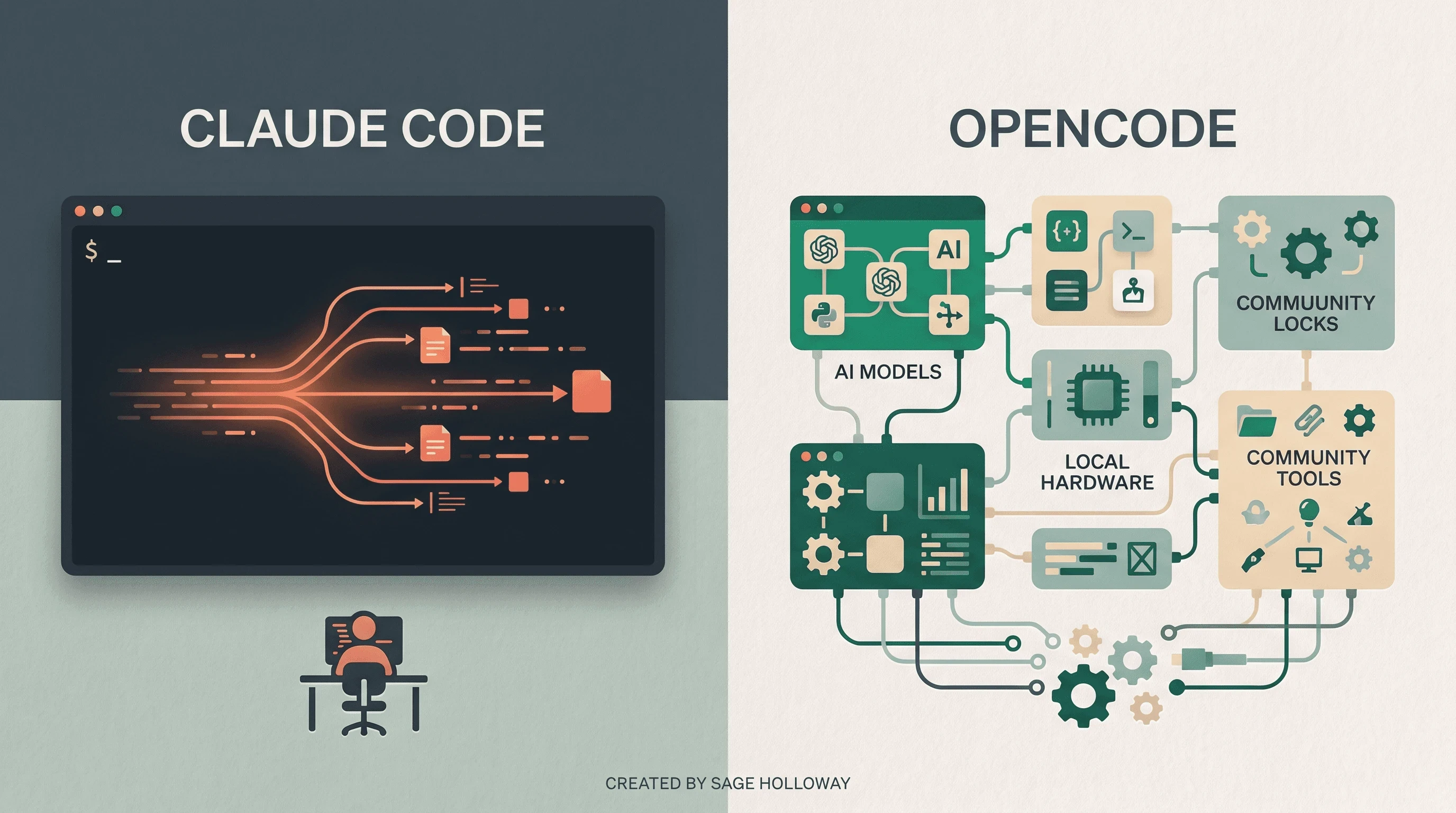
Terminal-first AI development has split into two competing philosophies. On one side stands the managed, highly polished approach: proprietary agent runtimes tightly coupled to benchmark-topping foundation models. On the other side stands the open, modular ecosystem: universal terminal harnesses capable of routing prompts to dozens of cloud providers, local hardware nodes, and custom proxy endpoints.
If you are choosing an autonomous coding assistant for your terminal in 2026, the decision is no longer just about which model scores higher on SWE-bench. It is about context engineering overhead, tool-calling latency, token economics, and whether you can afford to be locked into a single vendor's API ecosystem.
Managed autonomous reasoning or universal model freedom: choosing your terminal coding harness.
Direct Answer: OpenCode and Claude Code take opposite approaches to terminal-first AI development. Claude Code is a managed, proprietary agent tightly optimized for Anthropic models with native deferred Tool Search and sub-agent task coordination. OpenCode is an open-source terminal client supporting 75+ model providers, local Ollama execution, and integrated LSP diagnostics. Choose Claude Code for speed and benchmark-topping reasoning; choose OpenCode, Antigravity, or Cline for model freedom, privacy air-gapping, and zero subscription vendor lock-in.
Last verified: August 2026 against official Anthropic runtime specifications, OpenCode v1.4 releases, and Google Antigravity 2.0 harnesses.
What Separates Claude Code from Open-Source Alternatives?
When evaluating opencode vs claude code, developers quickly discover that the tools were built around contrasting assumptions.
Claude Code is Anthropic's flagship agentic CLI. It is engineered from the ground up to exploit the specific reasoning patterns, context caching mechanisms, and tool-use behaviors of Claude 3.7 Sonnet and Claude 3.5 Sonnet. The client, prompt architecture, and API transport operate as a unified vertical stack.
OpenCode, by contrast, was designed as a universal terminal adapter. It abstracts the model layer behind a provider-agnostic protocol, allowing developers to switch between Anthropic, OpenAI, DeepSeek, Google Gemini, and local Ollama instances with a single configuration flag.
<div class="video-embed-card" data-video-id="phtIqZcVLQE"> <iframe width="100%" height="400" src="https://www.youtube-nocookie.com/embed/phtIqZcVLQE" title="Claude Code VS Codex VS OpenCode" frameborder="0" allow="accelerometer; autoplay; clipboard-write; encrypted-media; gyroscope; picture-in-picture" allowfullscreen></iframe> <p class="caption">Watch NeuralNine compare Claude Code, OpenAI Codex, and OpenCode workflows in the terminal.</p> </div>
The 2026 OAuth Policy Shift
A critical turning point occurred in early 2026 when Anthropic updated its authentication architecture. Third-party harnesses (including OpenCode, Cline, and community terminal clients) were officially blocked from authenticating via personal Claude Pro and Claude Max web subscriptions.
As a result, if you run Claude 3.7 Sonnet inside OpenCode or Cline, you cannot use your flat $20/month consumer subscription. You must supply an Anthropic Console API key and pay standard token consumption rates. Claude Code remains the only terminal tool that natively authenticates against consumer Pro and Max subscription pools.
Context Engineering: Tool Search vs. Monolithic System Prompts
The most significant architectural divergence between Claude Code and open-source alternatives lies in how they handle context windows and tool definitions.
In agentic coding, every tool available to the model (file readers, grep searches, bash runners, git manipulators, MCP extensions) requires a structured JSON definition. In naive implementations, these definitions are appended to the system prompt on every single API request.
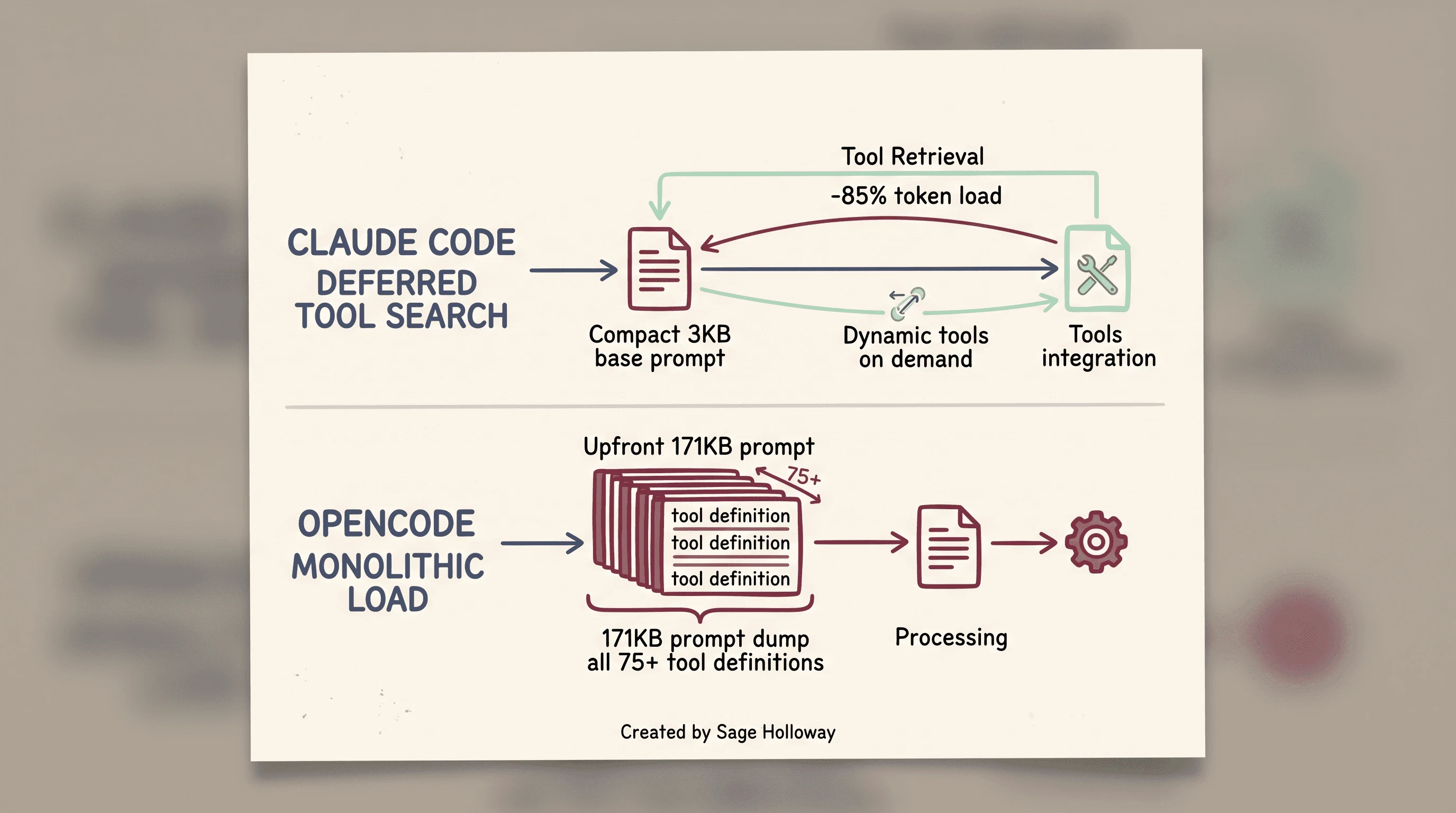
Deferred Tool Search slashes upfront token overhead by 85% compared to monolithic MCP prompt loading.
OpenCode's Monolithic Prompt Overhead
Because OpenCode supports arbitrary Model Context Protocol (MCP) servers and multiple tool definitions out of the box, it bundles all active tools into its initial system prompt. In complex monorepos with 10+ connected MCP servers, OpenCode's initial context payload can reach 171KB (over 8,000 tokens) before the user types a single word.
Claude Code's Dynamic Tool Search
Claude Code solves this problem through deferred Tool Search. Instead of loading every tool schema into active context, Claude Code exposes a lightweight tool index (roughly 3KB). When the model determines that a specific task requires an esoteric MCP tool or git command, it dynamically searches and loads only that tool schema into the immediate turn context. This reduces baseline token consumption by up to 85%, leaving maximum headroom for actual source code.
Architecture Deep-Dive: LSP Diagnostic Loops vs. Test-Driven Verification
How an AI agent verifies that its code changes work determines how often it hallucinates syntax errors.
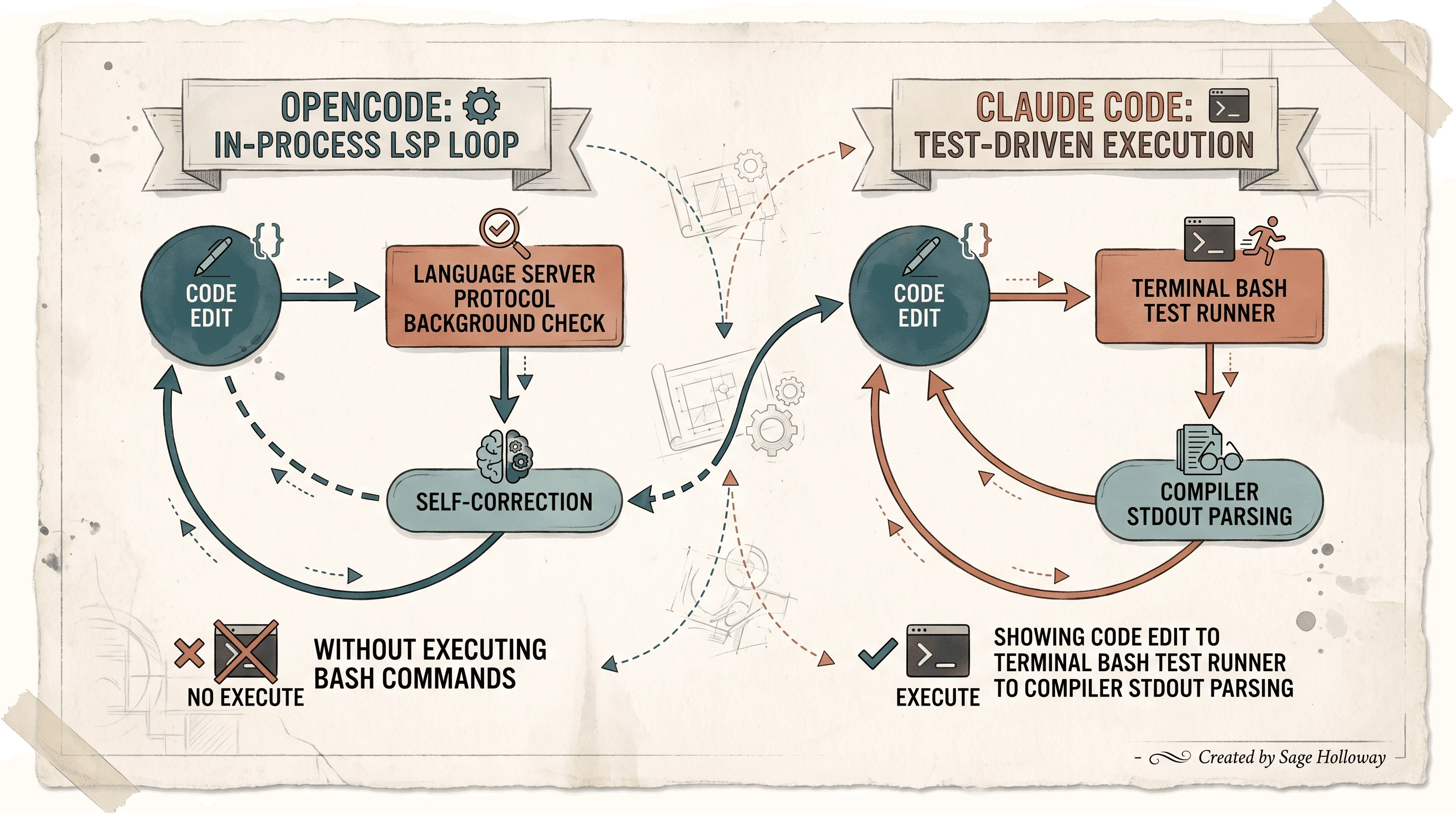
OpenCode feeds compiler errors directly through an LSP loop; Claude Code relies on active command-line test outputs.
OpenCode: The In-Process LSP Feedback Loop
OpenCode embeds native Language Server Protocol (LSP) clients directly into its execution loop. When OpenCode edits a TypeScript or Rust file:
It immediately queries the local language server in the background.
The language server returns compiler type errors, missing imports, and syntax warnings without executing any shell commands.
OpenCode feeds these diagnostic markers back into the model's reasoning loop for instant self-correction.
This makes OpenCode exceptionally resilient when modifying complex typed monorepos where executing full test suites is too slow.
Claude Code: Test-Driven Terminal Execution
Claude Code approaches verification through external command execution. Rather than running a background LSP server, Claude Code relies on real bash commands:
It modifies files on disk.
It runs
npm test,pytest, orcargo checkdirectly in your shell environment.It parses standard output and stack traces to identify runtime regressions.
While this approach incurs execution latency, it catches integration and logic bugs that static LSP diagnostics cannot detect.
<div class="video-embed-card" data-video-id="dMSZ0WcK1oI"> <iframe width="100%" height="400" src="https://www.youtube-nocookie.com/embed/dMSZ0WcK1oI" title="A very subjective comparison of Claude Code, OpenCode, Cursor & GitHub Copilot" frameborder="0" allow="accelerometer; autoplay; clipboard-write; encrypted-media; gyroscope; picture-in-picture" allowfullscreen></iframe> <p class="caption">Watch Maximilian Schwarzmüller evaluate developer workflows across Claude Code, OpenCode, Cursor, and Copilot.</p> </div>
The Full Alternatives Matrix: OpenCode, Antigravity, Cline, and OpenClaw
To select the right tool for your engineering stack, examine how the leading terminal and editor agents compare across core capabilities.
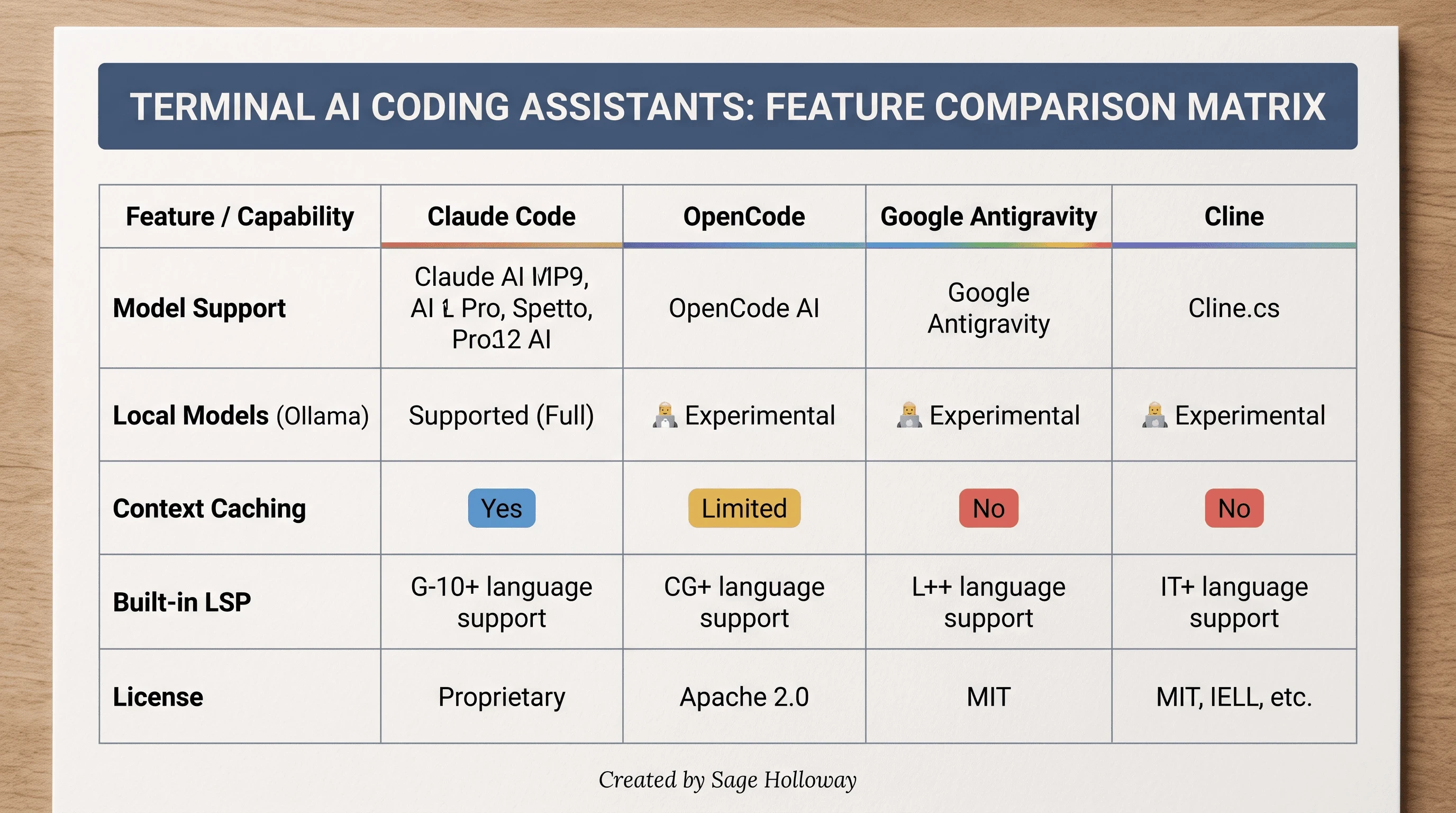
Side-by-side capabilities across model support, context caching, LSP integration, and license models.
1. Claude Code
Best for: Developers prioritizing state-of-the-art autonomous reasoning with minimal configuration.
Key Advantage: Native prompt caching and deferred Tool Search optimized specifically for Anthropic models.
Limitation: Proprietary harness; cannot use consumer subscription on third-party clients.
2. OpenCode
Best for: Engineers demanding multi-model flexibility, local LLM execution, and open-source transparency.
Key Advantage: Integrated LSP diagnostics and universal support for 75+ model providers via Ollama and LiteLLM.
Limitation: Higher baseline token consumption due to monolithic system prompt packaging.
3. Google Antigravity
Best for: Developers seeking full-workspace agentic pair programming with integrated headless browser recording, background cron tasks, and multi-agent subagent delegation.
Key Advantage: Native subagent spawning, background task management, and deep Gemini 2.5 integration.
Limitation: Cloud-connected IDE workspace environment.
4. Cline (formerly Claude Dev)
Best for: VS Code users who prefer an open-source extension interface with granular approval prompts for every file edit and terminal command.
Key Advantage: Transparent token cost tracking per request and direct MCP server management.
Limitation: Editor-bound extension; lacks standalone headless terminal execution.
<div class="video-embed-card" data-video-id="QMDLyJ_vN7s"> <iframe width="100%" height="400" src="https://www.youtube-nocookie.com/embed/QMDLyJ_vN7s" title="Anti Gravity Vs Claude Code Vs Cursor" frameborder="0" allow="accelerometer; autoplay; clipboard-write; encrypted-media; gyroscope; picture-in-picture" allowfullscreen></iframe> <p class="caption">Watch Tobi Teaches compare Google Antigravity, Claude Code, and Cursor workflows in 2026.</p> </div>
Cost and Token Economics: Subscription Quotas vs. API Consumption
The financial cost of running agentic coding assistants depends heavily on your billing model.
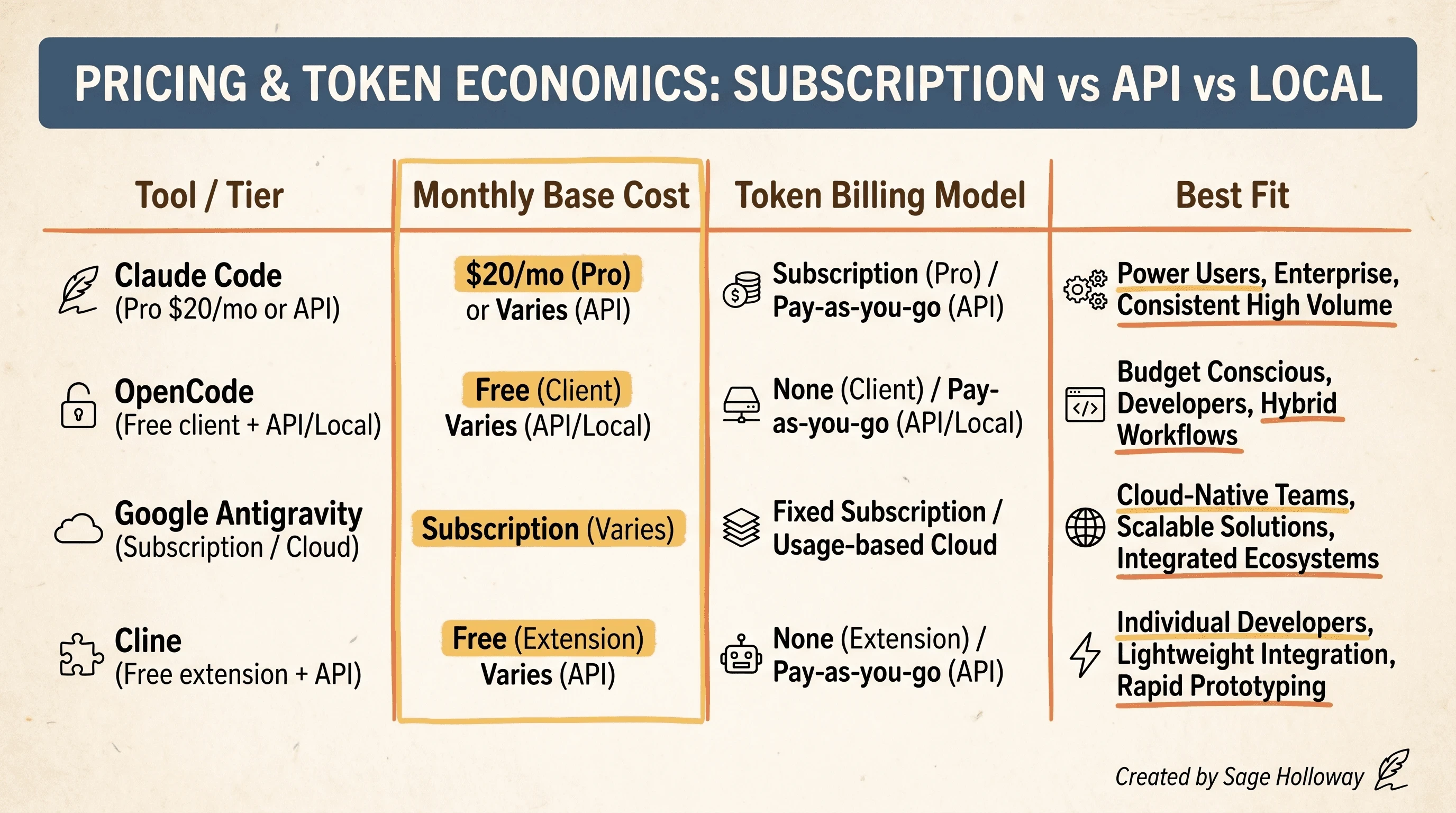
Comparing monthly flat subscription quotas against pay-as-you-go API token consumption and zero-cost local models.
Consumer Subscriptions vs. Pay-As-You-Go API Rates
Claude Pro ($20/mo flat): Highly cost-effective for moderate daily refactoring, but subject to 5-hour rolling message caps during intensive multi-file agentic loops.
Anthropic API (Pay-as-you-go): Zero message caps, but large codebases can easily consume $5 to $15 per complex refactoring session if prompt caching is not properly utilized.
Local Models ($0/mo): Zero incremental token cost, but requires local GPU hardware (Apple Silicon 64GB+ or dedicated NVIDIA RTX 4090) to run models like Qwen 2.5 Coder 32B at acceptable speeds.
Local Model Execution and Air-Gapped Workflows
For developers working in enterprise environments with strict data loss prevention (DLP) rules, sending proprietary source code to cloud APIs is prohibited.
OpenCode provides native local model routing out of the box through Ollama:
Routing Claude Code to Local Endpoints
Few developers realize that Claude Code can also be directed to local proxy endpoints using standard environment variables:
By pointing ANTHROPIC_BASE_URL to a local LiteLLM or Ollama proxy that implements Anthropic-compatible tool-calling endpoints, you can utilize Claude Code's streamlined terminal UI while keeping all source code completely on-device.
<div class="video-embed-card" data-video-id="f33Fw6NiPpw"> <iframe width="100%" height="400" src="https://www.youtube-nocookie.com/embed/f33Fw6NiPpw" title="Getting Started with Cline" frameborder="0" allow="accelerometer; autoplay; clipboard-write; encrypted-media; gyroscope; picture-in-picture" allowfullscreen></iframe> <p class="caption">Watch ZazenCodes demonstrate configuring open-source agentic tools with custom model providers.</p> </div>
Decision Matrix: Which Terminal Agent Should You Pick?
Selecting the best terminal coding assistant comes down to three primary criteria: model preference, token budget, and privacy constraints.
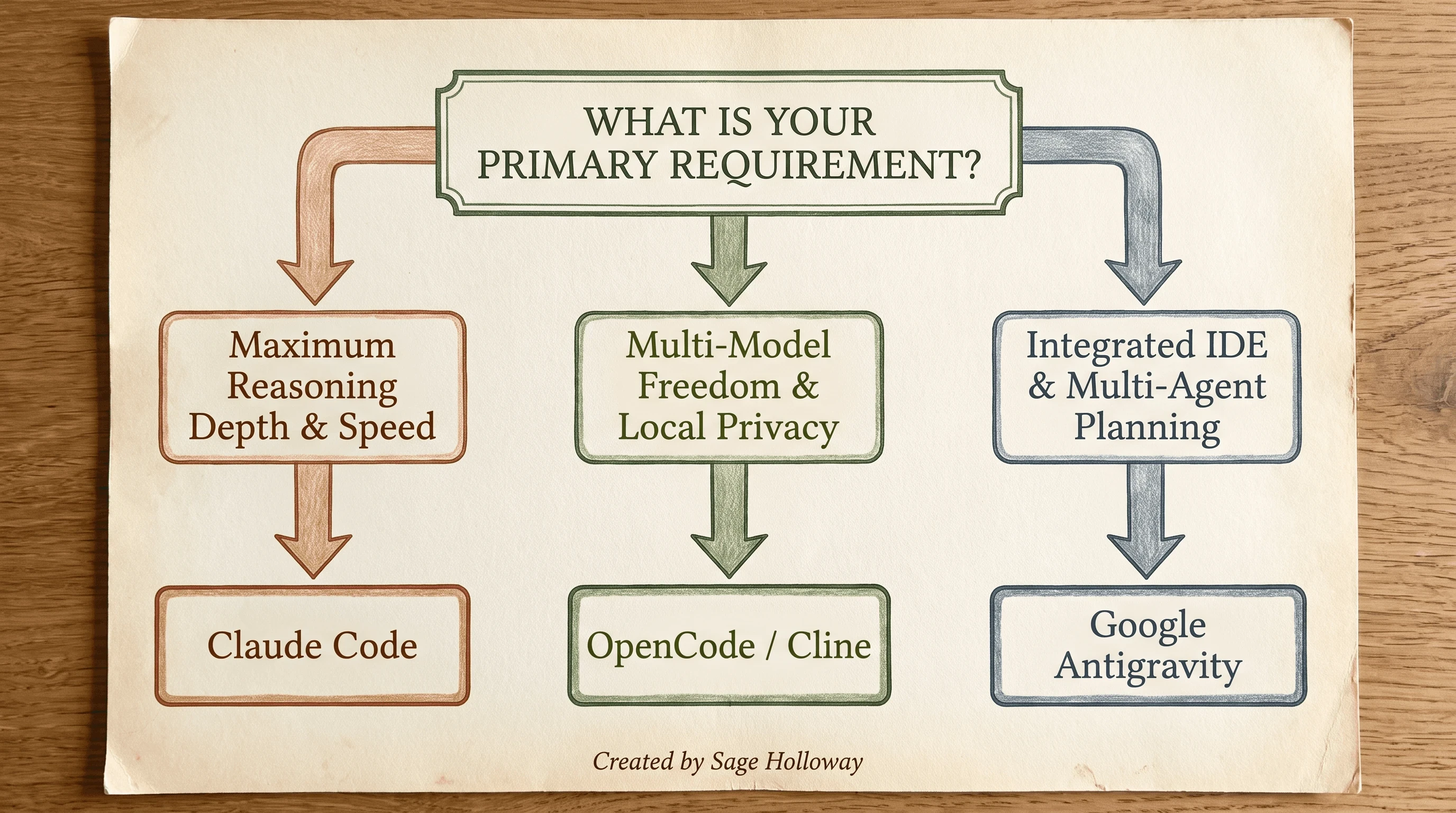
A simple decision framework based on model preferences, token budget, and enterprise privacy requirements.
Follow These Practical Guidelines:
Pick Claude Code if:
You already subscribe to Claude Pro or Claude Max and want flat-rate terminal coding.
You want maximum reasoning capability on complex refactoring tasks without tuning prompts.
You value low token overhead via deferred Tool Search.
Pick OpenCode if:
You want to switch between DeepSeek R1, GPT-4o, Gemini 2.5, and Anthropic models in a single interface.
You work in typed monorepos where native Language Server Protocol (LSP) diagnostics save debugging time.
You want an entirely open-source terminal client.
Pick Google Antigravity if:
You need a full agentic IDE workspace with subagent delegation, browser automation, and persistent background task runners.
You want deep Gemini reasoning combined with artifact-driven planning workflows.
Pick Cline if:
You prefer an editor sidebar in VS Code over a headless command-line interface.
You want granular, line-by-line human approval for every file modification.
Frequently Asked Questions
What is the main difference between OpenCode and Claude Code?
Claude Code is a proprietary, managed agent CLI optimized exclusively for Anthropic models with deferred Tool Search and consumer subscription support. OpenCode is an open-source universal terminal adapter supporting 75+ model providers, local Ollama execution, and integrated LSP diagnostics.
Can I use my Claude Pro subscription inside OpenCode?
No. Anthropic's 2026 OAuth policy restricts consumer Claude Pro and Claude Max subscription authentication to official Anthropic clients (the Claude Code CLI and VS Code extension). Third-party tools like OpenCode and Cline must use pay-as-you-go Anthropic Console API keys.
Is OpenCode completely free to use?
The OpenCode client itself is 100% free and open-source under the MIT license. However, you are responsible for paying API token costs to whichever model providers (OpenAI, Anthropic, OpenRouter) you connect, unless you route it to local models via Ollama.
Which tool is more token-efficient for complex coding tasks?
Claude Code is significantly more token-efficient due to its deferred Tool Search, which keeps baseline tool definitions at roughly 3KB compared to OpenCode's monolithic tool loading, which can exceed 171KB on initial context loads.
Can Claude Code run local models without sending data to Anthropic?
Yes. By setting ANTHROPIC_BASE_URL="http://localhost:11434/v1" in your shell, you can route Claude Code's terminal interface to local Ollama or LiteLLM endpoints running open-weights models like Qwen 2.5 Coder.
How does Google Antigravity compare to Claude Code?
Claude Code is a focused terminal client for codebase navigation and editing. Google Antigravity is a comprehensive agentic pair-programming workspace supporting multi-agent subagent delegation, headless browser automation, background task scheduling, and structured planning workflows.
Next Steps
To evaluate these tools on your own repositories:
Benchmark Claude Code on a complex multi-file refactoring task using
claude.Install OpenCode (
npm install -g opencode) and test local model routing withopencode --model ollama/qwen2.5-coder:32b.Track token consumption across both workflows to determine which pricing model aligns with your development velocity.
Sage
PS. If you decide to run OpenCode with paid API keys, configure a tight monthly budget cap on your model provider dashboard before running recursive agentic refactoring loops.
Author
Practical guides, tool teardowns & AI engineering workflows.