Comparisons
Claude Code vs Gemini CLI: Codex, Antigravity, and How to Choose

Sage Holloway
29 min read
Go back to blog
SHARE

You did not lose the afternoon because one logo was smarter. You lost it because you asked one station to taste the sauce, inventory the walk-in, and stamp the plate. The kitchen was never one job. The comparison posts made it sound like it was.
Claude Code is the stronger pick for high-ambiguity architecture and precise implementation. Gemini CLI, sunset for individual accounts on June 18, 2026 and replaced by Antigravity CLI, still defines the Google side of this search: a 1M-token context window for whole-repo exploration plus a generous free tier. Codex CLI is the third terminal rival, often cheaper and more tightly sandboxed. Route by job: Claude for reasoning, Gemini/Antigravity for research-scale context, Codex for review and cost.
This claude code vs gemini cli choice is a terminal-native agent decision, not an IDE autocomplete duel. GitHub Copilot and Cursor live on other pages. Treat names, seats, and quotas as time-sensitive. Confirm live details in the Claude Code overview and the Gemini CLI repository. Research for this guide is grounded in NotebookLM synthesis dated 2026-08-15, including DataCamp’s editor note on the individual sunset.
Claude Code for high-ambiguity work, Gemini or Antigravity for research-scale context, Codex for cheap review. Route by the job.
Claude Code vs Gemini CLI at a glance
Here is the contrast before the essay.
On SWE-bench Verified, comparison sources put Claude Code at 80.9% and Gemini CLI at 80.6%. Codex sits around 80%. Three tools, three marketing decks, a rounding error.
If you came here for claude code vs gemini cli because a teammate waved a winner, start with the matrix. Quality scores are close. Harness, context, price, and sandbox are not.
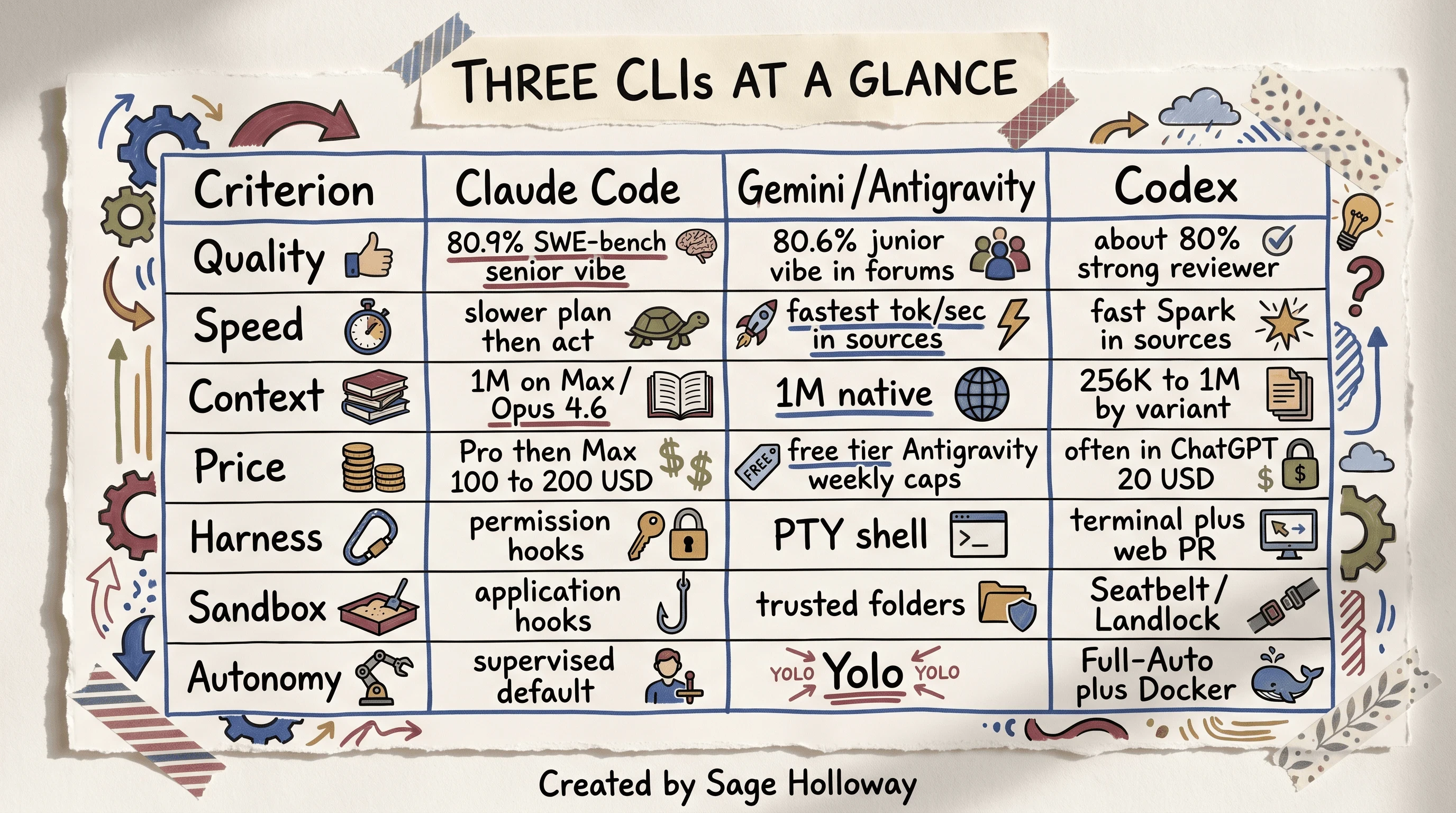
Quality, speed, 1M context, price, PTY vs permissions, sandbox, and autonomy in one scan.
What the comparison sources largely agree on (DataCamp, NxCode, DeployHQ, Composio, and practitioner threads):
Quality: Claude Code wins practitioner “senior” language and frontend precision. Gemini often reads as faster and more junior in forums. Codex shows up as a strong reviewer.
Speed: Claude Code is slower when it plans before it acts. Gemini / Antigravity is cited as the fastest tokens-per-second story (Antigravity 2.0 at 800 tok/sec in walkthrough sources). Codex Spark is also described as very fast.
Context: Gemini’s 1M-token window is native and central to the pitch. Claude Code also offers 1M on Max / Opus 4.6 class plans in sources, with a conflict flag on how that window actually ships. Codex ranges from 256K to 1M by variant.
Price: Claude Pro is the $20 seat that fills fast; Max is $100 to $200 for daily power users. Gemini’s free tier is the volume play. Codex often rides a ChatGPT $20 seat.
Harness: Claude uses permission hooks. Gemini uses a PTY shell (a pseudo-terminal, meaning a virtual terminal session the agent can keep alive). Codex pairs a terminal agent with a web PR companion.
Sandbox: Claude is application-layer hooks. Gemini uses trusted folders. Codex uses OS-kernel isolation (Seatbelt on macOS, Landlock on Linux).
Autonomy: Claude defaults to supervised. Gemini has Yolo. Codex has Full-Auto plus Docker stories.
The scores will not pick your stack. The job will.
If you want a live three-way before the sunset and harness sections, Codex Community recorded one. Watch it as texture, not as a 2026 product bible. Google’s consumer CLI moved after a lot of those cameras stopped.
[EMBED: YouTube - https://www.youtube.com/watch?v=7fQcsPOm8ys ] Caption: Watch a three-way AI CLI comparison, then come back for sunset, harness, and routing.
What Google replaced Gemini CLI with
This is the part ranking blogs still skip.
People keep searching google alternative to claude code and codex as if Gemini CLI were still the default consumer product. For individual accounts, that stopped being true on June 18, 2026.
Why are we still ranking a retired consumer CLI? Because the query did not retire with the product.
Sunset for individual accounts (June 18, 2026)
DataCamp’s 2026 comparison carries the editor note that matters: Google sunset Gemini CLI for individual and consumer accounts on that date, and pointed people at closed-source Antigravity CLI. Gemini CLI remains in the story as open source (Apache 2.0 in sources) and as an enterprise path. It is not the live individual default.
If your bookmarks still say npm install -g @google/gemini-cli and gemini auth login, those commands are still in the claim ledger. They describe the Gemini CLI product. They do not describe what Google wants a personal Google account to live on after the sunset.
Paid Antigravity users in walkthroughs reported weekly caps, then later increases (sources mention tripling weekly caps to meet demand). Do not hear “Google’s free AI” and assume a blank check. Vaibhav Sisinty’s masterclass is useful on the successor stack and brutally honest on the caps if you listen past the demo.
Antigravity CLI vs Google Jules (interactive CLI vs async PR pool)
Antigravity is the interactive successor. In sources you launch it with ag in the terminal or editor. It is chat-shaped, closed-source on the consumer side, and built for mass parallelism. One walkthrough shows 93 sub-agents on a single OS-scale build. That is unsupervised dynamic scaling in the marketing. Claude Code v2.0+ Agent Teams are the other shape: parallel sessions with a shared task list, more like manual orchestration than a swarm.
Google Jules is a different paradigm. Digital Applied and related matrices treat Jules as an asynchronous PR pool: you throw work at it, it comes back as pull requests. It is not a Claude-style interactive CLI. If you try to use Jules as a pair-programmer in the terminal, you will hate it for a reason that is not “the model is dumb.”
Enterprise leftover: Gemini CLI as OSS still exists for teams that want that repo. Individuals shopping a Google alternative to Claude Code and Codex in 2026 are mostly choosing between Antigravity (interactive) and Jules (async PRs), then still comparing both to Claude and Codex.
The full antigravity vs claude code fight belongs on Claude Code vs. Antigravity CLI (planned). This page only needs you to stop treating Gemini CLI as the live consumer default.
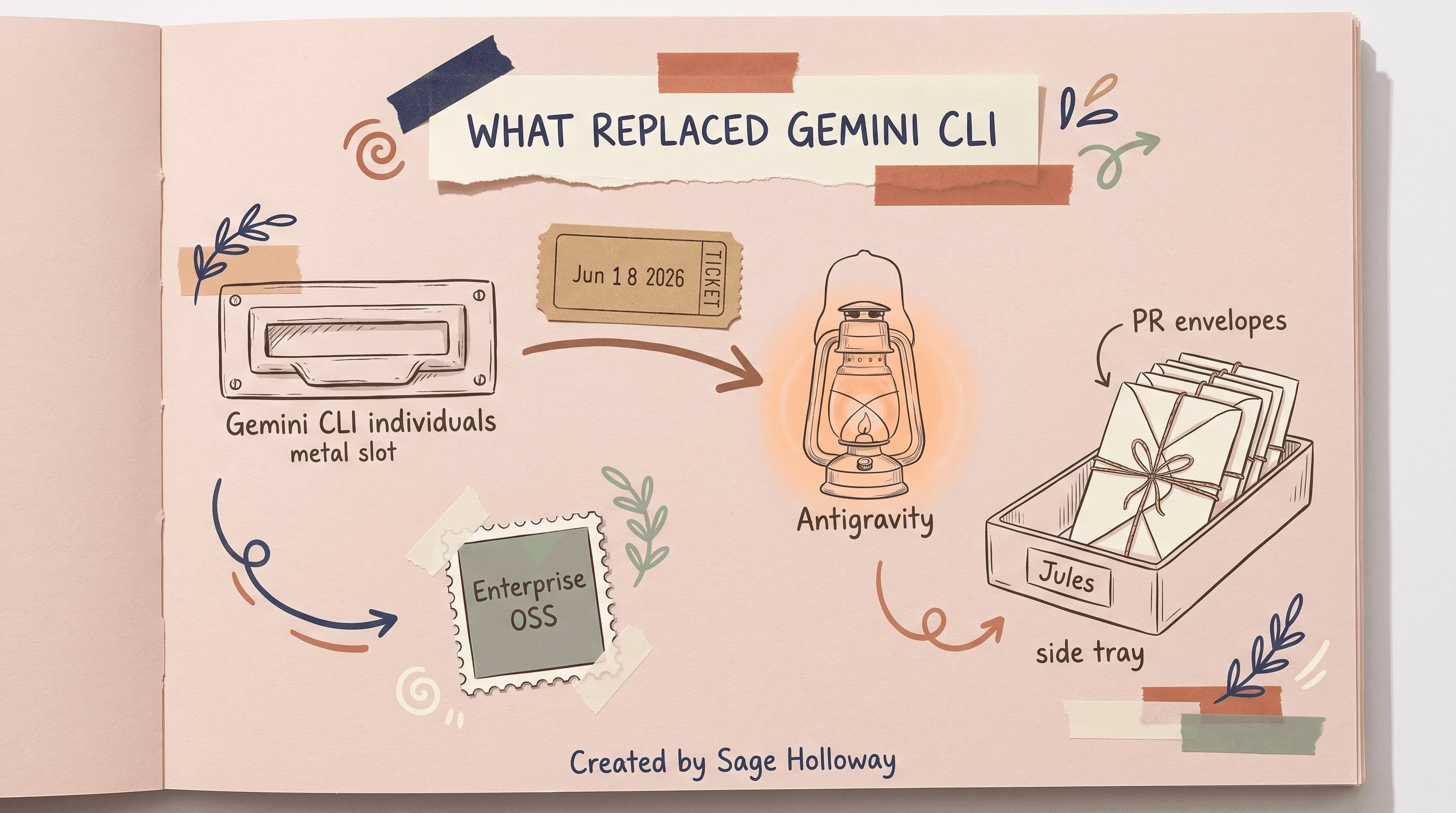
June 18, 2026: individual Gemini CLI sunset. Antigravity is the interactive successor. Jules is an async PR pool, not a Claude-style CLI.
[EMBED: YouTube - https://www.youtube.com/watch?v=-dwLbaCB-_I ] Caption: See Google’s successor stack beside Claude Code and Codex, including parallel agents.
Workflow benchmarks: Gemini CLI vs Claude Code
Reverse the phrase and the SERP is the same job: gemini cli vs claude code is still “which agent finishes real work.” Benchmarks help. They also lie if you treat them as a purchase order.
SWE-bench Verified and Terminal-Bench (what scores do and do not mean)
SWE-bench Verified is a coding-agent benchmark: can the system resolve real GitHub issues in a controlled set. Terminal-Bench (sources cite 2.0 / 2.1 depending on the write-up) stresses terminal workflows rather than issue patches.
NxCode-style showdowns put the three CLIs in a tight band around 80% on SWE-bench Verified. That is the contrast reveal. Claude 80.9. Gemini 80.6. Codex about 80. If you are buying a 0.3-point gap, you are buying a story.
What the scores do not tell you: whether the agent hangs on vim, whether it asks you 40 times to write a file, whether it still remembers the bug after /compact, whether the 1M window is actually loaded, and whether you still have quota at 4pm.
So why does anyone still argue?
Practitioner language is more useful than the third decimal. Claude Code is repeatedly described as a senior engineer: cleaner, more idiomatic, better at breaking out of failed loops. Gemini is repeatedly described as fast, context-hungry, and sometimes stuck repeating a bad approach.
Some Reddit and HN voices call Gemini 3 Pro “catastrophic” for coding. Others say it is “not as dumb as people think” if you prompt it like a junior who needs a spec. Both camps are in the sources. Neither is a lab result.
I will not paste a “67% of blind tests” line. It is not in the claim ledger we trust for this page.
Build-off evidence (Composio time/cost) vs practitioner quality
Composio ran a same-project build-off. Claude Code finished in 1 hour 17 minutes at $4.80 API cost. Gemini CLI finished in 2 hours 2 minutes at $7.06. That architecture is useful: same job, two harnesses, wall-clock and spend on the table.
Flag the date. That write-up is mid-2025. Models, seats, and Google’s product names have moved. Use the method (timed build-off) more than the dollars.
Quality in that genre of review still tends to land on Claude for the thing you would merge. Speed and whole-repo swallow still tend to land on Gemini. If your week is “understand this monorepo and ground it in current docs,” the slower-looking SWE-bench winner can be the wrong seat.
The quiet truth: the models are close enough that the harness is the whole argument.
Harness and execution: PTY snapshots vs permission hooks
You walk into a restaurant kitchen at 7pm and three stations are already loud. One cook keeps tasting the sauce and rewriting the special because the duck arrived different than the prep list. Another has the whole walk-in inventoried, every crate labeled, every leftover accounted for. A third never cooks; they taste the plate at the pass and send it back if the salt is wrong.
Same dinner service. Completely different jobs for the same night.
That split is the real claude code vs gemini cli decision once you ignore the logos. Claude Code is the tasting cook on high-ambiguity work. Gemini (now Antigravity for individuals) is the walk-in inventory: research-scale context. Codex is the pass: cheaper review with a harder safety gate.
The harness is how those stations actually move food.
Gemini PTY shell and interactive prompts (vim / long-running jobs)
A PTY, a pseudo-terminal, is a virtual terminal session. Gemini CLI’s harness can spawn one, snapshot it, and keep interactive programs alive. Sources specifically call out vim, htop, and long-running jobs that would hang a dumber pipe. The agent does not have to freeze the whole session because the child process asked a question.
That is why Gemini wins “terminal integration” in the comparison matrices even when people prefer Claude’s diffs. If your workflow is “stay inside a living shell,” a permission-gated tree of one-shot bash calls feels primitive.
Headless Gemini still exists: gemini -p "prompt" for pipeline / CI-shaped runs.
Claude permission modes, Shift+Tab, and approval fatigue
Claude Code’s security model is application-layer hooks: it stops and asks before file writes and bash. Default is supervised. You can cycle permission and interaction modes with Shift+Tab (sources describe Default, Plan, Auto in both tool families). Plan Mode, covered in depth on Claude Code Plan Mode, is the read-first cousin of that habit.
Headless Claude is claude -p "prompt" on stdin/stdout for CI.
There is a flag called --dangerously-skip-permissions. The name is the documentation. It is for isolated runners, not for your laptop on a Tuesday. If you skip that isolation, this will not work the way the demo implied. You did not get a faster senior engineer. You got an unsupervised intern with your credentials.
Approval fatigue is real. I have watched a session die because the human went to make tea and the agent was still waiting on ls. Gemini’s PTY people were already on the next crate. That is not a vibe. That is harness design.
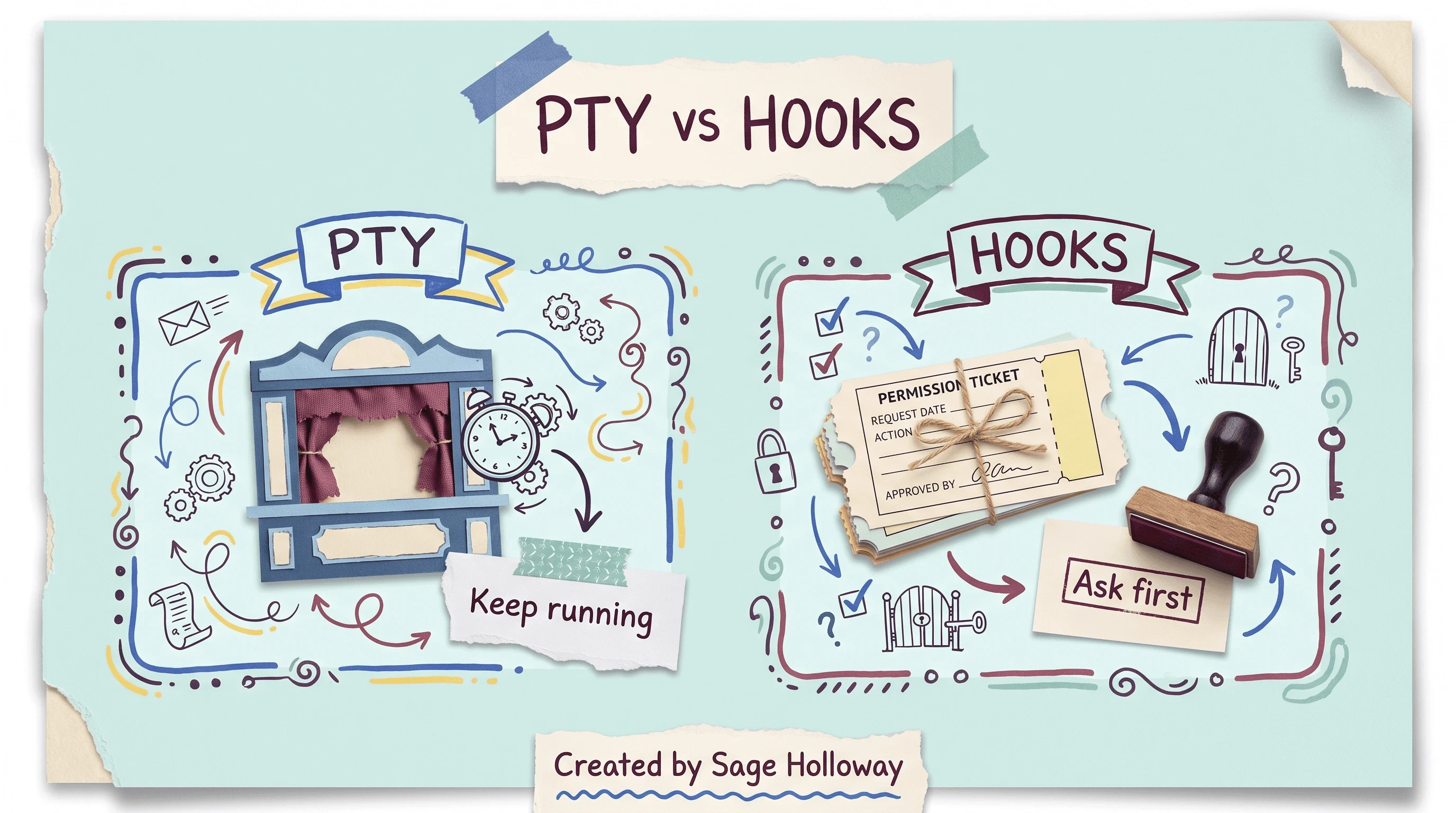
PTY snapshots keep interactive shells moving. Permission hooks trade speed for per-action control and can cause approval fatigue.
Shift+Tab cycles modes. /compact is how Claude compresses a long session on purpose. Claude also has a 25k-token individual file read limit in sources: a huge file can fail or truncate even when the window is advertised as 1M.
Pricing and usage limits
Sticker price is a brochure. Heavy use is a calendar.
Claude Pro rolling window vs Max power-user cost
Claude Code on a roughly $20 Pro seat is described in blogs as about 45 messages per 5 hours. Confidence: medium. Other write-ups disagree on the exact meter. What does not disagree: power users hit a wall and move to Max at $100 to $200 a month.
If you are doing architecture all day, budget Max. Pretending Pro is infinite is how people rage-quit at 3pm and declare the model “got worse.” Why does the $20 seat feel infinite in the marketing? Because the brochure is not a workday.
Compaction is part of the bill. Claude’s harness is described as better at keeping architectural memory after /compact, including a 57-to-1 compression story in sources. Gemini’s larger window still needs nudges and retries in those same write-ups. A giant context that forgets the bug from yesterday is not cheaper. It is a second session.
Gemini free-tier quotas vs Antigravity weekly caps vs Codex on ChatGPT
Gemini CLI’s individual free tier is widely cited as 1,000 requests per day. Confidence: high that a quota exists, with conflict in the ledger on the exact number. When you blow it, people report 429 Too Many Requests.
GitHub discussion #1662 is the privacy note to actually read: free-tier prompts can help improve Google models; paid API / Workspace usage is the path people cite when they do not want that bargain.
Antigravity’s consumer pitch sounded like everything-for-free. Users then hit weekly caps. Paid tiers later tripled those caps in the walkthrough sources. Still not free-forever.
Codex often arrives inside a ChatGPT $20 subscription with forum language about generous or “non-existent” limits. Treat the generosity as opinion. Treat the seat bundling as the actual product fact.
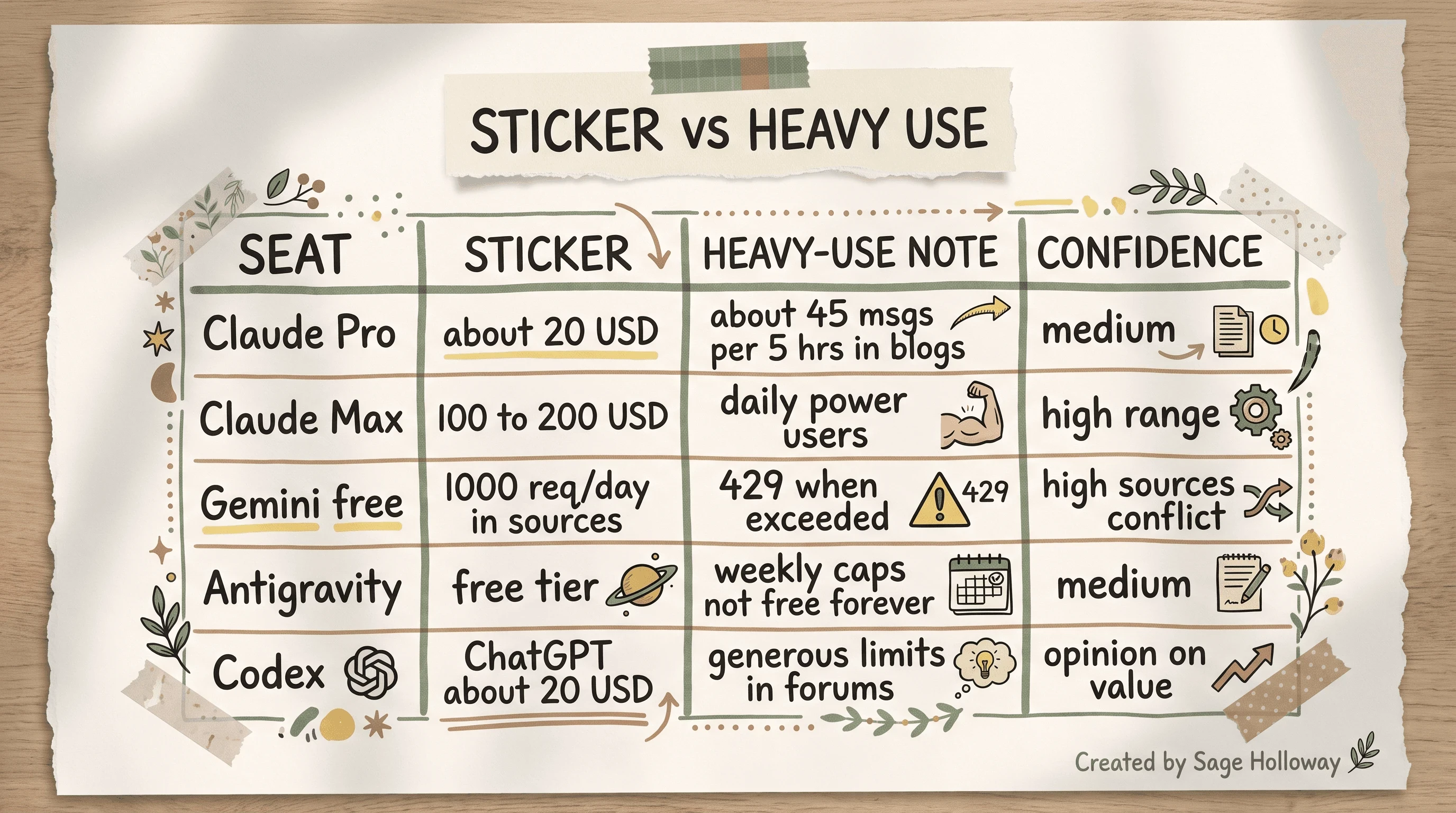
Pro windows fill fast. Gemini’s free quota and Antigravity weekly caps are not the same product. Codex often rides a ChatGPT seat.
For Claude-only meter detail, keep Claude Code pricing as the spoke. This page only needs the three-way contrast.
Codex CLI vs Claude Code
Codex is not a footnote. codex cli vs claude code is a real secondary because OpenAI shipped a terminal agent people actually use for backend work and review.
Feature and security split (kernel sandbox vs application hooks)
Codex isolates at the OS kernel: Seatbelt on macOS, Landlock (and seccomp language) on Linux. Claude asks per action. That is not a personality difference. It is where the fence sits.
Job fit in the sources: Claude Code for high-ambiguity implementation. Codex for a cheaper review pass once a plan exists. Reddit hybrid threads treat Codex as the methodical reviewer that stretches Claude’s limits: Claude plans and implements, Codex nags the diff.
gpt-5 vs claude code searches belong here as a model-seat row, not as a second primary. Sources put GPT-5 variants under the Codex / ChatGPT umbrella and Claude’s family under Claude Code. You are rarely choosing “GPT-5 the product” versus “Claude Code the product.” You are choosing which CLI harness that model sits in.
Config files follow the same split: AGENTS.md (layered global / repo / sub-dir) for Codex, ~/.codex/config.toml for MCP and local settings. Claude uses CLAUDE.md and ~/.claude/settings.json (including permissions.defaultMode). A low-confidence Ubuntu/WSL report mentions Codex failing against localhost port 1455. Flag it; do not treat one thread as a platform law.
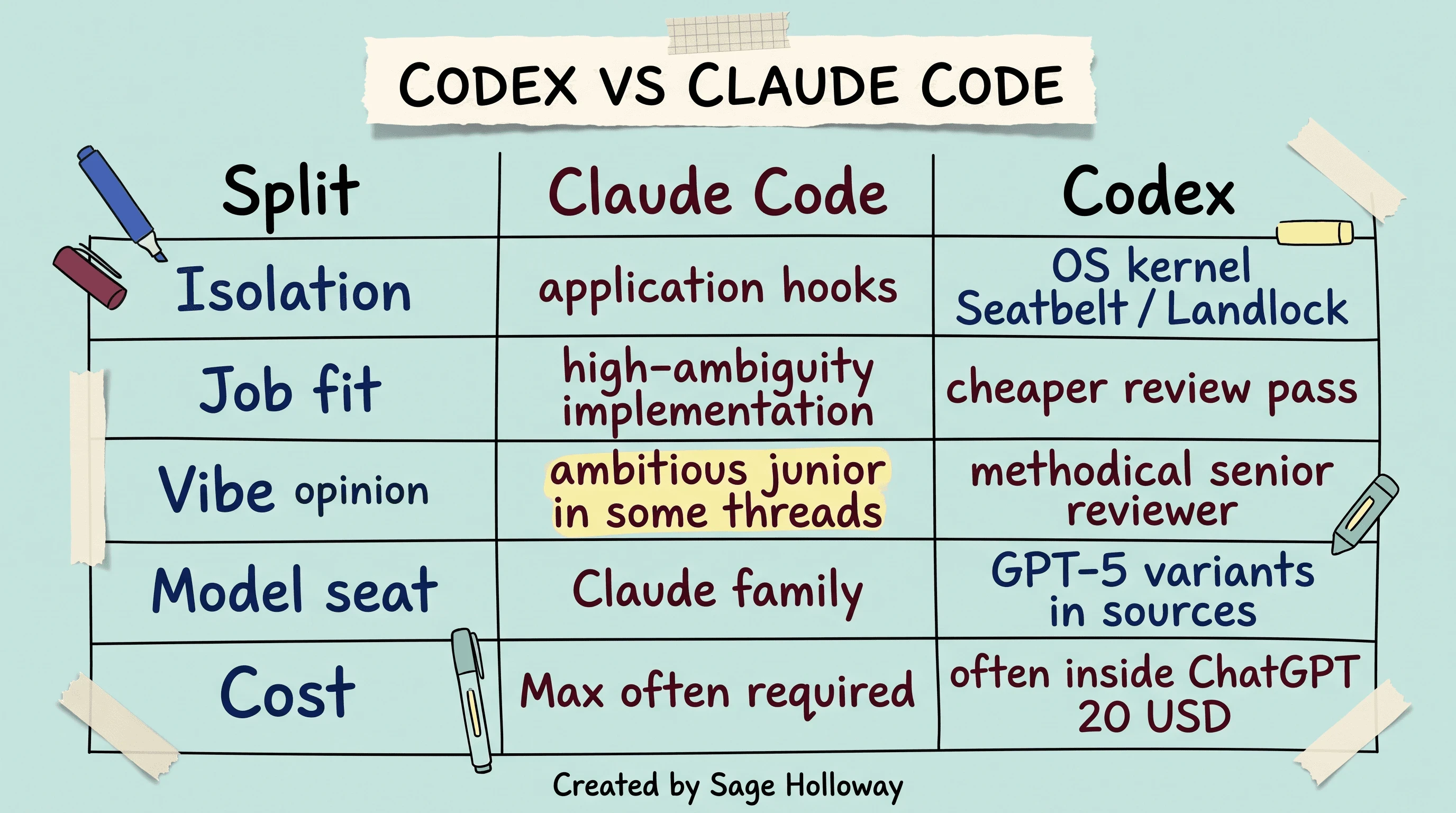
Codex wins kernel isolation and cheap review. Claude Code still owns high-ambiguity implementation. GPT-5 vs Claude Code stays a row here.
Senior vs junior “vibe” (opinion, tagged)
Here is the honest admission: I expected the “senior vs junior” talk to be cope. Then I read enough practitioner threads that the pattern stopped being cute.
Some voices call Codex the senior reviewer and Claude the ambitious junior: Claude reaches further, Codex is fussier and safer. Other voices reverse it and call Claude the senior engineer versus Gemini’s junior. The labels move with the opponent.
Opinion, tagged: if the task is still foggy, I want Claude’s willingness to grill the design. If the task is a spec and a review pass, I want Codex’s kernel fence and cheaper seat. “Is Codex better than Claude Code” is a bad question until you name the job.
OpenAI’s own community thread on the missing piece being the harness is worth reading for that reason: Codex vs Claude Code, the missing piece is the harness.
[EMBED: YouTube - https://www.youtube.com/shorts/asxkdlVdprU ] Caption: Holmes on when Claude Code vs Codex: high ambiguity first, then cheaper execution.
Safety and sandboxing
DeployHQ is the infrastructure-minded comparison. Safety is not a sticker. It is where the process is allowed to live.
Codex Seatbelt / Landlock vs Claude hooks vs Gemini trusted folders
Codex: kernel. The OS is in on the joke.
Claude Code: application hooks. You are in on the joke, every write, until you are tired.
Gemini CLI: trusted folders. Path-scoped permission. Yolo still lives inside that map in the sources.
None of these validate that the generated code is secure. They constrain where the agent may wander while it writes the insecure code.
Headless / Yolo / Full-Auto: when isolation matters
Unattended modes are how you get CI value. They are also how you get a bad Tuesday.
Claude’s skip-permissions flag needs an isolated runner. Gemini’s Yolo still wants a trusted-folder story. Codex Full-Auto still wants Docker / sandbox language in the same matrices.
Shared rule: isolate the runner for unattended mode. If you cannot isolate, you do not get a power-user mode. You get a production incident with a cute flag name.
A community note to lock Claude Code at v2.0.76 to avoid alleged 3x token burn in v2.1+ is low confidence. Do not freeze your toolchain on a forum rumor. Do watch your meter after upgrades.
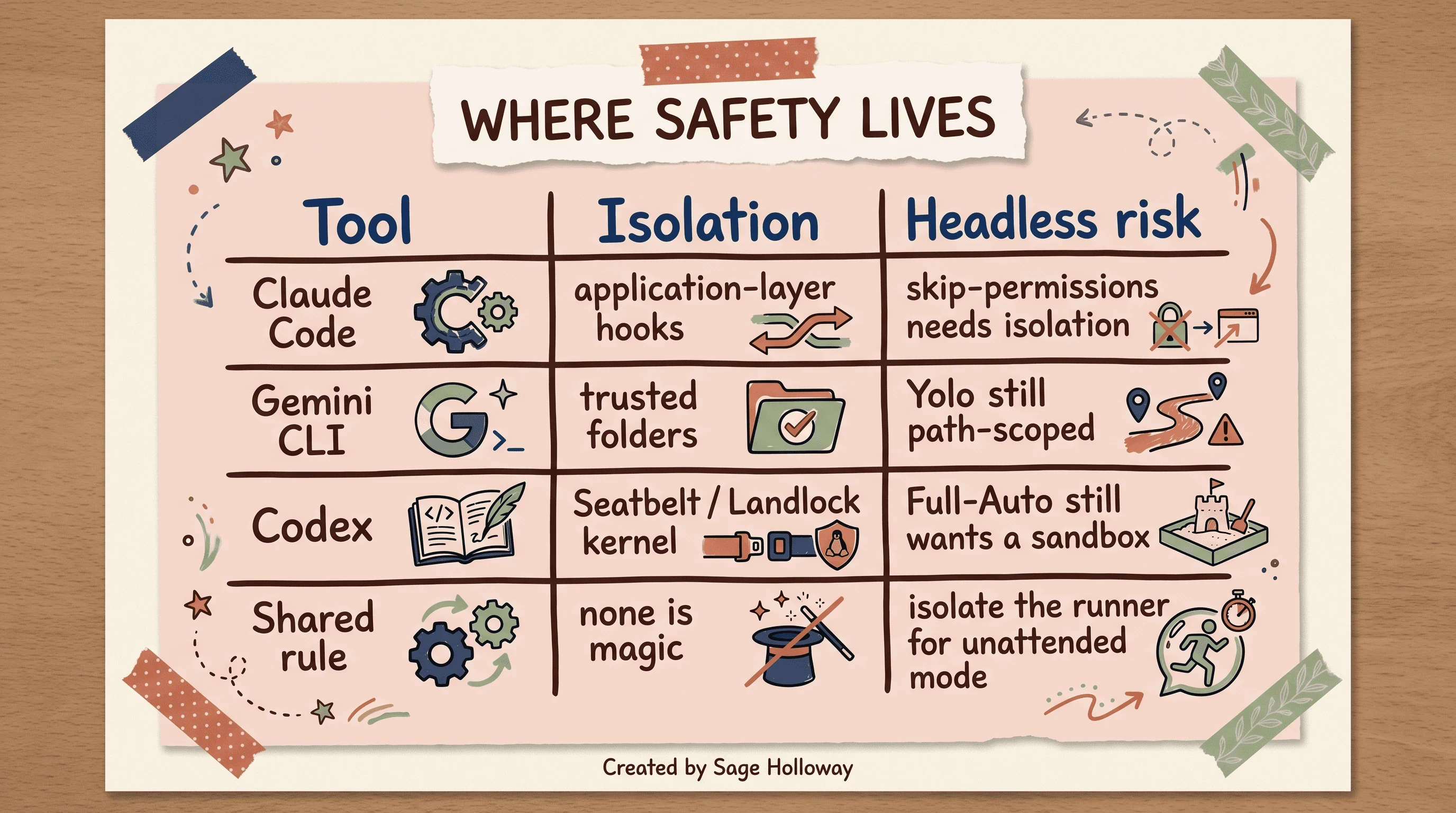
Codex isolates at the OS kernel. Claude asks per action. Gemini scopes trusted folders. Yolo and skip-permissions need an isolated runner.
Ecosystem and MCP
MCP is Model Context Protocol: a standard way to attach extra tools (GitHub, Slack, databases) to an agent so it is not stuck with only the files in the repo. Catalog depth lives on Claude Code MCP servers. This page only needs the comparison-relevant recipes.
CLAUDE.md, GEMINI.md, AGENTS.md
These are standing project briefs. CLAUDE.md tells Claude Code the stack conventions. GEMINI.md does the same for Gemini CLI (also via GEMINI_SYSTEM_MD in sources). AGENTS.md is Codex’s layered version.
If you skip the file, you will re-explain the repo every session and call it a model quality problem. It is a briefing problem.
Claude install paths in the ledger, if you still need the binary: native curl -fsSL https://claude.ai/install.sh | bash on macOS/Linux, or npm install -g @anthropic-ai/claude-code (Node 18+). Full install belongs on Install Claude Code. Gemini’s global install is npm install -g @google/gemini-cli. Antigravity’s launch command is ag.
Wrapping Gemini as an MCP server for Claude (hybrid recipe from sources)
Advanced hybrid write-ups wrap Gemini as an MCP server so Claude can borrow the 1M-window research pass without leaving the session. The ledger command shape:
User-scope MCP also shows up in ~/.claude.json in sources. This is a recipe, not a second MCP guide. Point the URL at whatever Gemini / research server you actually trust, then verify with the MCP servers loop, not with hope.
Stale APIs and “AI code outdated on arrival”
Milvus is almost alone on this SERP in saying the quiet part: generated code can be stale the day it lands if the library moved. MCP and docs grounding are how Gemini/Antigravity’s Search-backed research is supposed to help. Claude’s precision does not magically know that a package renamed a function last Tuesday unless you give it a current source.
If your pain is deprecated APIs, the 1M window is only useful when it is filled with today.
The hybrid strategy and the ambiguity line
Most “pro” threads do not crown a winner. They route.
Ben Holmes’s line is the one that survived contact with real weeks: use Claude when the job is still foggy; use cheaper execution when the plan is locked.
Gemini/Antigravity for research-scale context, Claude for execution
A common pattern: Gemini or Antigravity swallows the monorepo, grounds in Search, drafts the map. Claude Code takes the map and implements like it has taste. That is the walk-in, then the tasting cook.
The other common pattern, from r/ClaudeAI hybrid consensus: Claude plans and implements, Codex reviews so you do not burn Max on the nag pass.
You can use both together. People do. Confused about which hybrid is “correct”? There is no correct. There is an owner for each file, or there is a mess.
Codex as reviewer to stretch Claude limits
When Pro’s rolling window is the bottleneck, Codex is the overflow valve. You are not choosing a smarter model. You are choosing who is still allowed to work after the expensive seat says stop.
Limits-as-bottleneck is the actual hybrid trigger. If one seat already covers the job, a three-tool desk is cosplay.
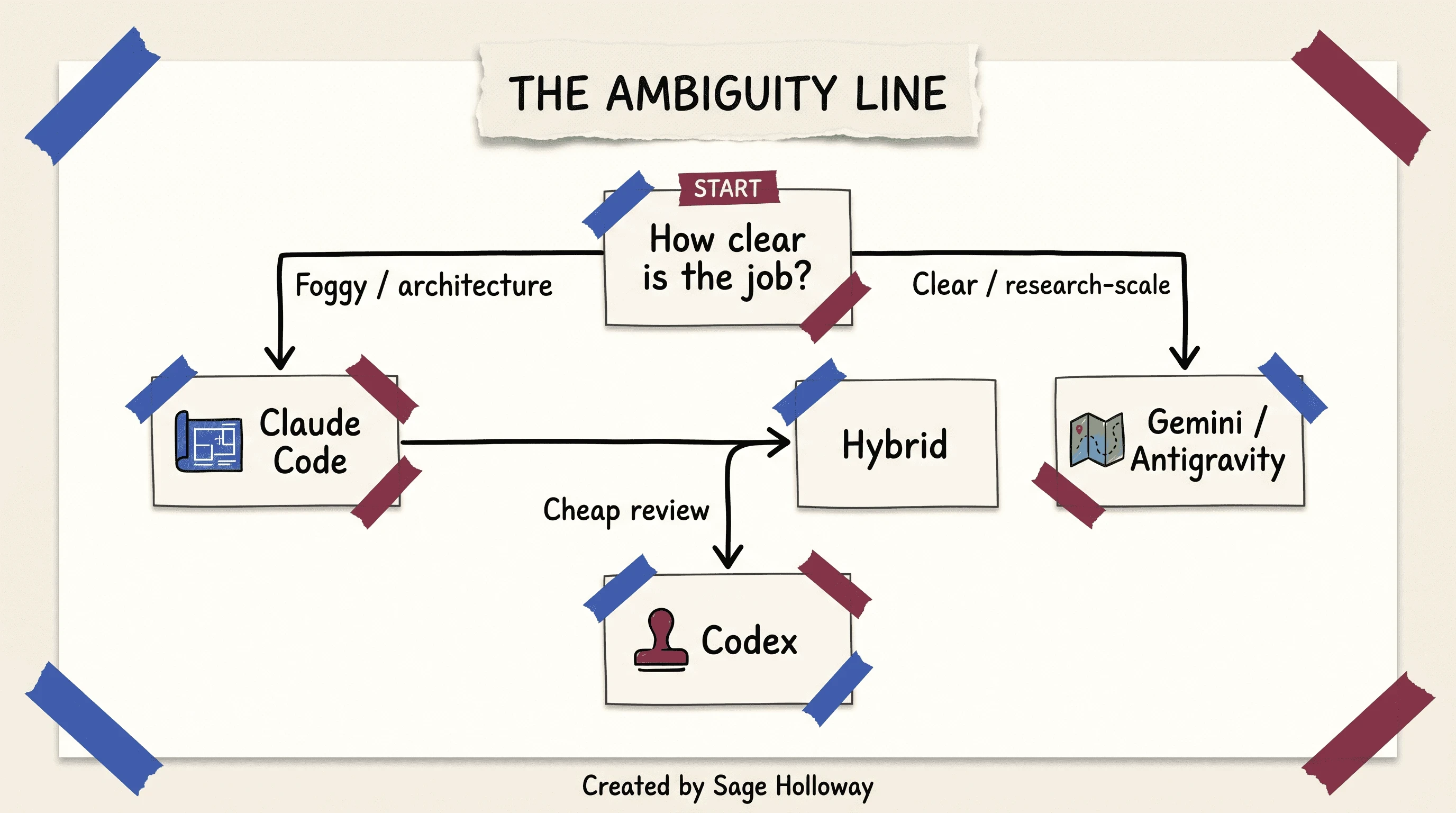
High-ambiguity architecture to Claude Code. Research-scale context to Gemini or Antigravity. Cheap review to Codex. Limits bottleneck to hybrid.
But here is the thing.
The hybrid story sounds like maturity. It can also be how you pay twice and review never. Wrapping Gemini as MCP inside Claude does not merge the bills. Yolo plus skip-permissions plus Full-Auto on one laptop does not make you a power user. It makes the blast radius three logos wide.
Route on purpose. Or pick one seat and finish the ticket.
Which tool for which job
Short list. No ceremony.
High-ambiguity architecture or UI exploration: Claude Code. Skip if you only need bulk generation and the window is already the bottleneck.
Monorepo explore / Search-grounded research: Gemini CLI where it still exists for you, otherwise Antigravity. Skip if you need precise implementation tonight.
Cheap review plus kernel sandbox: Codex. Skip if the task is still foggy.
Many power users, mixed week, limits biting: hybrid. Skip if one seat already covers it.
When not to force Claude Code onto low-ambiguity bulk generation: if the job is “generate the obvious from a locked spec until quota dies,” you will hate Max and call it quality. It was a routing error.
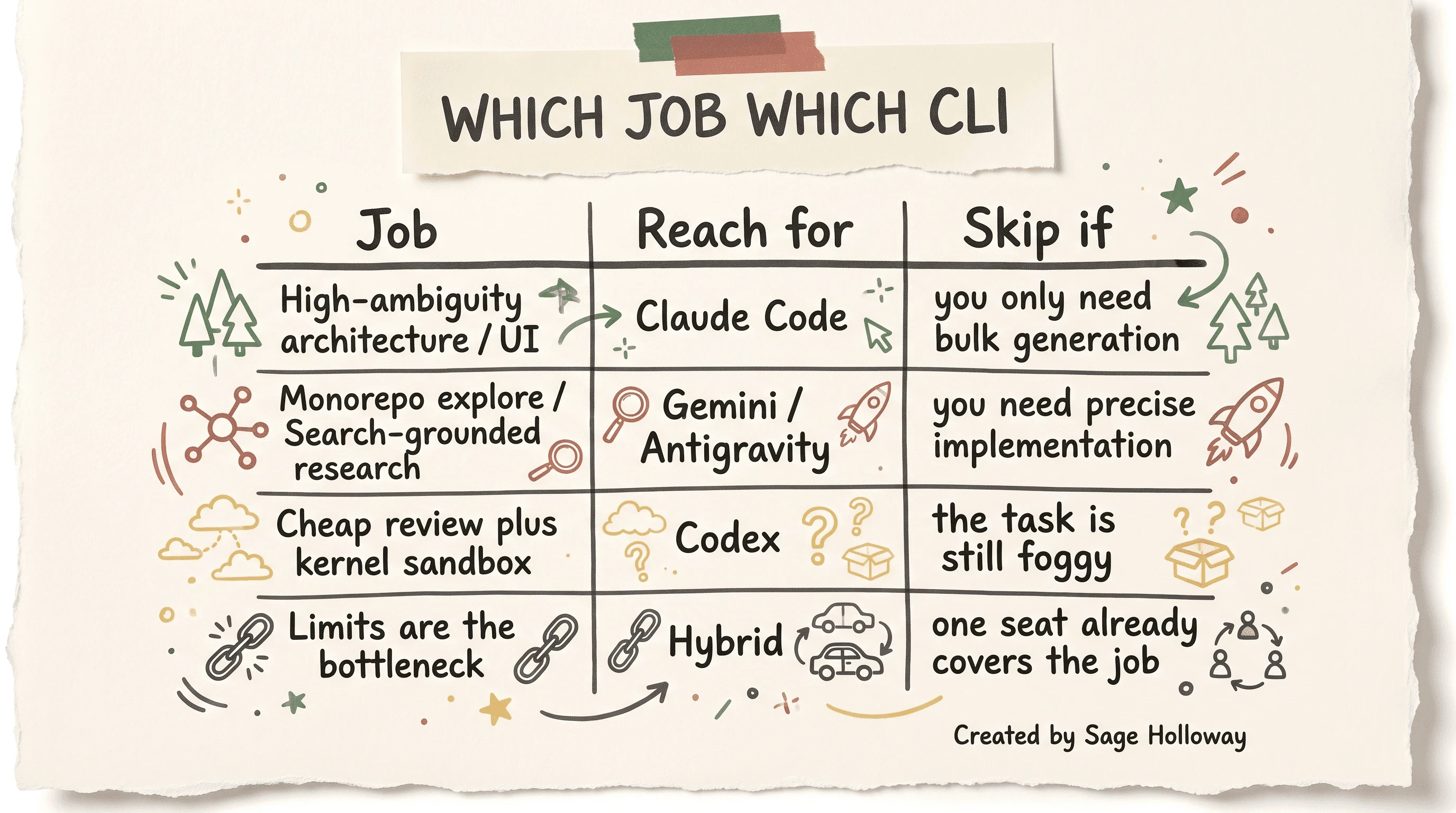
Architecture and UI: Claude. Monorepo explore: Gemini or Antigravity. Kernel-sandboxed review: Codex. Many power users: hybrid.
This page will not cover Cursor (see Claude Code vs Cursor), GitHub Copilot (see Claude Code vs GitHub Copilot), or a full alternatives roundup. OpenCode is The OpenCode Alternative (planned). Command trivia is Claude Code CLI Cheatsheet (planned).
Whether Google keeps Antigravity as the consumer CLI, whether Claude’s Max math stays sane, and whether Codex remains the cheap reviewer are all still moving. The teams that look calm are assigning stations, not waiting for a single logo to win dinner service.
FAQ
Is Codex better than Claude Code?
Not as a blanket. Codex wins kernel isolation and a cheaper review seat in the sources, and some practitioners prefer it once a plan is locked. Claude Code still wins high-ambiguity implementation and the “would I merge this” quality talk. Name the job first. Then the ranked question has an answer.
What is the main difference between Gemini CLI and Claude Code?
Gemini CLI is the open-source Google CLI with a generous free-tier story and a native 1M-token window for whole-repo exploration. Claude Code is proprietary, paid, and repeatedly cited for stronger reasoning and more idiomatic code. After June 18, 2026, individuals should treat Antigravity as Google’s interactive successor while Gemini CLI remains in enterprise / OSS conversations.
Which tool is better for beginners?
Gemini CLI was the easy on-ramp: free, Google account, gemini auth login, no API billing ritual. After the individual sunset, that on-ramp is Antigravity’s free tier with weekly caps, not a blank check. People who hate the terminal still get a gentler start from polished desktop surfaces. Claude Code’s terminal-native habit has higher activation energy and a real bill.
Can you use Claude Code and Gemini CLI together?
Yes. Common pattern: Gemini or Antigravity for research-scale context and a draft plan, Claude Code for execution. Advanced pattern: wrap Gemini as an MCP server so Claude can borrow the wide window. Codex as reviewer is the other hybrid. Pick an owner for each file.
What happened to Gemini CLI in June 2026?
On June 18, 2026, Google sunset Gemini CLI for individual and consumer accounts and pointed that audience at closed-source Antigravity CLI. Gemini CLI remains relevant as open source and for enterprise. Jules is a separate async PR product, not the interactive replacement.
How do usage limits and pricing compare?
Claude Code is the expensive seat: Pro walls show up fast in blogs (~45 messages / 5 hours, medium confidence), Max is $100 to $200 for daily power users. Gemini’s free tier is the volume play (1,000 req/day in sources, with conflict flags), then 429s. Antigravity has weekly caps, not free-forever. Codex often rides ChatGPT ~$20 with more generous forum reports.
Which tool is better for large codebase analysis?
Gemini CLI and Antigravity lead for broad ingest because the 1M window is the product. Claude Code also has 1M on high-tier plans in sources, and is stronger when the job is reasoning about specific files and dependencies rather than swallowing the whole tree. Watch Claude’s 25k file-read limit on giant single files.
How do these tools handle interactive terminal sessions?
Gemini CLI’s PTY shell can keep vim, htop, and long-running jobs alive without hanging the agent. Claude Code stops for per-action approvals on writes and bash, which is safer and slower. Shift+Tab cycles modes in the families that support it. Headless both exist via -p.
How do security and sandboxing differ?
Codex uses OS-kernel sandboxing (Seatbelt / Landlock). Claude Code uses application-layer permission hooks. Gemini CLI uses trusted folders. Unattended flags (skip-permissions, Yolo, Full-Auto) all want an isolated runner. None of them certify the generated code.
Related guides
Claude Code vs. Antigravity CLI
Claude Code CLI Cheatsheet
The OpenCode Alternative
Try this on the next foggy ticket: write one sentence that states whether you know the design yet. If you do not, open Claude Code and stay in Plan Mode until the sentence is true. If you already know, send the spec to Codex or to Gemini/Antigravity for the wide-context pass and keep Claude off the bulk generation. If quota is the only reason you are switching, say that out loud so you do not dress a billing problem up as a quality debate.
The next year will keep renaming Google’s CLI and remixing who sits inside ChatGPT. The kitchen will still have a tasting station, a walk-in, and a pass. Watch which job is actually on the ticket.
Until then...
Sage
PS. I once left a long-running install in a tool that asked permission for every bash line. I went to make tea. When I came back the kettle was cold and the agent was still waiting on yes for ls. The people with a living shell were already unpacking the next crate. Fatigue is a security feature until it is a stopped clock.
Author
Practical guides, tool teardowns & AI engineering workflows.