Claude Code
Do You Need Claude Pro for Claude Code? Plans, API Math, and Free Access

Sage Holloway
31 min read
Go back to blog
SHARE

<!-- X Hook: most developers think claude code requires a $20 monthly subscription. it does not. you can run the entire terminal agent on a $5 pay-as-you-go api key, but there is one architectural catch that quietly inflates token bills for daily builders. here is the exact math 🧵
Substack Subject: ⚖️ Do you need Claude Pro for Claude Code? (The real API math)
Medium Title: Do You Need Claude Pro for Claude Code? Plans, API Math, and Free Access
Medium Subtitle: Why terminal agent loops make subscription flat rates cheaper than pay-as-you-go API tokens for daily developers.
LinkedIn Post Opener: If you are evaluating Claude Code for your engineering workflow, the most common question is whether you need a $20/month Claude Pro subscription to run the CLI. The short answer is no. But the economic answer depends on how your codebase accumulates tokens across multi-turn agent sessions. Here is the breakdown. -->
You install a new command-line tool, expecting a straightforward utility with a predictable price tag. Within twenty minutes, you are staring at two completely different authentication screens, wondering whether you just signed up for a flat monthly subscription or hooked your credit card directly to a live meter that charges by the syllable. The terminal is ready, but nobody explained which door keeps your wallet intact.
No, you do not need Claude Pro for Claude Code. Anthropic allows developers to run the terminal agent using pay-as-you-go credits on a Claude Console API key. However, because Claude Code re-sends codebase context on every turn, repetitive multi-file edits can quickly exceed API budgets. For daily development, a $20 monthly Claude Pro or $100 to $200 Max subscription provides predictable flat-rate pricing under a shared 5-hour rolling usage window.
This guide is an economic and architectural breakdown, not a promotional pitch. Every command, limit, and configuration parameter cited here reflects verified Anthropic Help Center documentation, official Claude plan guides, and developer research current as of 16 August 2026. If an outdated forum post or affiliate blog claims you must buy an enterprise plan or pay extra for flagship reasoning models inside the terminal, trust the official documentation cited throughout this guide.
This setup will not help you if you expect unlimited, unmetered frontier model reasoning for zero dollars. Autonomous coding agents are computationally heavy. Every automated test run, directory scan, and file edit incurs real server costs. The goal is to understand how those costs are structured so you can choose the most cost-effective path for your development cadence.
Claude Code does not require a subscription. You can choose a flat monthly quota or pay-as-you-go API metering.
The Core Decision: Pro Subscription vs. Console API Key
When developers first encounter Claude Code, confusion almost always stems from a failure to distinguish between Anthropic's two independent product ecosystems.
On one side sits the consumer web and mobile subscription tier: Claude Free, Claude Pro ($20 per month), and Claude Max ($100 to $200 per month). On the other side sits the developer platform: the Claude Console, where you generate an API key (an authentication string starting with sk-ant- that grants programmatic access to machine learning models) and pay strictly per token processed.
A token is the basic unit of text processing in large language models, roughly equivalent to four characters or three-quarters of an English word.
Claude Code can operate on either system.
If you authenticate using the default browser login (claude login), the CLI connects directly to your consumer Claude Pro or Max subscription. You pay a fixed monthly charge on your credit card. You never receive an itemized per-token bill. Your terminal sessions draw from the exact same usage pool as your browser chats at claude.ai.
If you instead export an ANTHROPIC_API_KEY into your terminal environment, the CLI bypasses your web subscription entirely. It routes every prompt, file read, and diff directly to the Claude Console API. You pay only for the exact volume of input and output tokens your agent consumes. If you run one five-minute debugging session this month, you might owe seventeen cents. If you do not touch the terminal for three weeks, you owe zero dollars.
Why does this matter? Because searchers asking do you need claude pro for claude code are often afraid that testing the CLI requires committing to a recurring $20 monthly subscription.
It does not. You can deposit $5 into a prepaid Claude Console account, install the tool, and run full agentic refactoring sessions today.
The real question is not whether Pro is required. The real question is economic: at what point does a flat $20 monthly subscription become cheaper than pay-as-you-go API tokens?
Watch Leonardo Grigorio break down the itemized cost mechanics of Claude Pro flat rates versus Console API metering:
https://www.youtube.com/watch?v=Ejr0VUucg3U Caption: Watch Leonardo Grigorio compare itemized monthly costs between Claude Pro and Console API billing.
Plan Breakdowns and Tier Limits: What You Actually Get
To evaluate whether a subscription makes sense for your workflow, you need to understand the precise limitations of each tier.
Many third-party blogs publish vague claims about message caps or outdated pricing figures. Let us examine the verified parameters across all four available tiers.
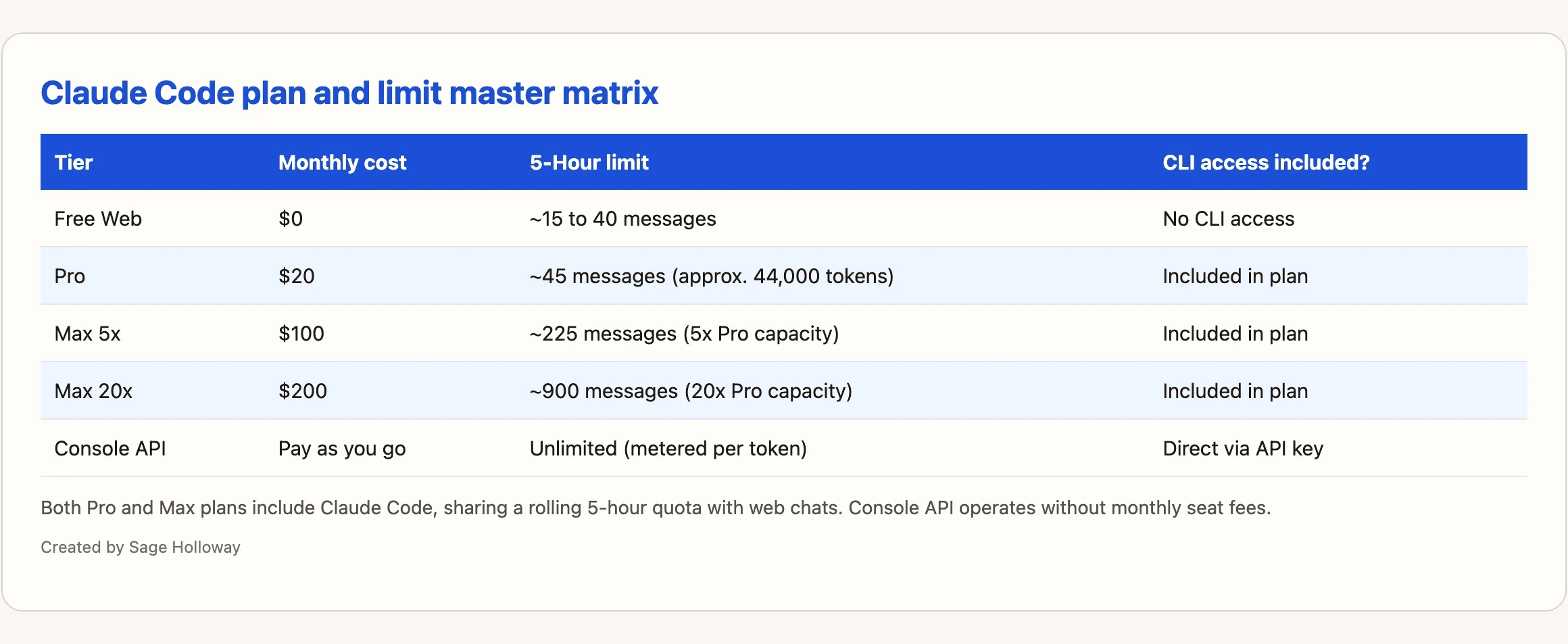
Both Pro and Max plans include Claude Code, sharing a rolling 5-hour quota with web chats. Console API operates without monthly seat fees.
The Free Tier Reality
Let us clear up the most widespread misconception first: there is no permanent claude code free tier.
While Anthropic provides a free tier on the claude.ai web interface, this free access is strictly limited to browser-based chat. It grants access to Claude Sonnet with dynamic message caps (typically 15 to 40 messages per 5-hour window depending on global server demand). It does not include terminal CLI authorization.
If you install @anthropic-ai/claude-code and attempt to log in using a free web account, the CLI will notify you that an active paid subscription or Console API key is required. The open-source npm package is free to download, but the backend inference engines require funded credentials.
Claude Pro ($20/month)
The claude code pro subscription costs $20 per month (or local currency equivalent plus tax) and provides individual access to Anthropic's flagship models, including Claude 3.7 Sonnet and Claude 3.5 Sonnet, as well as Claude 3 Opus.
Key characteristics of Claude Pro include:
Shared Quota Architecture: Your terminal commands and your browser conversations draw from the exact same usage budget. If you spend your morning chatting with Claude in the browser, your available capacity in Claude Code is proportionally reduced.
The 5-Hour Rolling Window: Claude Pro does not enforce a rigid daily message cap that resets at midnight. Instead, it operates on a sliding 5-hour window. Your quota continuously refills based on your activity over the preceding five hours.
Estimated Capacity: Under normal operational conditions, a Pro subscription yields approximately 44,000 tokens or roughly 45 standard messages per 5-hour window. However, because Claude Code sends rich codebase context with each turn, complex multi-file terminal tasks consume this budget much faster than simple text chats.
The April 2026 A/B Test Resolution: In late April 2026, Anthropic briefly tested removing Claude Code access from 2% of new Pro signups, sparking concern in developer forums that the CLI would become exclusive to the $100 Max plan. Anthropic quickly reverted this experiment and confirmed that Claude Code remains a permanent, standard feature of the $20 Claude Pro plan.
Claude Max Plans ($100 to $200/month)
For professional software engineers and teams running continuous agentic workflows throughout the workday, the standard Pro limits can feel restrictive. Anthropic offers two high-capacity individual subscription tiers:
Claude Max 5x ($100/month): Provides five times the capacity of a standard Pro plan, allowing approximately 225 complex messages or roughly 220,000 tokens per 5-hour rolling window.
Claude Max 20x ($200/month): Provides twenty times standard Pro capacity, allowing approximately 900 messages per rolling window. This tier is designed for full-time autonomous agent loops where the CLI runs automated test suites, performs deep code audits, and executes large refactors without hitting rate limits.
Guest Passes (
/passes): Max subscribers gain access to the/passescommand inside Claude Code. This command generates up to three unique 7-day trial links that grant colleagues or friends full Pro-equivalent access to test the terminal environment.
Watch Matt Maher benchmark real-world coding limits across the $20 Pro and $200 Max subscriptions:
https://www.youtube.com/watch?v=CSt23RTkmbQ Caption: Watch Matt Maher benchmark real-world coding agent limits on the $20 Pro plan against the $200 Max plan.
Mathematical Breakeven: When Is Pay-As-You-Go API Cheaper?
To decide between a $20 Pro subscription and Console API pay-as-you-go billing, you must understand how autonomous coding agents consume tokens.
When you chat with an AI model in a standard web browser, each message is relatively lightweight. You send two sentences of text, the model reads the conversation history, and it replies with two paragraphs.
Claude Code behaves completely differently. It is an agentic system that explores your local file system, executes bash commands, inspects error logs, and edits files autonomously.
The Token Accumulator Mechanism
Every time you submit a prompt in Claude Code, the client does not simply send your words. It packages and transmits:
The system prompt and tool definitions (explaining how to run shell commands, view files, and write diffs).
Your project briefing file (
CLAUDE.md), which outlines architecture standards and project conventions.The entire conversation history from your current terminal session.
The contents of any files the agent has inspected or modified during the session.
The terminal output of any tests, linters, or build scripts executed by the agent.
This compounding context expansion is what engineers call the Token Accumulator. Even if your prompt is only five words ("fix the failing test"), the agent may transmit 50,000 tokens of accumulated context to the API to evaluate that fix.
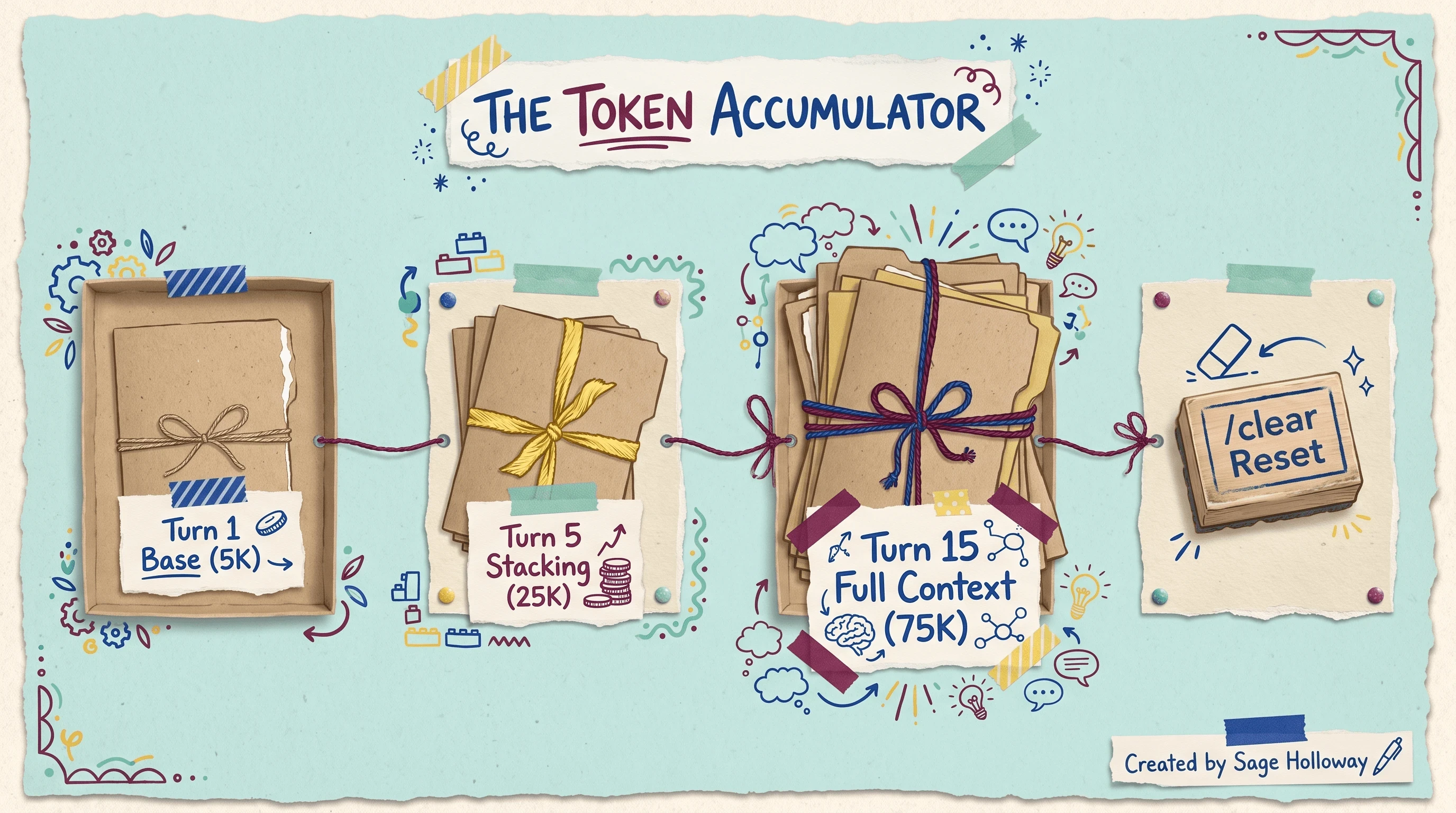
Because Claude Code re-sends conversation history and repo files on every turn, token costs compound unless reset with /clear.
The Pricing Math
On the Claude Console API, pricing is metered per million tokens (MTok). For Claude 3.7 Sonnet, standard rates are:
Input tokens: $3.00 per million tokens (or $0.003 per 1,000 tokens).
Prompt caching reads: $0.30 per million tokens (a 90% discount on cached input prefix tokens).
Output tokens: $15.00 per million tokens (or $0.015 per 1,000 tokens).
Let us model what this looks like across three distinct developer workload profiles:
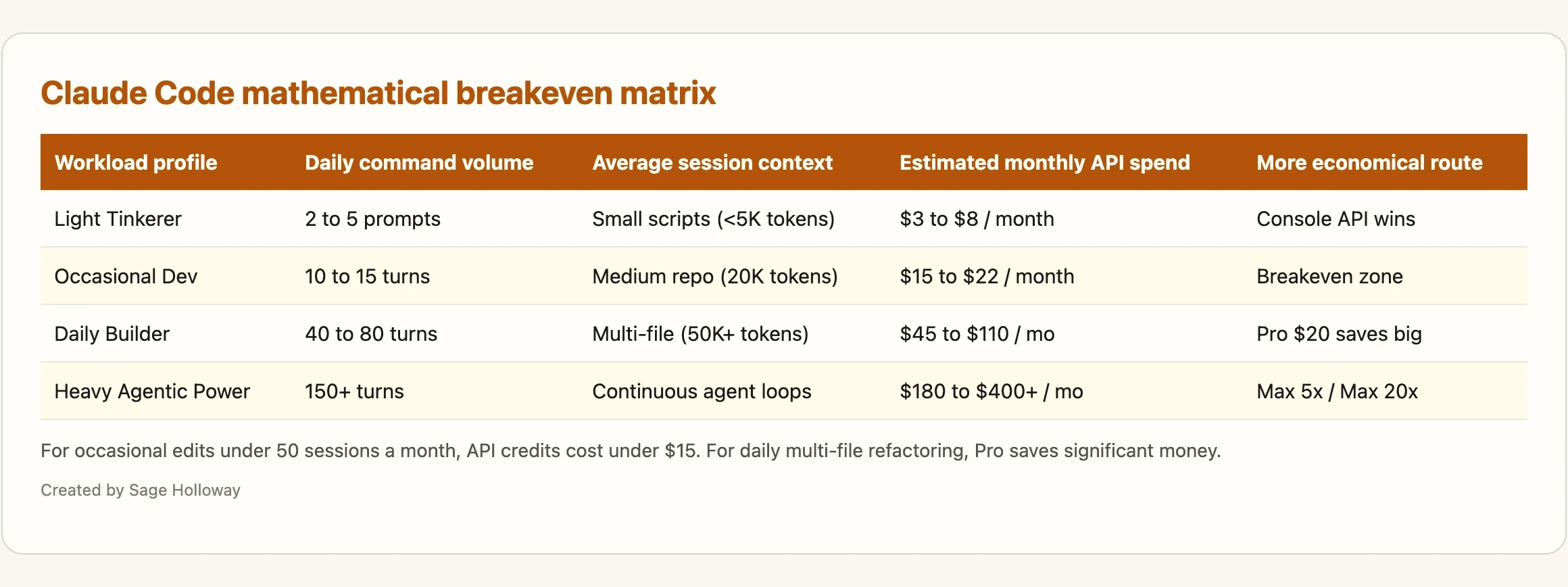
For occasional edits under 50 sessions a month, API credits cost under $15. For daily multi-file refactoring, Pro saves significant money.
The Light Tinkerer: You use Claude Code twice a week to write quick shell scripts, debug a single regex function, or inspect git diffs. Your sessions average under 10 turns. Your monthly API spend will typically sit between $3 and $8. Paying $20 for a monthly subscription is unnecessary; Console API pay-as-you-go is significantly cheaper.
The Daily Builder: You use Claude Code as your primary coding partner. You run 50 turns per day across multi-file TypeScript or Python projects. Because context accumulates on each turn, your daily API cost can easily reach $2.50 to $4.00. Over twenty working days, your Console bill would reach $50 to $80. Here, the $20 Claude Pro plan saves you substantial money.
The Heavy Agentic Team: You run autonomous loops that write full test suites and execute end-to-end refactors across large codebases. Your monthly token consumption exceeds 50 million tokens ($150+ on the API). A Claude Max 5x ($100) or Max 20x ($200) plan provides flat-rate cost certainty.
The Buffet Principle
Think of choosing your billing model the same way you evaluate dining at an all-inclusive hotel buffet versus ordering from an a la carte bistro menu.
If you only want a black coffee and a piece of toast on your way to an early train, paying for the full buffet is pure waste. You buy the coffee, pay the exact dollar amount on the receipt, and walk out.
But if you sit down for three hours, sampling six courses and asking the chef to prepare fresh omelets for the entire table, paying per plate will rapidly bankrupt you. You want the flat rate. You want to know that no matter how many plates cross the table, the bill at the door never changes.
The subscription does not buy you more intelligence; it buys you insurance against the cost of your own context.
Context Mitigation Techniques
If you choose to run on Console API credits, you can drastically reduce your monthly bill by adopting three disciplined habits:
Wipe Session Context with
/clear: When you finish debugging one function and move to an unrelated module, type/clear. This resets the accumulated conversation history while keeping your terminal session active, preventing stale file contents from inflating future prompt tokens.Pin Models with
/model: Use the/modelslash command to set Claude 3.7 Sonnet as your standard default for implementation and test writing. Reserve the heavier, more expensive Claude 3 Opus model for architectural planning sessions where deep reasoning is strictly necessary.Streamline
CLAUDE.md: Keep your project instructions concise. A 2,000-line markdown briefing file adds 3,000 tokens to every single turn. Trim it down to essential build commands, lint rules, and architectural constraints.
For in-depth strategies on handling memory and session history, consult our dedicated guide on Claude Code session management.
How to Configure and Decouple Auth Without Surprise Charges
One of the most frequent support issues developers face is accidental billing: expecting commands to draw from a $20 Claude Pro plan, only to discover their credit card on the Claude Console was charged fifty dollars for API tokens.
This happens because of Anthropic's strict Authentication Precedence Hierarchy.
If an ANTHROPIC_API_KEY environment variable is detected in your shell, Claude Code always gives it top priority. It silently ignores your browser subscription login and routes all token consumption to your Console account balance.
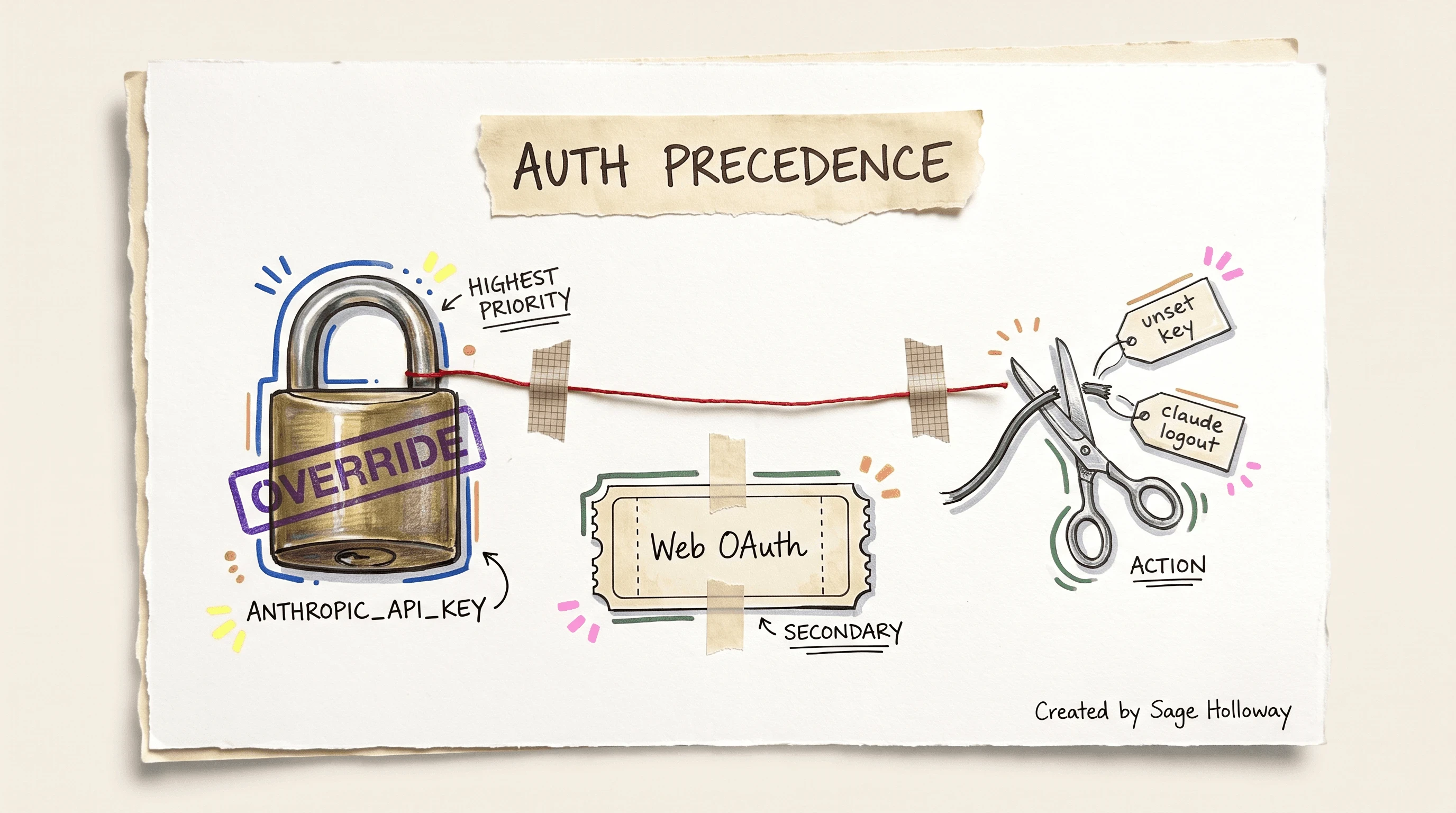
Setting ANTHROPIC_API_KEY automatically overrides web login. Unset the variable and run claude logout to prevent surprise API charges.
Follow this step-by-step procedure to configure your preferred billing route and safely decouple credentials.
Step 1: Install the Terminal CLI
Install the official Claude Code package globally using Node Package Manager (npm):
(Note: Never run this command with sudo. If you encounter permission errors on macOS or Linux, configure a user-level npm directory or use Node Version Manager.)
For complete operating-system-specific installation walkthroughs, see our guide on how to install Claude Code.
Step 2: Authenticate via Subscription (Pro or Max)
To use your $20 Pro plan or $100-$200 Max plan:
Ensure no API key variable is active in your terminal.
Launch the client:
A browser window will open at
claude.ai. Log in with your subscription credentials and grant authorization to the CLI.Return to your terminal. Your session is now authenticated against your flat-rate subscription quota.
Step 3: Switch to Console API Pay-As-You-Go
If you prefer to pay per token without a monthly subscription:
Obtain your API key from the Claude Console.
Export the variable in your current terminal session (on macOS or Linux):
(On Windows PowerShell, use $env:ANTHROPIC_API_KEY="sk-ant-api03-...")
Launch Claude Code:
The CLI will detect the environment variable and route all requests through your Console API credit balance.
Step 4: Safely Decouple and Revert to Subscription
If you previously used an API key and want to return strictly to your Pro subscription without risking accidental API charges:
Remove the active environment variable from your current shell:
Check your shell configuration files (
~/.zshrc,~/.bashrc, or system environment variables) and delete any persistentexport ANTHROPIC_API_KEYlines.Clear existing authentication tokens and re-establish your browser link:
When prompted by the CLI if your subscription quota runs out, decline any prompt to automatically enable API backup credits.
To verify your local configuration state, inspect your user configuration file located at ~/.claude.json on macOS/Linux (or %USERPROFILE%\.claude.json on Windows). Ensuring "hasCompletedOnboarding": true is present confirms your local profile is properly initialized.
Student and Academic Access: Institutional SSO vs. .edu Myths
A massive volume of search queries focuses on academic discounts: claude code for students, claude code student discount, and is claude free for college students.
Unfortunately, much of the advice circulating on student forums and TikTok is inaccurate. Let us establish the facts regarding academic access.

Individual .edu emails do not unlock free Pro plans. Campus-wide SSO agreements and the GitHub Student Pack provide real access.
The .edu Reality Check
Anthropic does not offer an individual, self-serve student discount verified through SheerID or UNiDAYS.
Signing up for a personal account at claude.ai using an academic email address ending in .edu, .ac.uk, or .edu.au will not automatically discount your subscription. You will be billed the standard $20 per month for Claude Pro. Any website advertising a secret "50% off student promo code" for individual Claude Pro accounts is promoting unverified referral links or scam coupon aggregators.
Institutional Claude for Education
While individual discounts do not exist, free academic access does exist through Claude for Education.
Claude for Education is an enterprise-level institutional licensing program deployed directly by university IT departments. Participating institutions (such as Northeastern University, Columbia University, and the London School of Economics) provide enrolled students, faculty, and researchers with sponsored Claude accounts authenticated via campus Single Sign-On (SSO).
Key elements of Claude for Education include:
Campus-Funded Access: The university covers the licensing cost. Enrolled students log in through their university identity portal at zero individual cost.
Enterprise Privacy Standards: Student prompts and submitted codebase files are strictly excluded from Anthropic model training pipelines.
LMS Integrations: Institutional deployments often integrate directly with learning management systems like Canvas.
Terminal CLI Considerations: Because Claude for Education is managed under institutional security policies, campus IT administrators can selectively restrict raw API key generation or external CLI terminal access. If your university provides Claude for Education, verify with your campus computing helpdesk whether command-line developer tools are enabled on your account profile.
Watch Anthropic's official announcement detailing the Claude for Education institutional framework:
https://www.youtube.com/watch?v=MIzq6LCMTtA Caption: Watch Anthropic explain how Claude for Education deploys through university enterprise SSO rather than individual student discounts.
Alternative Academic Pathways
If your university does not participate in Claude for Education, you have two legitimate options to reduce costs:
The GitHub Student Developer Pack: While the pack does not grant a direct Claude Pro license, it provides free access to GitHub Copilot, which includes access to Claude 3.5 Sonnet and Claude 3.7 Sonnet models within supported IDE extensions.
Prepaid API Budgeting: Instead of paying $20 every month during exam periods or summer breaks, use a Console API key funded with a modest $5 or $10 deposit. This allows you to complete coursework projects while paying only for active terminal turns.
For a comprehensive breakdown of academic setups, read our dedicated Claude student discount guide.
Free and Subsidized Paths: Trials, Credits, and Open Source Grants
If you are looking for legitimate, verified methods to access Claude Code without paying full retail subscription rates, several official programs exist.
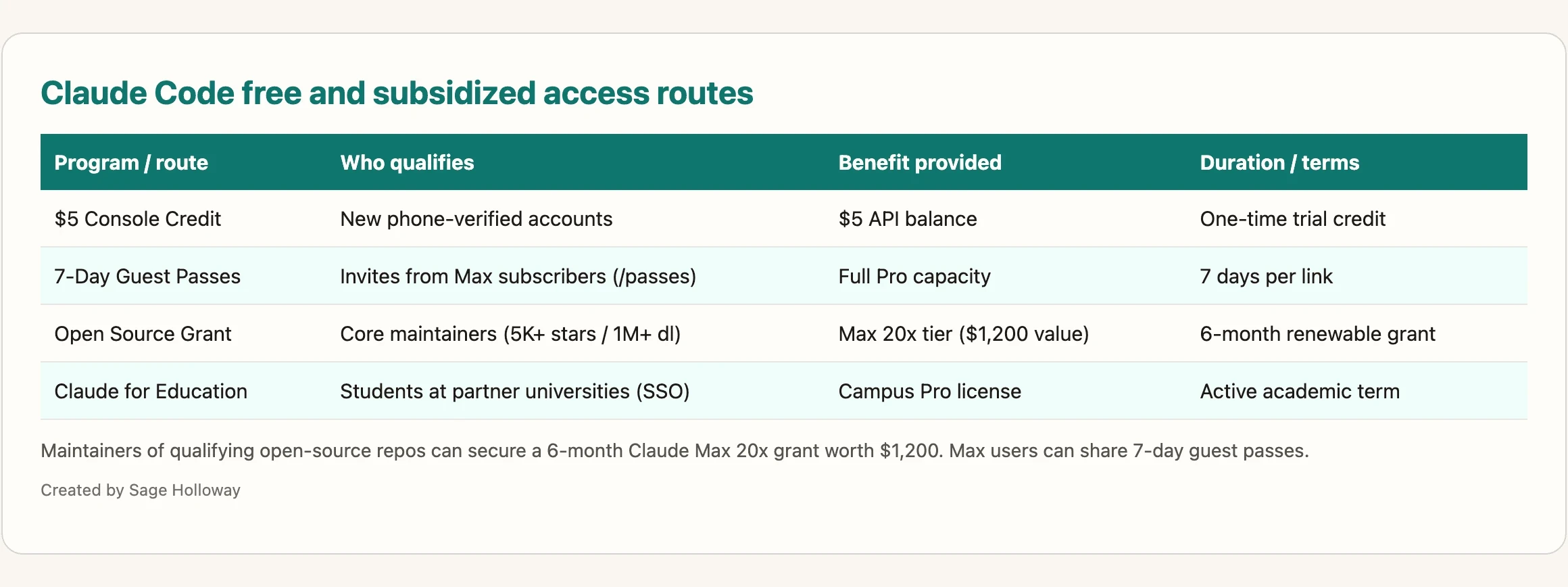
Maintainers of qualifying open-source repos can secure a 6-month Claude Max 20x grant worth $1,200. Max users can share 7-day guest passes.
The $5 Console Sign-up Credit
Every newly registered developer account on the Claude Console receives a one-time promotional credit of approximately $5 upon completing mobile phone verification.
Because input tokens with caching cost only thirty cents per million tokens, a $5 credit provides substantial runway for initial testing. It is sufficient to run dozens of terminal sessions, initialize workspaces with /init, and test multi-file refactoring on small-to-medium codebases without entering credit card billing details.
The 7-Day Guest Pass System
If you know a colleague, team lead, or community member who subscribes to Claude Max ($100 or $200 tier), they have access to the /passes feature inside Claude Code.
By running /passes, a Max subscriber can generate up to three claimable 7-day Guest Pass referral links. When claimed, a Guest Pass activates 7 days of full, unrestricted Pro-equivalent access on your personal Anthropic account, allowing you to test the complete terminal workflow before committing to a paid plan.
The Claude for Open Source Maintainer Grant
For active open-source software maintainers, Anthropic runs the Claude for Open Source sponsorship program.
This program awards qualifying open-source developers six months of free access to the highest-tier Claude Max 20x plan, representing an estimated retail value of $1,200.
To qualify for an Open Source Maintainer Grant, your project must meet specific criteria:
You must be a lead maintainer or core contributor of an active, publicly accessible repository licensed under an OSI-approved open-source license.
The project must demonstrate significant community adoption, typically defined as having over 5,000 GitHub stars, more than 1 million monthly downloads on package registries (npm, PyPI, Crates.io), or acting as a critical dependency in major software ecosystems.
Applications are reviewed through Anthropic's developer relations portal, and grants can be renewed upon expiration if the project remains active.
For application templates and eligibility checklists, see our complete Claude Open Source Max Grant guide.
Local Models and Third-Party Proxies: Free Alternatives with Tradeoffs
A subset of developers seeks zero-cost operation by repointing Claude Code away from Anthropic's cloud infrastructure toward local open-weight language models or third-party API proxies.
Community projects like Alishahryar1/free-claude-code and open-source proxies (such as Spectre Proxy) allow developers to redirect CLI traffic to local runtime engines like Ollama, LM Studio, or llama.cpp.
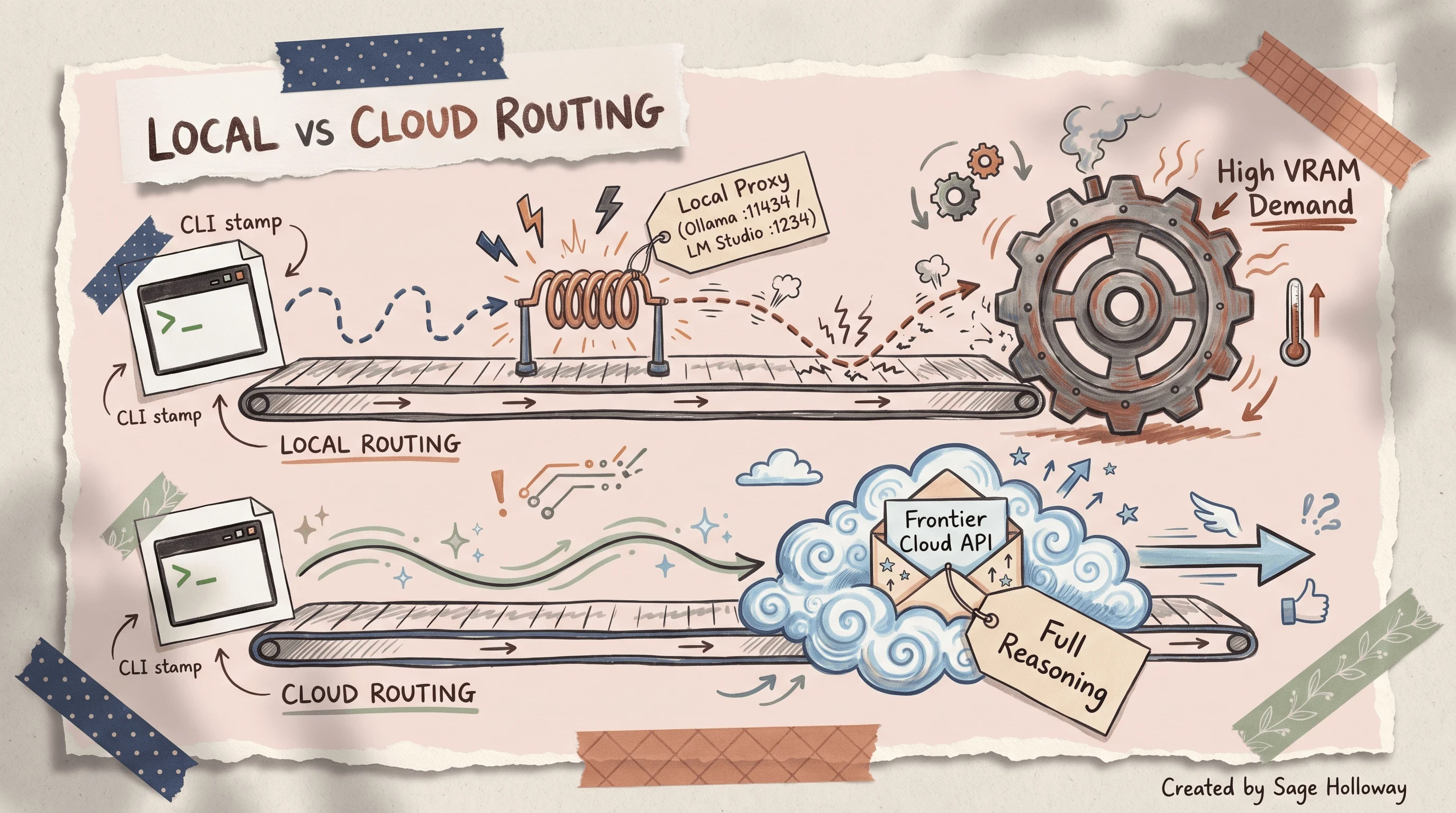
Local models run without API fees but require heavy VRAM and offer lower agentic reasoning compared to native cloud models.
How Local Redirection Works
To connect Claude Code to a local backend, developers typically configure local endpoint variables:
Ollama Default Endpoint:
http://localhost:11434LM Studio Default Endpoint:
http://localhost:1234/v1llama.cpp Default Endpoint:
http://localhost:8080/v1
When coupled with custom configuration files that set "hasCompletedOnboarding": true in ~/.claude.json to bypass standard web login dialogs, the CLI sends its structured tool calls and code analysis prompts to locally running models like Qwen 2.5 Coder or DeepSeek R1.
The Honest Technical Reality Check
While running locally eliminates recurring subscription fees and token charges, you must be prepared for severe operational tradeoffs:
Hardware and VRAM Demands: Autonomous coding agents require models with deep reasoning capabilities (typically 32-billion parameters or larger) to understand multi-file architectures. Running these models locally requires substantial dedicated video memory (VRAM), generally necessitating an NVIDIA GPU with 24GB+ VRAM or an Apple Silicon Mac with 64GB+ unified memory.
Execution Latency: Local inference on consumer hardware generates tokens significantly slower than cloud data centers. In a multi-turn agent loop where Claude Code reads ten files, runs a linter, and writes three diffs, a local model may take several minutes to complete a sequence that cloud Sonnet resolves in fifteen seconds.
Agentic Reasoning Degradation: Smaller open-weight models frequently struggle with strict JSON tool-calling schemas and complex dependency graphs. They are prone to getting trapped in recursive repair loops, hallucinating command arguments, or corrupting file diffs during multi-stage refactoring tasks.
Security and Maintenance Risks: Community-hosted token pools and unofficial reverse proxies often require trusting unverified SSL certificates or routing code through third-party servers. For proprietary or sensitive codebases, routing data through untrusted community proxies introduces unacceptable security risks.
For casual experimentation on personal hobby scripts, local models provide an educational playground. For professional software engineering where developer time is the most expensive variable, first-party cloud models remain far more efficient.
If you are comparing terminal agents against dedicated AI code editors, read our head-to-head analysis of Claude Code vs Cursor.
Frequently Asked Questions
How much does Claude cost?
Claude pricing spans five primary tiers: Free web access ($0), Claude Pro ($20 per month), Claude Max 5x ($100 per month), Claude Max 20x ($200 per month), and pay-as-you-go Claude Console API billing. On the Console API, Claude 3.7 Sonnet costs $3.00 per million input tokens ($0.30 per million cached input tokens) and $15.00 per million output tokens. Claude 3 Opus costs $15.00 per million input tokens and $75.00 per million output tokens.
Is Claude free for students?
No, Claude is not free for students by default, and Anthropic does not offer individual student discounts for personal accounts. However, students whose colleges or universities have deployed Claude for Education receive free, sponsored access through their institutional Single Sign-On (SSO) login. Students can also access Claude models at no cost by leveraging the GitHub Student Developer Pack with GitHub Copilot.
Is Claude free for college students?
Individual college students cannot obtain a free Claude Pro account simply by signing up with a .edu email address. Free access is only available if your specific university has established an enterprise campus agreement under the Claude for Education program. If your college is not enrolled, you can test Claude Code using the $5 new-account Console credit or utilize pay-as-you-go API keys to control your budget.
Is Claude Pro worth it?
Claude Pro is worth the $20 monthly cost if you write software daily or frequently perform multi-file code refactoring. Because Claude Code transmits codebase context on every prompt, pay-as-you-go API bills for daily developers often reach $40 to $80 per month, making the $20 flat subscription far more economical. For casual users who code once or twice a week, pay-as-you-go API credits are cheaper than a recurring subscription.
Can I use my Claude Console API key instead of a Claude Pro subscription?
Yes. Claude Code natively supports pay-as-you-go API billing without requiring a Claude Pro subscription. By exporting the ANTHROPIC_API_KEY environment variable in your terminal, Claude Code will authenticate directly with your Claude Console account and bill your token consumption at standard API rates.
Does Claude Pro officially include access to Claude Code?
Yes. Access to the Claude Code terminal agent is an officially included feature of Claude Pro ($20/month) and Claude Max ($100-$200/month) plans. While Anthropic ran a brief A/B test in April 2026 that temporarily omitted Code for 2% of new signups, that test was quickly reverted, and full access was restored for all Pro subscribers.
What happens when I hit my subscription's usage limits inside Claude Code?
When you exhaust your subscription quota within a 5-hour rolling window, Claude Code will pause and inform you when your limit will reset. You can either wait for your sliding window to refill, or choose to supply a Claude Console API key to continue working on pay-as-you-go credits without interruption.
How can I prevent Claude Code from charging my API card balance when my subscription runs out?
To prevent unexpected API billing, decline any prompt from the CLI offering to enable pay-as-you-go usage credits when your limit is reached. Additionally, remove any active ANTHROPIC_API_KEY environment variables from your shell configuration files and run claude logout followed by claude login to ensure the tool authenticates strictly via your browser subscription session.
Can I use Claude Code for free through the Claude for Open Source program?
Yes. Lead maintainers and core contributors of qualifying public open-source projects (typically repositories with 5,000+ GitHub stars or 1M+ monthly downloads) can apply for the Claude for Open Source program. Approved applicants receive six months of free Claude Max 20x access ($1,200 retail value), which includes top-tier Claude Code priority capacity.
The landscape of AI developer tooling is moving toward automated, multi-agent workflows that run dozens of file inspections and test commands in the background. As these autonomous loops become standard practice, understanding the economics of context consumption will be just as essential as knowing how to write an effective prompt.
If you are just getting started, do not rush into a $200 subscription before you have calibrated your actual usage. Claim your $5 new-account Console credit, initialize your repository with /init, and measure how many tokens your typical workflow consumes over a three-day sprint. Let your real command volume dictate your billing model.
Until then...
Sage
PS. A colleague spent four hours last Tuesday trying to figure out why his terminal agent kept failing with rate-limit errors while his browser chat worked perfectly. He had set an old test API key in his .bashrc seven months ago and completely forgotten it was overriding his brand new Pro subscription. Check your shell variables before you blame the servers.
Author
Practical guides, tool teardowns & AI engineering workflows.


