AI Watermarks
Does Claude Leave a Watermark? How Anthropic's Text Marking Actually Works

Sage Holloway
18 min read
Go back to blog
SHARE

Something changed in the words Claude hands you this month, and you cannot see it, hear it, or copy it out. It rides along in every reply, invisible to you and to whoever you send it to, until someone with the right key decides to check. That is not a rumor. That is the current state of the model you use every day.
You paste four lines of Claude's output into a file, save it, and run git diff. The terminal shows a change on a line you never touched. You revert it, run the diff again, and the phantom change comes back. Nothing looks different when you read the text out loud. Something is different, and your editor cannot show you what.
If you went looking for an explanation, you probably found two competing stories. One says Claude has never carried any kind of mark, so there is nothing to worry about. The other says a handful of hidden characters explain everything, and a browser tool will strip them clean for you. Neither one describes what actually shipped inside Claude on August 2, 2026, when Anthropic began embedding a genuine, statistical watermark to satisfy Article 50 of the EU AI Act. So does Claude leave a watermark? Yes, as of that date, and the mechanism is stranger and more durable than either story above.
Here is the direct answer, stated as flatly as the sources allow. Claude models launched on or after August 2, 2026 embed an invisible statistical watermark in every eligible text response, built to satisfy Article 50 of the EU AI Act. Instead of hiding characters inside the text, it uses a version of Google DeepMind's SynthID-Text approach to quietly bias which words the model reaches for, a pattern no reader can see but a keyholder can check. Copy-paste carries it along. Heavy rewriting degrades it. Exact answers, math, and code mostly do not carry it at all.
Here is where the rest of this guide goes:
Why Anthropic flipped this switch in August 2026, and which models are actually covered.
How the SynthID-Text approach alters word choice, explained without the math degree.
The one distinction almost nobody online gets right: invisible Unicode junk versus the real statistical mark.
When the watermark does not apply, or gets destroyed by editing.
Why a watermark check and a generic AI detector are not the same test, even though people use the words interchangeably.
What broken git diffs, failing linters, and SQL errors actually have to do with any of this.
How Claude's approach stacks up against ChatGPT and Gemini, without inventing claims we cannot back.
What removing a mark could cost you, legally, if you are the one who scrubs it.
Why Anthropic started watermarking Claude's text in August 2026
The EU AI Act Article 50 trigger
Article 50 of the EU AI Act requires providers of general-purpose AI systems to make AI-generated content machine-readably detectable. That is regulatory language for a simple idea: somewhere in the output, there has to be something a machine can check, even if a person never notices it. Anthropic's own documentation confirms this is the trigger, stating that Claude models launched on or after August 2, 2026 support machine-readable marking at launch.
Here is the part that surprises people: this is not a Europe-only feature that quietly turns off if you are logged in from Ohio. Anthropic applied the watermark at the model level, globally, rather than building a separate EU-flagged version of Claude. Legal writer Stephen Smith makes this point directly in his analysis of the rollout, arguing that the shift isn't only a Europe thing precisely because shipping two different models for two different jurisdictions would have been the harder engineering problem. One watermarking behavior, applied everywhere, is simpler to build and simpler to audit.
Which models are watermarked from launch vs grandfathered
Not every Claude response you have ever received carries this mark, and the cutoff is a specific date rather than a vague "recent models" hand-wave.
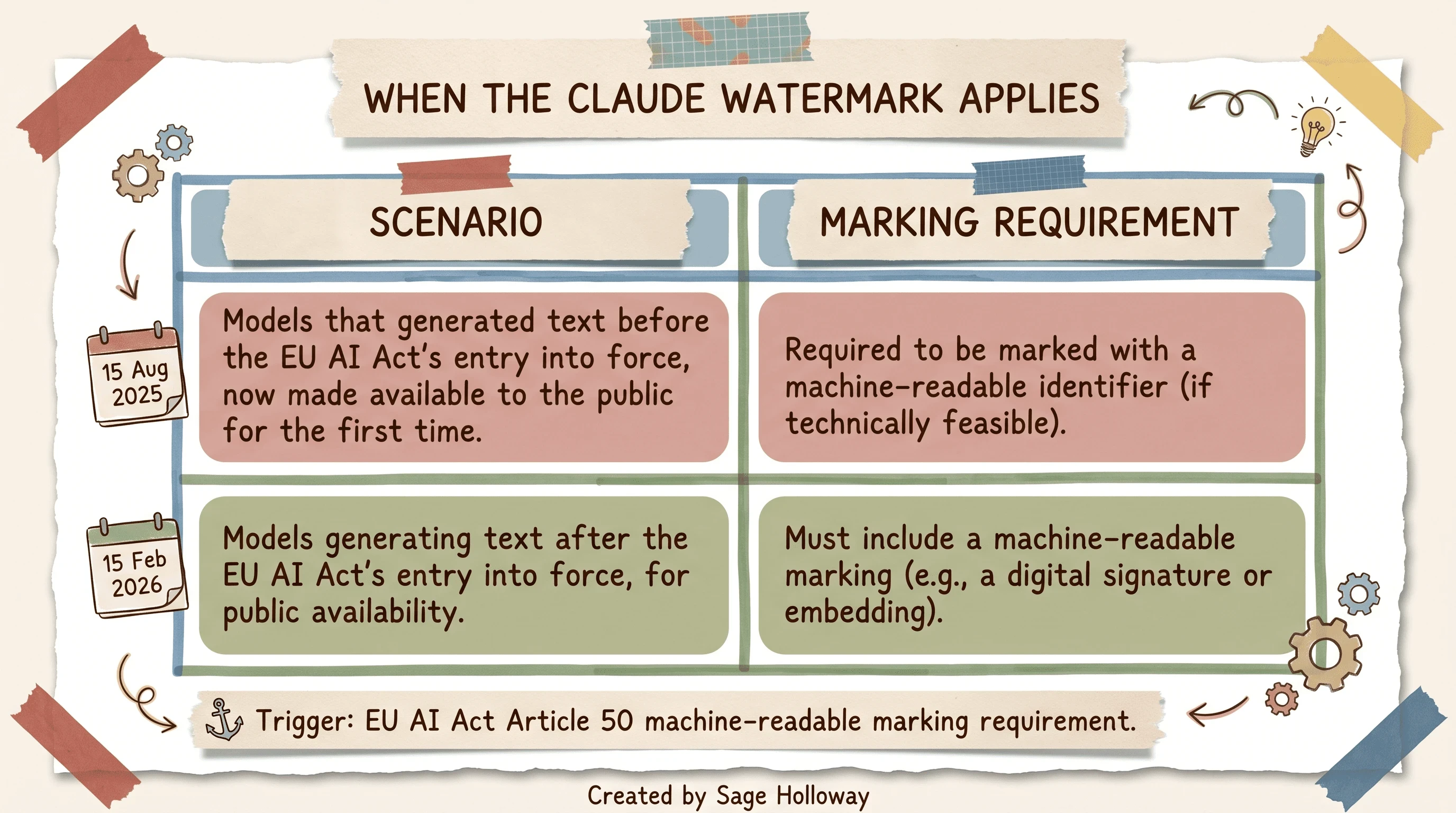
Models launched on or after August 2, 2026 carry the watermark from day one; older models have until December 2, 2026.
Any Claude model that launched on or after August 2, 2026 ships with watermarking active from the moment it goes live. Models that were already on the market before that date got a grace period instead of an instant flip. According to Smith's sourced framing, models already in the wild have until December 2, 2026 to add support. That four-month gap matters if you are trying to figure out whether something a colleague generated last spring could plausibly carry a mark at all. If the model predates the rollout and the December deadline has not passed, the honest answer is: it depends on exactly when that model added support, and you should not assume either way.
How Claude's statistical watermark actually works
The SynthID-Text approach in plain terms
Picture a board game where every player rolls two physical dice to move around the track. The outcome is genuinely random. Nobody, not even the game's designer, can predict where you will land before you roll. Now imagine a second version of the same game, where instead of dice, each player reads the next unused digit from a printed book of Pi. The sequence of digits looks exactly as random and unpredictable as a dice roll to anyone watching. But it is not random at all.
It is fixed, reproducible, and if you know which page of the book a player started on, you can verify every move they made afterward.
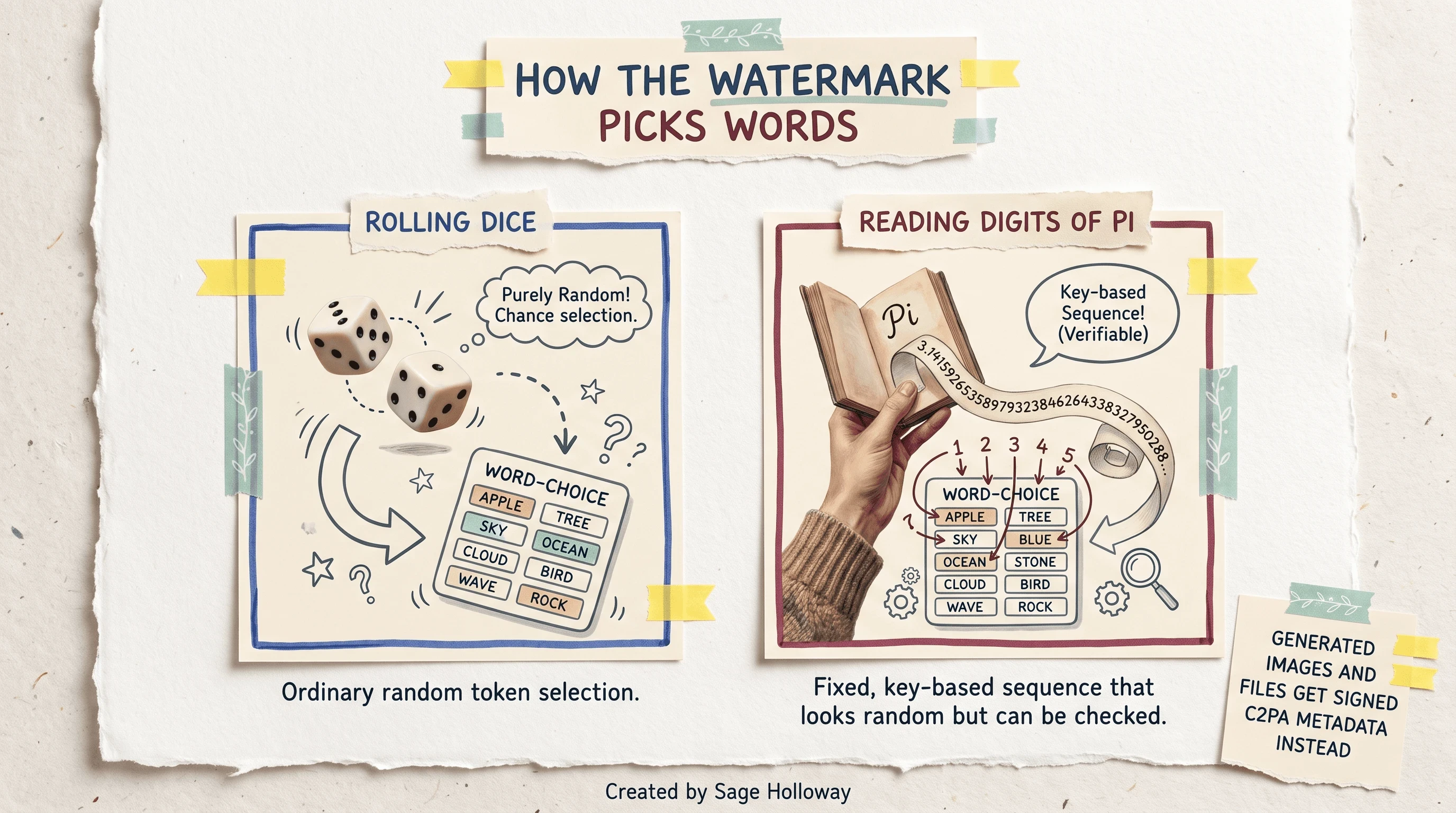
Normal generation rolls dice for each word. The watermark reads a fixed, key-based sequence that looks random but can be checked.
Video explainer: How Claude and SynthID's statistical text watermarking actually biases word choice under the hood.
That second version is the closest everyday picture of Claude's watermark, and it is Anthropic's own comparison, not a stretch on my part. Claude's text watermark is a version of Google DeepMind's SynthID-Text approach, and instead of picking each next word through ordinary randomness, the model uses a secret key to steer that choice along a fixed, checkable sequence, one that still reads as completely natural prose. Nothing gets inserted into the text. There are no extra characters, no invisible tags, no metadata riding along in the file. The claude watermark lives entirely in which synonym, phrasing, or sentence structure the model happened to prefer, thousands of tiny decisions per response, each one nudged just enough to be checkable later without ever being detectable by a human reader.
What it costs in speed, price, and quality
You would expect a system layered on top of every single word choice to slow things down or cost more. It does not, at least according to Anthropic's own numbers. The company states plainly that watermarking has a negligible impact on the speed of models, and because the process produces no extra tokens, the model costs exactly the same to serve. I went into the sourced material expecting a tradeoff worth flagging. There isn't one, at least not one Anthropic has disclosed, and that absence of a tradeoff is itself worth noting, because most engineering decisions this invisible usually cost somebody something.
What happens to generated files and images
Text is not the only thing Claude can produce, and images do not get the SynthID-Text treatment because pixels do not have "word choices" to bias. Instead, when Claude generates a supported file type such as an .svg, .png, or .jpg, it attaches cryptographically signed provenance metadata that follows the open C2PA standard, the Coalition for Content Provenance and Authenticity. That metadata records where the file came from and travels with the file itself, separate from anything happening in the text.
The two things people confuse: invisible Unicode characters and the statistical watermark
This is the section most guides skip, and it is the one that actually explains why your git diff broke while your English professor's plagiarism scanner found nothing at all.
What "watermark remover" tools actually strip
A whole category of sites, several of them ranking for searches about Claude watermarks right now, promise to detect and remove Claude's watermark by scrubbing invisible Unicode characters, things like the zero-width space (U+200B) or the zero-width joiner. These characters are real. They genuinely show up in AI-generated text sometimes, and they genuinely cause the problems described later in this guide. What these tools get wrong is the claim that scrubbing those characters removes Anthropic's actual watermark. It does not, because that is not where the watermark lives.
Why stripping Unicode does nothing to the SynthID signal
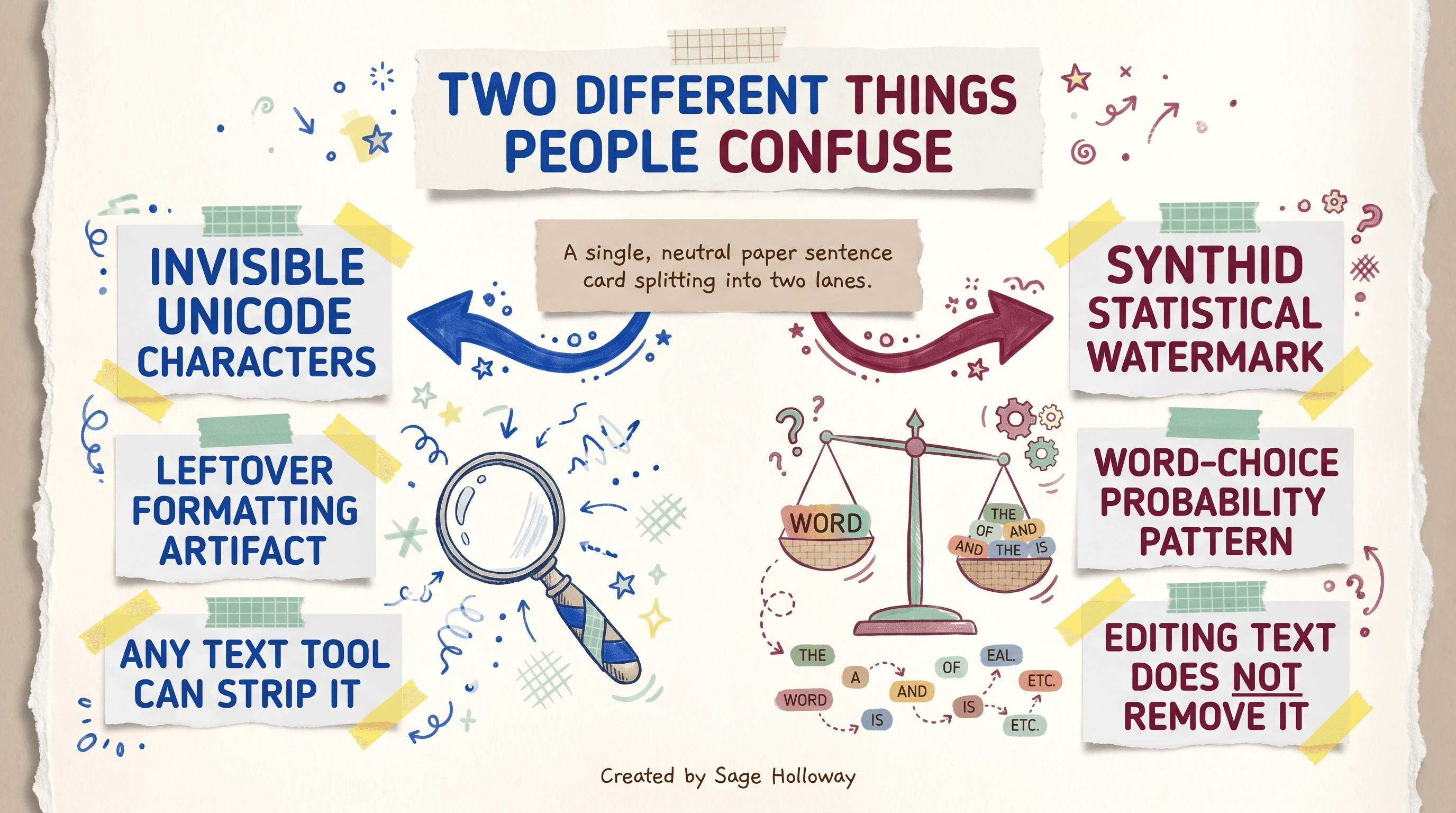
Removing a Unicode character and defeating the statistical watermark are two different problems.
Anthropic states this about as directly as a company can: its SynthID-based watermark has no hidden characters at all. The invisible zero-width spaces that remover tools hunt for are leftover formatting artifacts, the kind of thing that can slip in during copying, publishing pipelines, or training data cleanup. They sit at the character level. The real watermark sits at the level of which words got picked in the first place, a pattern baked into the actual sequence of language, not a stray byte tucked between two letters. Running every character-stripping tool on the internet against a watermarked paragraph would leave the statistical pattern completely intact, because you cannot delete a decision that already happened by deleting a character that came along for an unrelated ride.
The mark was never trying to catch you in the act. It was built to survive the argument about whether it exists at all, which is exactly why deleting a few bytes cannot touch it.
Side-by-side comparison table
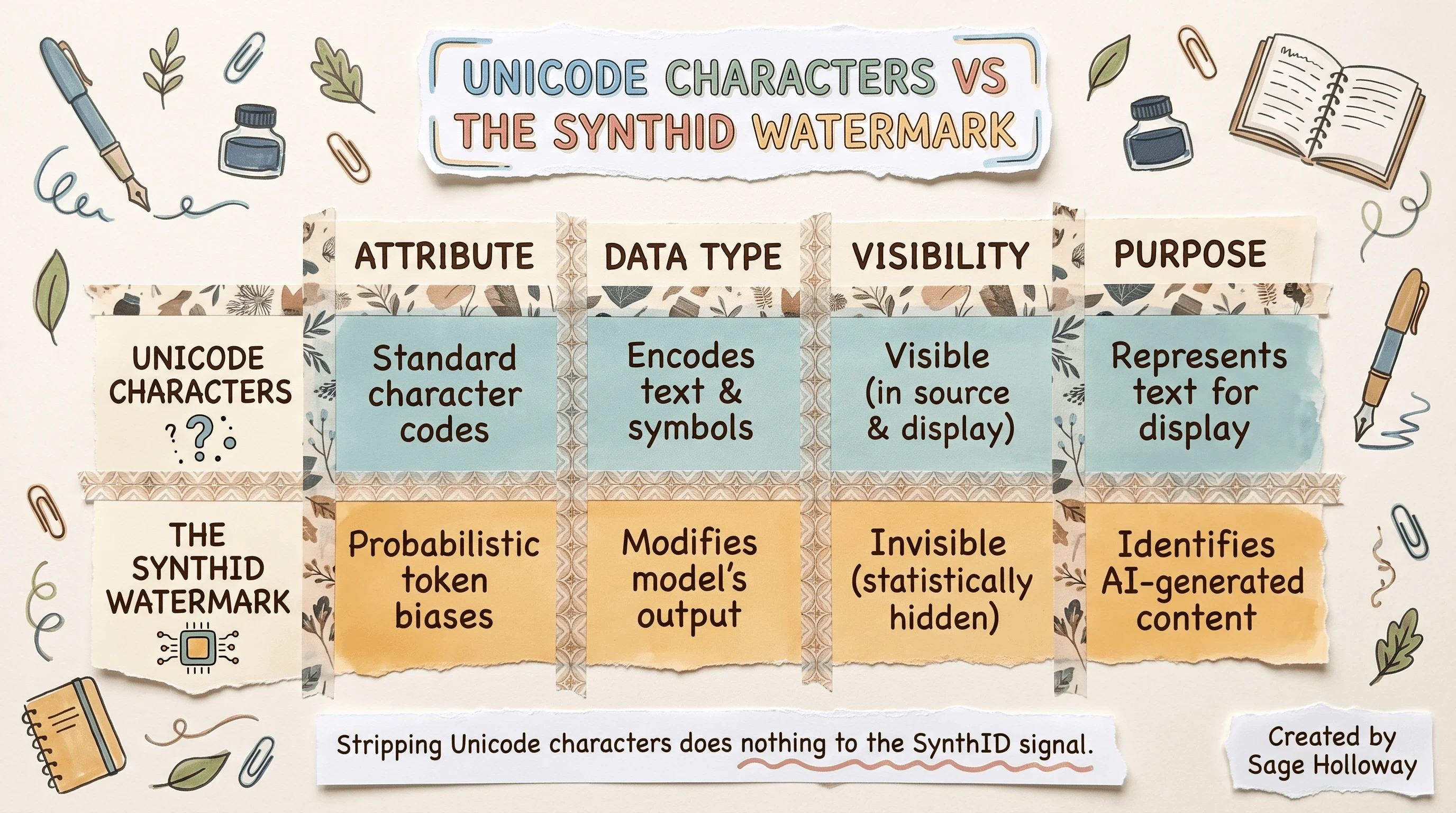
Unicode characters are formatting leftovers. SynthID is Anthropic's real, intentional watermark.
Put plainly: if a tool's entire pitch is "removes hidden characters," it is solving a real but unrelated problem, one worth fixing for your git history, but not one that touches the statistical mark you actually asked about.
When the watermark does not apply or gets destroyed
The watermark is not applied uniformly to every word Claude ever generates. It needs room to operate, and some kinds of text simply do not offer any.
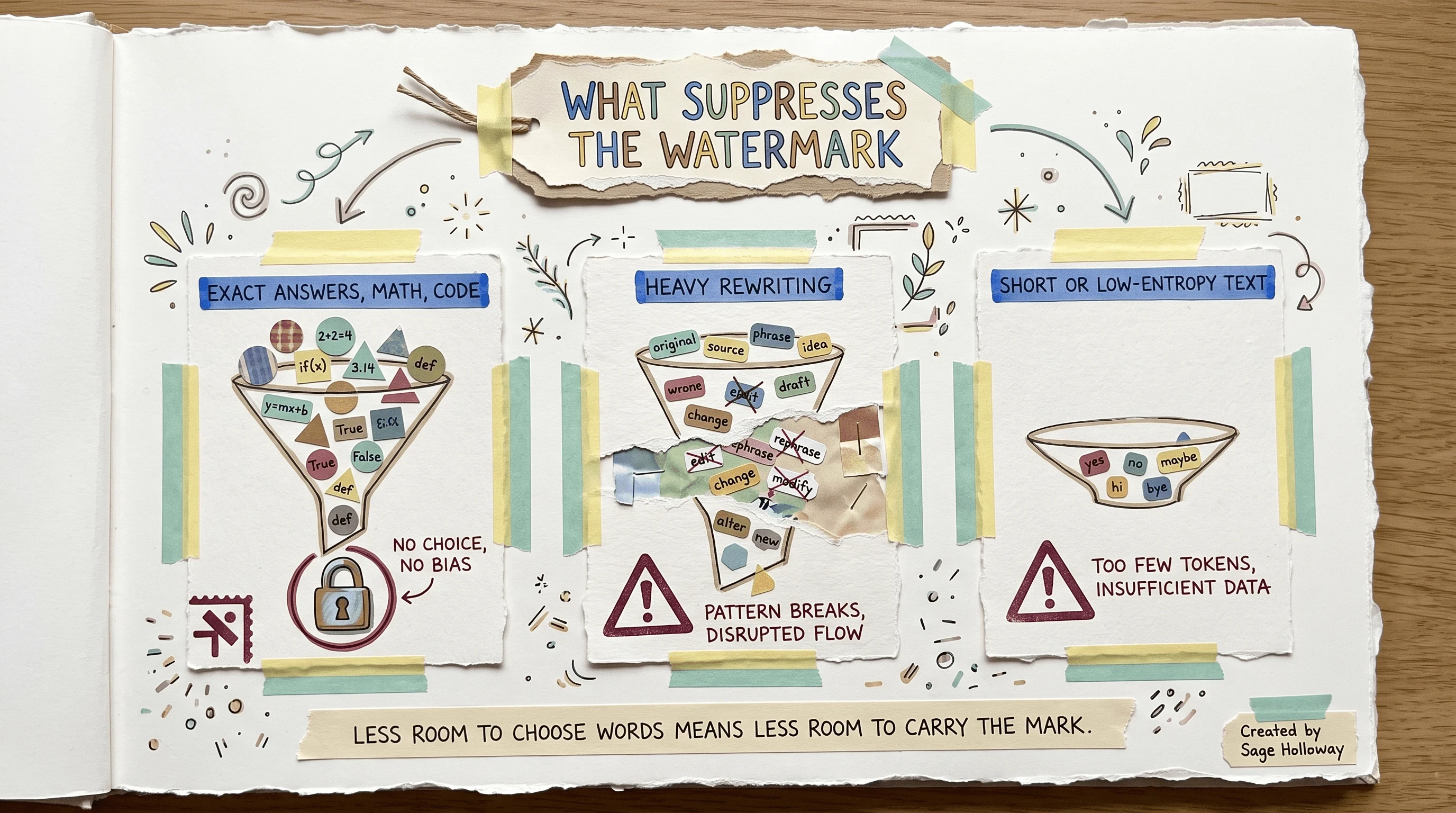
Less room to choose words means less room to carry the watermark.
Exact answers, math, and code that suppress the pattern
Watermarking works by nudging the model toward one acceptable word over another acceptable word. But some outputs do not have acceptable alternatives. Anthropic explains that where an exact output is required, where there isn't a choice, and something would be factually wrong or a piece of code would break if a different term were chosen, the watermark isn't applied. A factual date, a specific variable name, a working line of code: none of these have room for a synonym swap, so there is no probability distribution left to bias. The watermark simply has nothing to attach to.
How much editing it takes to break the signal
Light editing does not erase the mark. Copying a paragraph, fixing a typo, or reformatting a bulleted list leaves the underlying word-choice pattern mostly intact, because the majority of the original words survive untouched. Substantive rewriting is a different story. Once you have replaced enough of the actual word choices with your own, the statistical signal that depended on those specific choices degrades, and eventually disappears. The sourced material does not hand us a single, universal percentage where this tips over, and I am not going to invent one just to sound precise. What the evidence does support is the general shape: the more of the sentence structure and vocabulary that is genuinely yours, the less of the original pattern survives to be checked.
Short outputs and low-entropy text
A one-sentence reply carries far fewer word-choice decisions than a three-page report, which means it carries far less statistical signal to begin with. Low-entropy text, meaning text where the range of plausible next words is already narrow, behaves the same way. A greeting, a yes-or-no answer, a list of ingredient measurements: none of these give the watermark much to work with, watermark or no watermark.
Watermark detection vs generic AI-writing-style detectors
People use "AI detector" to mean at least two completely different tests, and mixing them up is where most of the internet's confusion about Claude actually comes from.
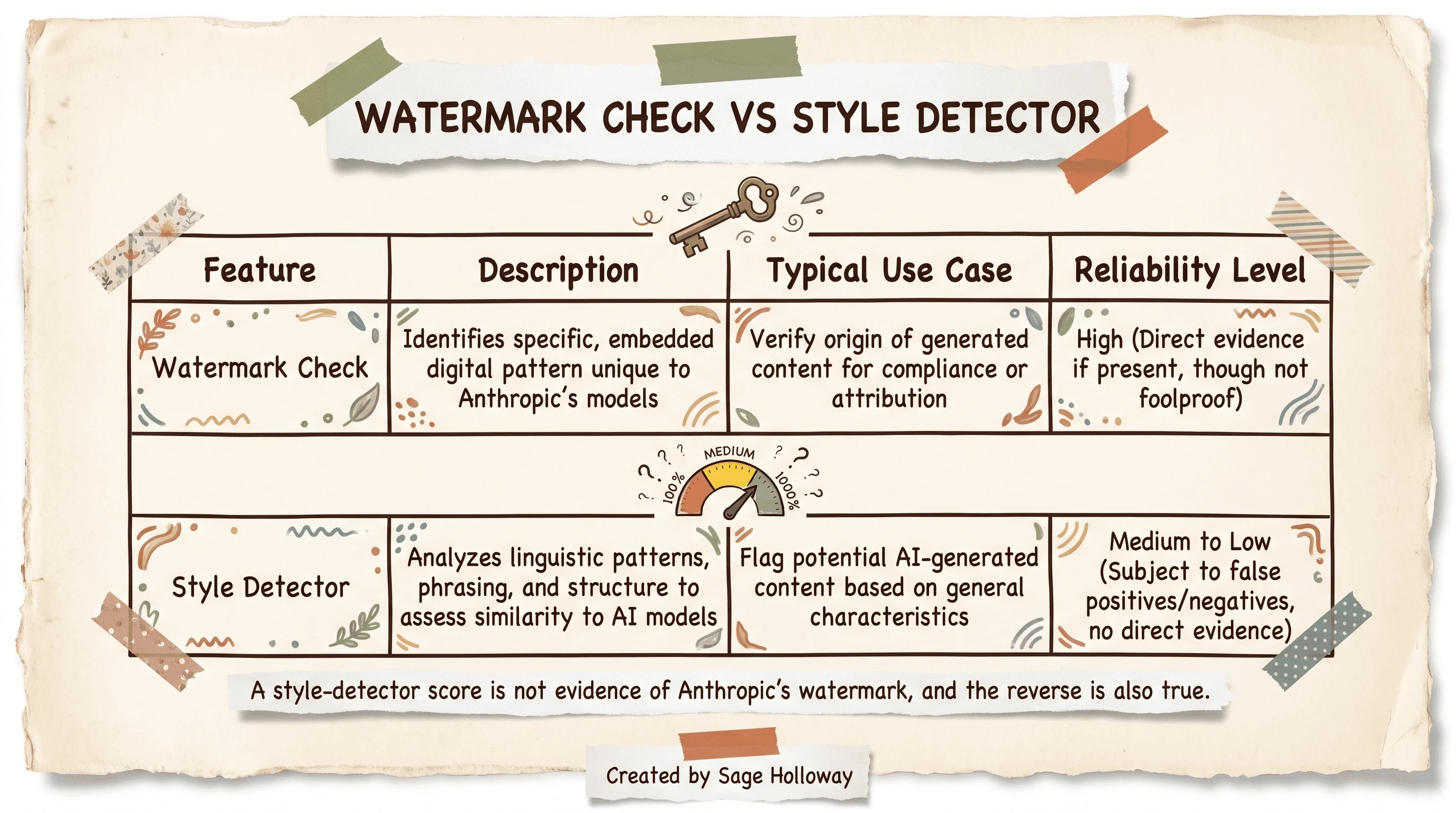
A watermark check is binary pass/fail. A style detector is a probability guess.
What a statistical watermark check actually verifies
A genuine watermark check asks one narrow question: does this text match Anthropic's key-based token pattern strongly enough to count as a hit? Legal analyst Stephen Smith describes the current state of this test plainly, noting that detection as described today is binary. It checks whether text carries a mark. It does not report a proportion, does not tell you which passages, and does not hand anyone a percentage. That is a much narrower claim than most people assume a "watermark detector" makes.
Why style-based detectors are a different test
Tools like GPTZero or Turnitin are not running Anthropic's watermark check at all. They are measuring writing style, things like sentence-length variance and how predictable each word is given the words before it, and inferring a probability that a human versus a model wrote the passage. A style detector can flag entirely human writing as suspicious if it happens to read smoothly and consistently. It can also miss AI-assisted text that has been heavily rewritten by a person. Neither failure mode has anything to do with whether Claude's actual watermark is present. They are separate instruments measuring separate things, and treating a style-detector score as proof about Anthropic's watermark, or the reverse, is a category error every time.
Why there is no public Claude watermark checker yet
If you have gone looking for an official, standalone tool where you paste in text and get a real answer about Anthropic's watermark, you will not find one yet. Anthropic is developing a watermark detection API, but the sourced material does not give a confirmed release date, and I am not going to guess one. If you want the fuller picture across text, images, audio, and video, and across more than one provider, we cover the whole landscape in how to detect AI watermarks without fooling yourself, including how to avoid the exact style-versus-statistical mixup described above.
What broken git diffs and failing linters actually mean for developers
This is the section almost nobody writing about Claude watermarks actually addresses, and if you are a developer, it is probably the reason you are here.
Where the zero-width characters come from
Remember the invisible Unicode characters from earlier, the ones that are not the real watermark? They are still real, and they are still a genuine source of pain if you work with code. When you copy Claude's output directly from a chat interface into a file, occasional zero-width characters, artifacts of formatting and training rather than an intentional mark, can ride along invisibly inside the pasted text. Your terminal will not show them. Your eyes will not catch them. Your tools absolutely will.
Fixing git diff, ESLint/Prettier/Black, and SQL insert failures
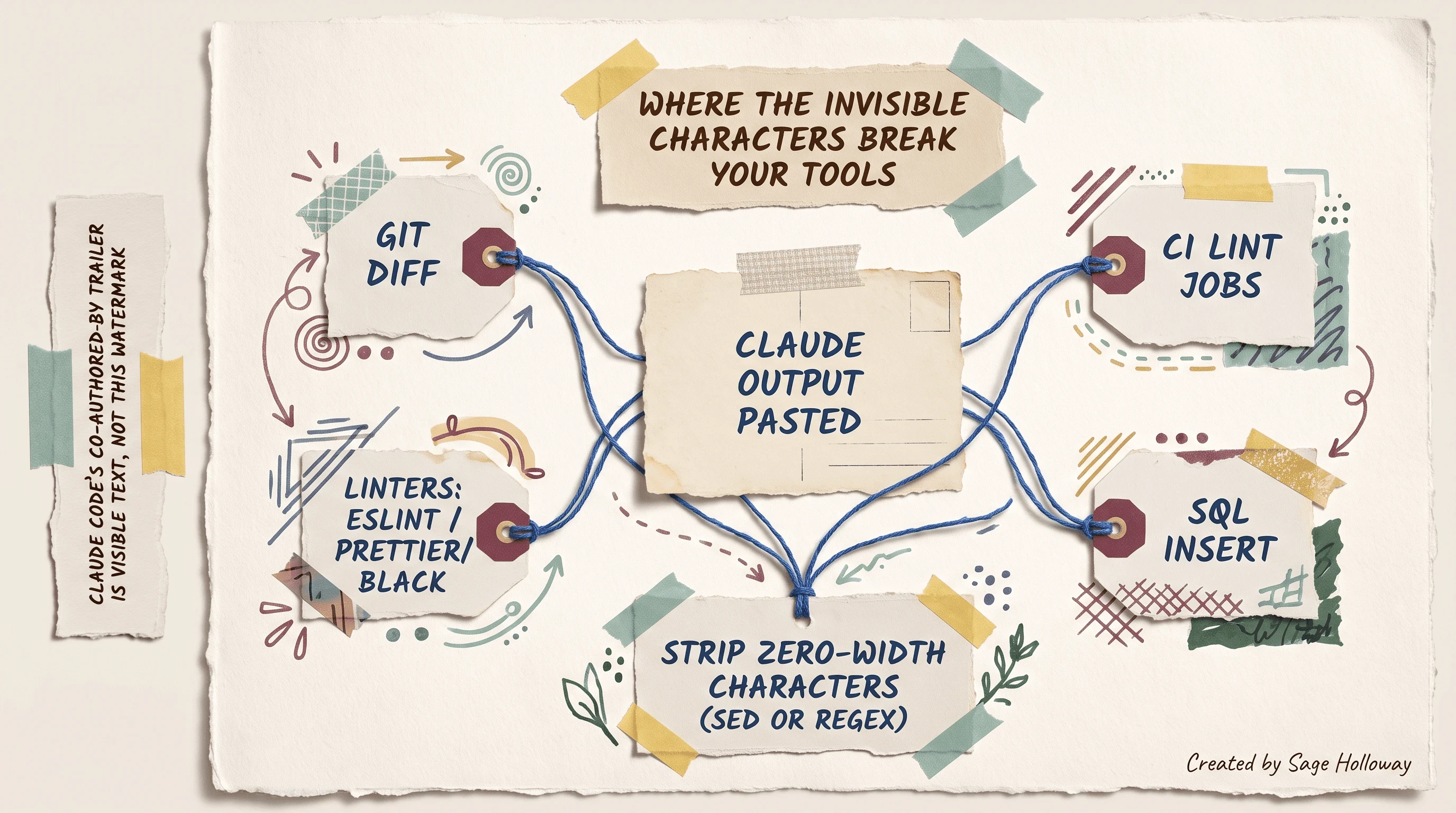
One pasted output, four different tool failures, one shared fix.
Here is what those characters actually do once they land in a real codebase, with the exact failure signatures reported by developers who have hit each one.
A git diff on a file with a stray zero-width space shows a phantom change on a line where nothing visibly moved:
A pre-commit hook can strip these before they ever reach your commit history by targeting the exact code points. Note that plain sed on macOS and most Linux systems does not understand \u Unicode escapes inside a bracket expression, so a sed-only version of this command silently fails, or worse, strips literal letters like u from your code instead of the invisible character. Perl's Unicode-aware regex mode handles it correctly:
Formatters and linters, including ESLint, Prettier, Black, gofmt, rustfmt, and clang-format, can crash outright when they hit one of these characters mid-token:
If you paste into VS Code often, a custom snippet configuration can strip the same character range straight out of your clipboard buffer on the way in:
For teams, a CI/CD lint step can scrub an entire workspace before anything else runs, using the same Unicode-aware approach rather than a plain sed pattern that will not actually match:
And if you are inserting pasted text into a database, a zero-width character's raw byte footprint can trip an encoding check that has nothing to do with your actual data:
Pick whichever one matches your workflow, drop it in, and the phantom diffs, crashed linters, and failed inserts stop. None of this touches Anthropic's actual statistical watermark, because as established above, that pattern does not live in individual characters you can regex away.
Claude Code's Co-Authored-By trailers are not a watermark
One more mix-up worth killing outright: Claude Code, Anthropic's developer command-line tool, is not the same thing as Claude's text watermark, and confusing the two leads people to worry about the wrong risk. Claude Code does not embed an invisible watermark in the code it writes. Instead, it appends a visible, plain-text Co-Authored-By trailer to git commits it makes, an attribution footer you can read, edit, or delete like any other line in a commit message. It is disclosure by default, not surveillance. If you are worried about a hidden mark in your codebase, the trailer you can actually see was never the thing to worry about, and the statistical watermark that might apply to Claude's plain-text explanations around your code is a separate question covered throughout this guide.
How Claude's approach compares to ChatGPT and Gemini
Transparent statistical marking vs cautious or image-only approaches
Anthropic has been unusually direct about what it built, publishing the mechanism, the trigger, and the limitations in public documentation rather than leaving people to guess. That transparency is itself notable. Not every major provider has taken the same path with text specifically, and rather than repeat a stylistic comparison matrix from a source flagged as outdated in our research, here is what our sourced pack can actually stand behind.
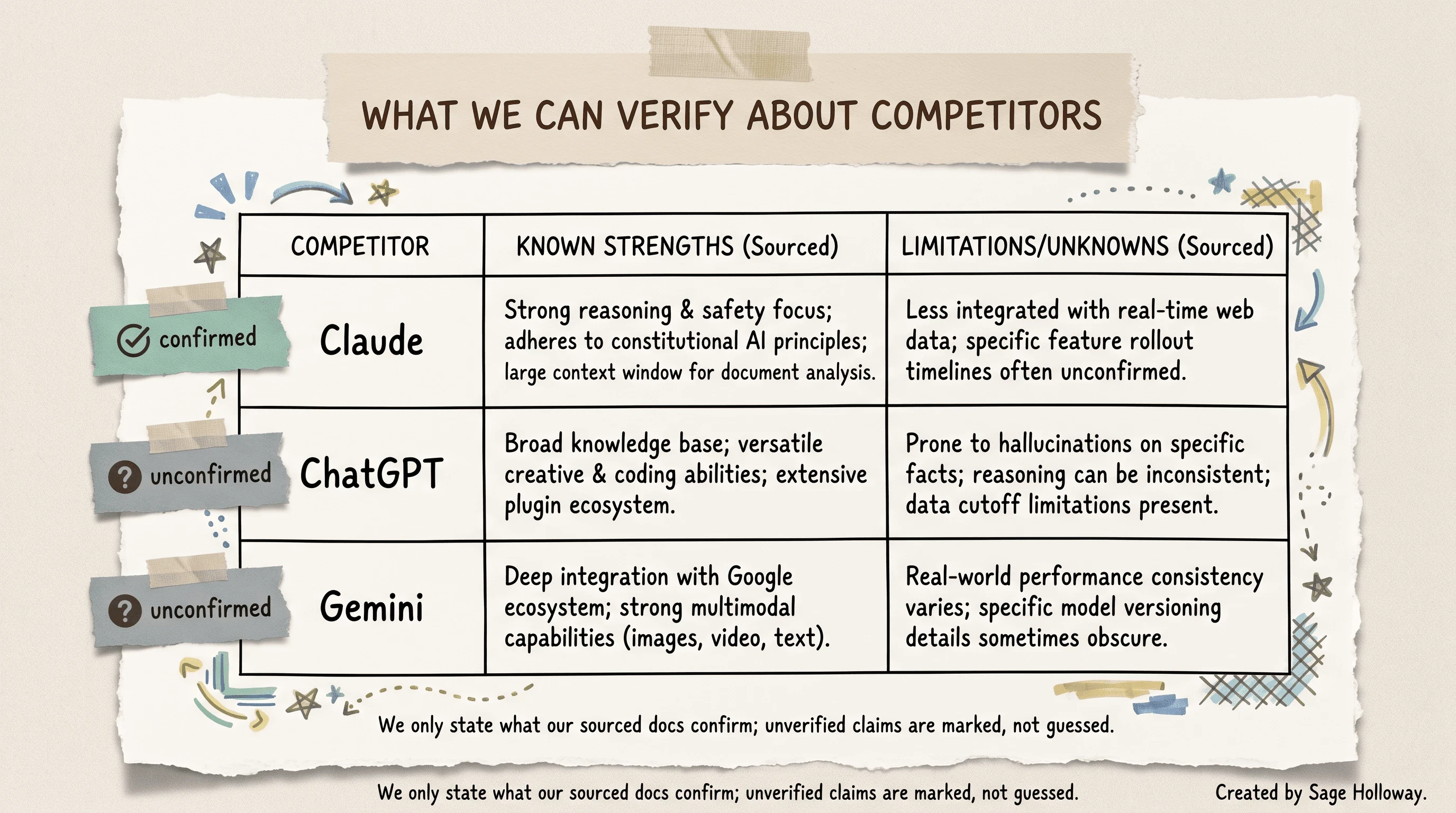
We only state what our sourced docs confirm about each provider.
What we can and cannot verify about competitors
Claude's transparent, statistical SynthID-Text watermark is documented directly in Anthropic's own official materials, cited throughout this guide. For ChatGPT and Gemini, our sourced research pack does not contain a technical claim precise enough to state as fact here, so we are not going to manufacture one just to fill a row in a table. If you are specifically trying to figure out what is really going on with OpenAI's product, including the invisible-character quirk that gets mistaken for a deliberate watermark constantly, we walk through that entire question, sources and all, in does ChatGPT leave a watermark. The Gemini side of that same question gets its own dedicated breakdown in does Gemini leave watermarks in text.
What this means for compliance, disclosure, and legal risk
Article 50's ban on removing marks
Here is the part that turns a technical curiosity into a genuine liability question. Article 50 does not just require providers to add marks. It prohibits deliberately removing or altering them. Smith frames the stakes clearly: stripping a mark off something you file turns a passive fact into an affirmative act. In plain terms, quietly using AI assistance is a different situation than quietly using AI assistance and then taking a specific step to erase the evidence of it. The second one is the version regulators are actually targeting.
What to tell partners and clients
I am not a lawyer, and neither is this guide, so take this as framing rather than legal advice. The honest, low-drama version to share with a partner or client is simple: Claude's watermark does not identify who wrote a document or how much of it is AI-assisted, it only signals that Claude was likely involved in generating or processing the text at some point. Running a "remover" tool on a document you plan to submit somewhere official does nothing to Anthropic's actual mark and may create exactly the kind of deliberate-removal question Article 50 is built to catch, over a fix that was never going to work in the first place. If disclosure matters in your context, the honest move is disclosure, not a scrub.
Frequently asked questions
Does AI leave a watermark?
Yes, broadly. Many major AI providers now build in some form of watermarking, largely to comply with transparency requirements like Article 50 of the EU AI Act. These marks are typically embedded invisibly inside generated text, images, or audio to signal machine involvement. The exact technique varies by company, and not every model or output type carries one. For a wider look at how that plays out across providers and formats, see ai watermarks.
Does Claude leave a watermark in its text outputs?
Yes. Any Claude model launched on or after August 2, 2026 supports machine-readable statistical marking from launch, applied globally rather than region by region. Anthropic is also working to extend the same support to models that predate that date under the grandfathering window described earlier in this guide.
Which specific method of watermarking does Claude use?
Claude uses a version of the SynthID-Text statistical approach originally developed by Google DeepMind. Rather than inserting any hidden character, the model biases the probability calculations behind each word choice during generation. That leaves an imperceptible, checkable pattern across the sequence of words, verifiable with a secret key rather than visible to a reader.
Is it technically detectable if figures were generated via R or Python through Claude?
It depends entirely on where the figure came from. If Claude itself directly generates the file, in a supported format like .png, .jpg, or .svg, that file gets signed C2PA provenance metadata attached to it. If you instead run Python or R code Claude gave you on your own machine to produce the plot, the resulting file carries no intrinsic Claude watermark or hash at all, since Claude never touched the output file directly.
Does Claude Code leave watermarks?
No, not an invisible one. Claude Code appends a visible, plain-text Co-Authored-By trailer to git commits it makes, which you can read and edit like any other commit line. True program code also carries less statistical watermarking in general, because syntax has to stay exact or the code simply breaks.
Can a Claude watermark identify my personal account or organization?
No. The watermark does not carry any user, account, or conversation identifying data. It operates at the model level, checking word-distribution patterns rather than tracking who typed the prompt, which means privacy is preserved even when a pass is confirmed.
Can I use an online watermark remover tool to strip Claude's text watermark?
No. Those tools are built to find and remove invisible Unicode artifacts like stray zero-width spaces, which is a real but separate problem from Anthropic's actual watermark. Because the SynthID-based signal lives in the sequence of words themselves rather than in hidden bytes, a character-stripping tool has no effect on it whatsoever.
Can't someone just edit the text to get around the watermarking?
Substantial rewriting will degrade and eventually destroy the statistical pattern, yes. Light editing or straight copy-pasting will not, since most of the original word choices survive intact. Very short outputs or highly factual, low-choice text carry little to no watermark signal in the first place, watermark active or not.
What does a detected Claude watermark actually prove?
It proves Claude was probably involved in generating or processing the text at some point. It does not prove sole authorship, does not reveal what proportion of a document is AI-assisted, and does not carry any identifying user data. A human who wrote an original document and used Claude only to proofread or lightly edit it can still trigger a detectable mark, which is exactly why a pass should never be read as "this is entirely AI-written."
A five-minute way to check what you actually know
Try this on the next thing Claude writes for you. Before you send it anywhere official, ask yourself three questions instead of reaching for a remover tool: what model generated this, was it launched before or after August 2, 2026, and how much of the final wording is still Claude's rather than yours after your own editing pass. Those three answers tell you more about what you are actually holding than any browser-based checker will.
The bigger question, whether a checkable watermark like this one changes how people write with AI assistance at all, or just changes what they tell themselves about it, is still open. Anthropic built the detection API it promised to publish eventually, but the timing is not something our sources confirm yet, and neither is how thoroughly the rest of the industry follows this exact path instead of shelving it the way some competitors reportedly have. What is settled, as of this August, is that the words Claude gives you are carrying more information than they used to, whether or not you ever go looking for it.
Until then...
Sage
PS. The zero-width space that keeps breaking developers' git diffs has a legitimate day job most people never learn: designers use it in web typography to let a long word or URL wrap cleanly at a specific point without inserting a visible hyphen. The same character, doing exactly what it was designed to do, becomes a bug report the moment it sneaks into the wrong file.
Author
Practical guides, tool teardowns & AI engineering workflows.