AI Watermarks
Does Gemini Leave Watermarks in Text? Unicode Artifacts vs SynthID Explained

Sage Holloway
26 min read
Go back to blog
SHARE

You paste the draft into a cleaner. It flashes green. The page says the mark is gone. Then a different checker, a different policy, or a different person still treats the words as machine-made. You did the ritual. The ritual did not buy the verdict people want when they ask does Gemini leave watermarks in text.
Yes. Google integrated SynthID-Text into Gemini to create a statistical signal through token selection, rather than a visible label or hidden-character tag. Text copied from Gemini may also contain invisible Unicode formatting characters, but those are a separate layer. Character cleaners can remove formatting artifacts; they cannot detect or strip SynthID. Significant rewriting can weaken detection, but it does not prove human authorship.
That is the short answer. People searching does Gemini leave watermarks in text are usually holding both layers at once, which is why the ads can sound so complete and still be incomplete. This guide covers Gemini text: copied characters, statistical token steering, formatting cleanup, editing, and policy. It does not cover cropping a logo off a generated image, stripping video marks, or walking through a paid humanizer. Those are different jobs, and mixing them is how this topic got noisy.
Gemini text can carry a statistical SynthID signal while copied text may separately contain invisible formatting characters.
Here is the route through this guide:
What “watermark” actually means in Gemini text, including SynthID and copied-text artifacts.
Why Unicode cleanup and SynthID solve different problems.
How to inspect a paste before choosing a fix.
What editing changes, what it does not prove, and the responsible path forward.
Where clean formatting matters in Docs, Word, CMS editors, CSV files, and code.
Policy, disclosure, and academic use.
What the 2024 evidence actually establishes, and what it still cannot.
If you already know you need a broader checker workflow across tools, start with how to detect AI watermarks and come back here for the Gemini-specific layers.
What “watermark” means in Gemini text
Picture a house inspection the morning after you get the keys. The inspector wipes a windowsill and shows you a film of pollen. He opens a vent and there is dust you could vacuum in ten minutes. None of that is the building.
Then he taps the floor and says the joists were cut a few millimeters off the plan, so every room sits on a slightly different grid than the blueprints. You cannot vacuum that. You would have to rebuild the rooms.
That is the mess inside the word watermark here. People arrive holding one cloth, and they expect it to fix both reports.
A language model does not emit a finished paragraph in one shot. It chooses the next token, a word or a word-fragment, over and over. SynthID-Text, Google DeepMind’s statistical text watermark, lives in those choices. Copied Gemini text can also pick up invisible Unicode characters, which are formatting code points that take little or no visible width. Those two things share a search query. They do not share a mechanism.
SynthID is a statistical signal in token choices
According to IEEE Spectrum’s reporting on the launch, Google integrated SynthID-Text into Gemini on October 23, 2024. The system assigns random numerical scores to candidate tokens and steers the model toward higher-scoring words during generation. The reader does not see a stamp. The sequence of choices is what later inspection would try to measure.
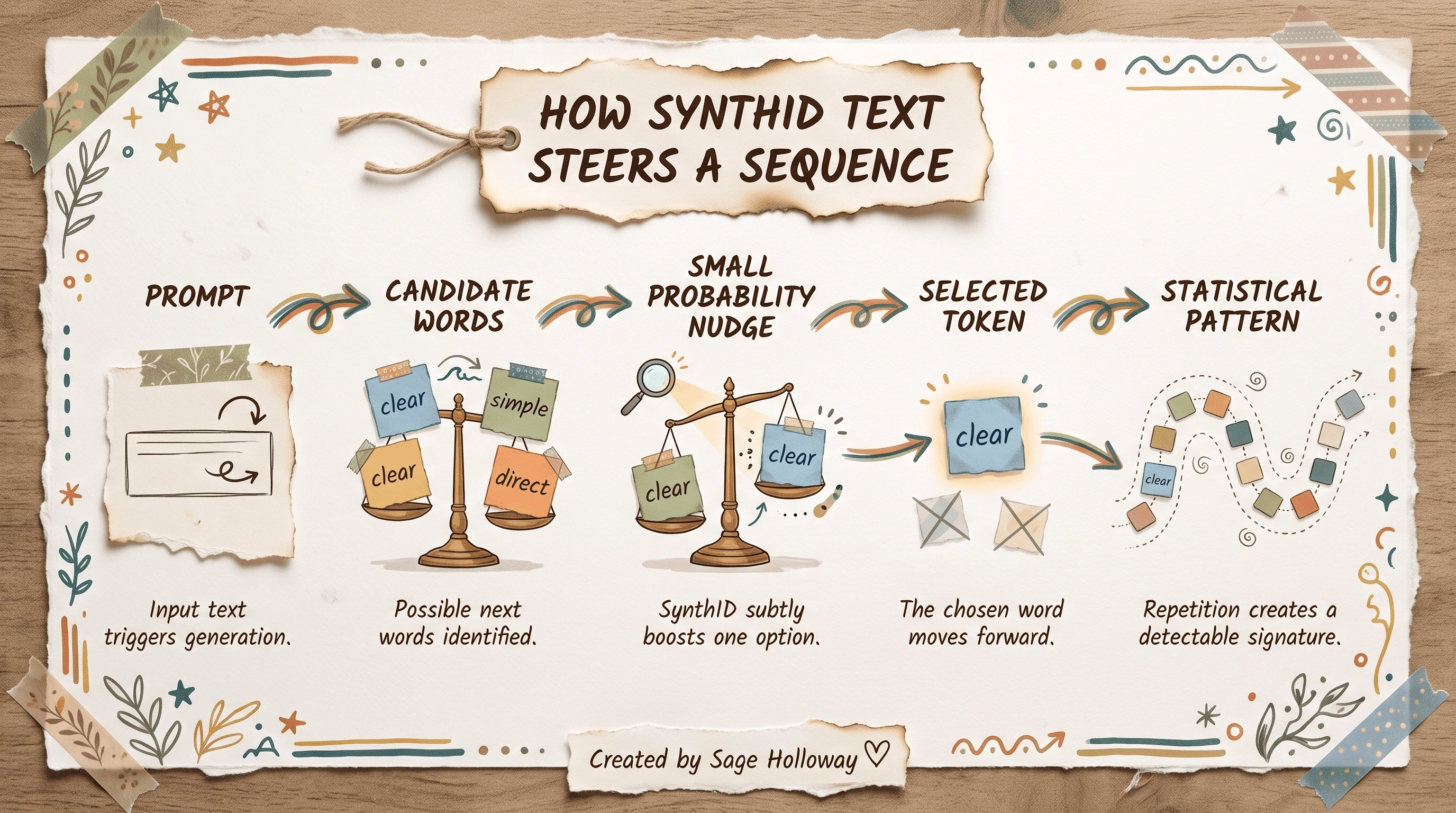
SynthID works through statistical token choices, not a visible tag or a hidden Unicode character.
Quality was the obvious objection, so DeepMind tested it at a scale most product claims never reach. IEEE Spectrum reports a trial on 20 million prompts inside Gemini, with no measured drop in user satisfaction compared with non-watermarked outputs. If you felt the writing get worse the day the watermark shipped, that is not what the published trial showed.
This is also why a paste box that “strips watermarks” is the wrong mental model. There is no extra byte sitting between clear and simple waiting to be deleted. The signal is the fact that clear got chosen, then the next word, then the next, in a pattern a matching detector can score.
The abstract part is easier to see in motion than in a paragraph. Not following the probability nudge? Fair enough. Watch the packed walkthrough:
<iframe width="560" height="315" src="https://www.youtube.com/embed/JQYgG99BM7g" title="Video explaining how SynthID Text changes token probabilities" frameborder="0" allow="accelerometer; autoplay; clipboard-write; encrypted-media; gyroscope; picture-in-picture; web-share" allowfullscreen></iframe>
If you only remember one sentence from this section, make it this: SynthID is a pattern in word selection, not a hidden character you can highlight.
Invisible copy-paste characters are a separate layer
Unicode is the standard that gives every character a unique number, called a code point, so computers can store letters, spaces, and symbols consistently. Most of those numbers print something you can see. A handful do not. Zero-width spaces, joiners, soft hyphens, and word joiners can sit in a string, survive an ordinary copy, and still look like nothing happened.
Vendor write-ups of Gemini paste behavior list five code points that can show up in copied text: U+200B, U+200C, U+200D, U+00AD, and U+2060. I will treat those as observed formatting artifacts, not as a second official Google tracking watermark. Sources disagree on intent. Some cleaner pages call them fingerprints. Others describe them as rendering leftovers from copying web text. Until Google publishes a text-specific claim that these bytes are deliberate identifiers, the honest label is copied-text artifact.
But is that a watermark? Only if you stretch the word until it covers every invisible character that ever survived a paste. Stretch it that far and your own CMS, your email client, and a badly exported PDF are “watermarking” you too.
I got this wrong in the other direction for a while. I assumed that if a cleaner found zero-width characters, I had found Gemini’s mark. Finding a character is evidence that a character is present. It is not evidence of who wrote the sentence, and it is not evidence of SynthID.
What detection can and cannot establish
A detector, in this context, is a tool that looks for a specific signal. Character tools look for code points. A SynthID-Text detector looks for a statistical pattern in token choices. IEEE Spectrum is explicit about the access limit: only Google and its authorized developers currently have access to the detector that checks for the SynthID-Text watermark.
That one fact wrecks a lot of landing-page copy. A public “Gemini watermark detector” that highlights spaces is not inspecting SynthID. It cannot. The matching test is restricted. Open-sourcing the underlying SynthID-Text tooling, which Google also did so developers can mark outputs from their own models, is not the same as handing everyone a Gemini-chat oracle.
So what can you actually establish today?
You can establish that specific invisible characters are present in a paste, if you inspect the code points.
You can establish that a character cleaner removed those characters, if you compare before and after.
You cannot, from a public character scan, establish that Google’s statistical watermark is present or absent.
You cannot treat a clean paste as proof of human authorship.
If you want the sibling story of how another lab applied a SynthID-Text-style mark to a different chatbot, that lives in whether Claude leaves a watermark. This page stays on Gemini text.
Unicode cleanup and SynthID solve different problems
Here is the product pitch you keep meeting: paste the text, click clean, the watermark is gone. The pitch is not exactly false. It is aimed at the pollen, then sold as if it leveled the joists.
Character cleanup is a formatting job. SynthID is a provenance job. Mixing them is how people download a tool, get a satisfying before-and-after, and still have no idea what Google could check.
Does a cleaner fix the thing you actually care about? Only if what you care about is spacing, wrapping, and broken imports.
Side-by-side comparison: location, symptoms, detection, and cleanup
Keep the two columns separate in your head. If a sentence in a sales page jumps from “zero-width space” to “undetectable AI,” it has changed subjects without telling you.
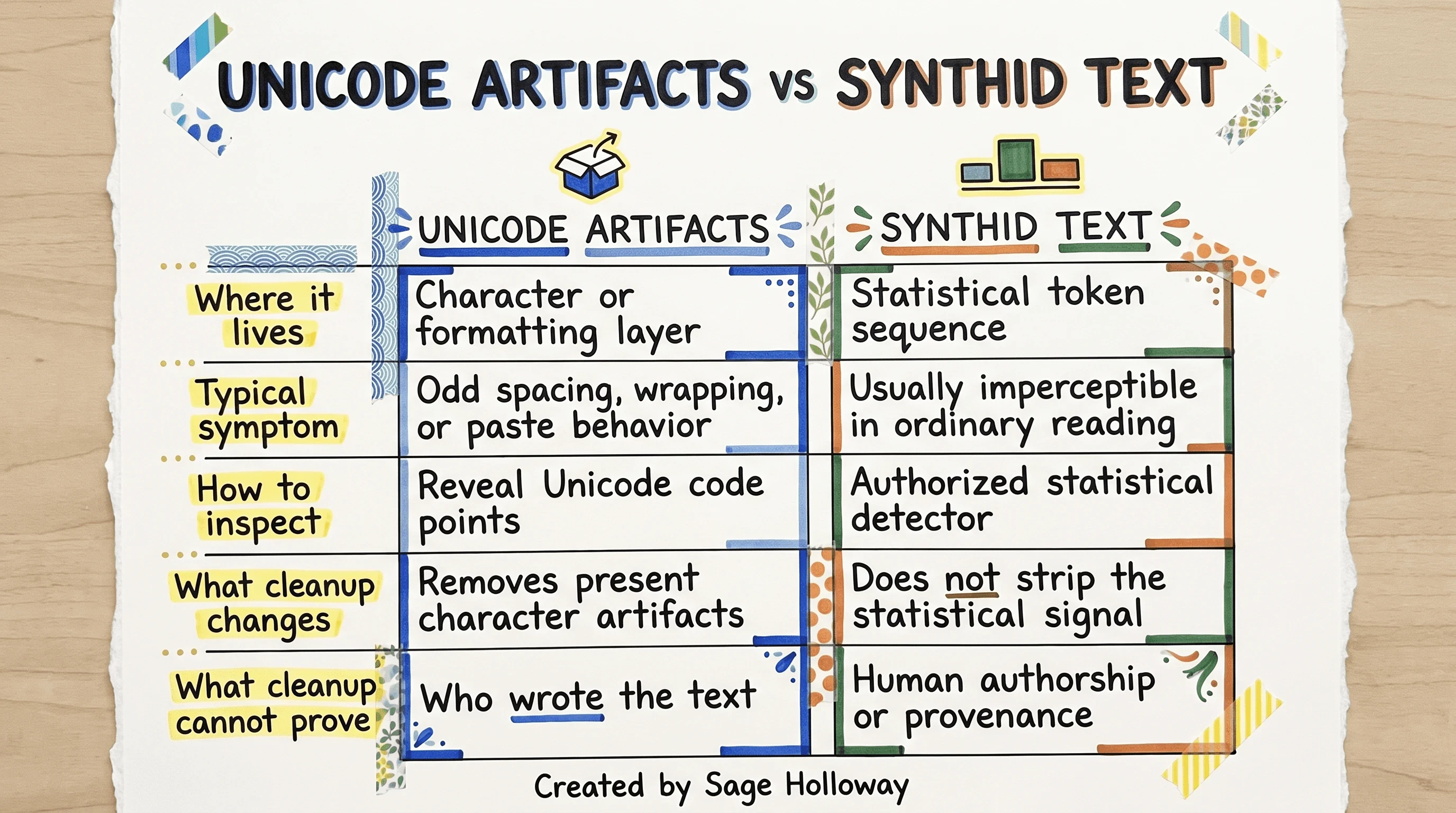
Unicode cleanup fixes character-level formatting artifacts; it does not detect or strip SynthID.
Read that table slowly. Cleanup can change the left column. Cleanup cannot prove anything in the right column’s last row. humantext.pro and gpt-watermark-remover.com both state the limit in plainer language than their headlines: no character-stripping tool detects or removes SynthID, because the signal lives in word selection, not in hidden formatting bytes.
The cleaner was never failing at character stripping. It was succeeding at a job you were not actually hiring it for.
One vendor comparison also claims ChatGPT’s public text marks are mostly Unicode, while Gemini adds SynthID. Treat that as a vendor contrast, not as an official statement from either lab. Cross-product watermarking is a different search, and this page will not pretend we have a dedicated, official side-by-side.
Hidden code points readers may encounter
If you are going to inspect a paste, inspect exact code points. Do not inspect “weird spacing” by eye and call it a Gemini watermark. Eyes are bad at this.
Copied Gemini text, according to cleaner documentation in the sources, may include:
A zero-width space is a character that occupies no visible width and can sit between letters or words. A zero-width non-joiner tells neighboring characters not to form a connected shape. A zero-width joiner can force a connection. A soft hyphen marks a place a line may break. A word joiner tries to prevent a break.
All five are real Unicode. All five have legitimate typesetting jobs. Presence in a Gemini paste is a formatting fact, not a confession.
This will not work if you only look at the text after a destination has already normalized it. Some editors, CMS fields, and chat boxes rewrite whitespace on paste. If you inspect the copy sitting in the final box, you may be inspecting the destination’s cleanup, not the original string.
Why punctuation patterns are not proof of authorship
gptcleanup.com advertises punctuation normalization as an advanced toolkit feature: converting characteristic em dashes to standard hyphens, commas, or stripping them. That is a style cleanup. It is not a detector.
Lots of humans use long dashes. Lots of models use them. Lots of style guides forbid them, including this site’s own prose rules. If you “prove” Gemini authorship by counting dash characters, you will eventually accuse a newspaper editor, a legal brief, and me.
Style is not a watermark. A watermark, in the SynthID sense, is a checkable generation-time bias. A punctuation habit is just a punctuation habit.
The same warning applies to any landing page that treats “we normalized the dashes, therefore the AI mark is gone.” You changed the punctuation. You did not inspect token statistics. You did not obtain authorized detector access. You edited a document.
How to inspect a paste before choosing a fix
If you have ever hit this wall, you already know the feeling: the document looks fine, the import is not. Do not start with a remover. Start with the symptom. Removers are optimized to look busy. Inspection tells you which of the two house-reports you are holding.
Start with the symptom, not a remover claim
Ask what actually broke. A heading that wraps in a strange place, a CSV column that splits wrong, a CMS preview that inserts a blank line you cannot delete, or a search that fails to match a phrase you can see on screen are formatting symptoms. They live in the left column.
If nothing looks wrong, and you are only scared because a page promised Google can “see” your draft, you are in the right column. A character cleaner will not answer that fear. It will only give you a cleaner string and a false sense of completion.
I have watched people run the same paragraph through three branded boxes and treat the green badge as provenance. The badge is a product UI. It is not Google’s detector.
Preserve the original before you touch anything. Duplicate the document, or save a UTF-8 copy, which is a common way of encoding Unicode as bytes. Cleanup destroys the evidence you wanted to inspect. That sounds obvious until you have already overwritten the only paste you had.
Reveal and document invisible characters locally
Use a trusted local method: a Unicode-aware editor, a character map, or a viewer that can show exact code points. Keep sensitive drafts on your machine if the content is confidential, graded, or unpublished.
Some cleaner sites say their on-page tools run entirely in the browser with client-side JavaScript, meaning the code executes on your computer rather than uploading the text. gpt-watermark-remover.com makes that claim for its own detector. That is a vendor-specific architecture statement, not a law of the internet. Other pages can log, store, or send what you paste. If privacy matters, do not treat “online watermark cleaner” as a synonym for “local.”
File upload is a different surface again. The same vendor documents a 50 MB cap for .docx and .pages files on its static-document cleaner. That is one product’s limit, not a universal rule, and it is irrelevant if you are only inspecting a paragraph.
Write down what you found: which code points, roughly where they sat, and whether they explained the symptom. If you found none, say you found none. Do not upgrade “none found” into “unwatermarked.”
Verify formatting without claiming the text is unwatermarked
If characters were present and they matched the symptom, cleaning those characters is a reasonable formatting fix. Verify the output in the actual destination: the Docs file, the Word outline, the CMS preview, the CSV import, the code block. Then stop.
Do not add a sentence that says the text is now human, original, or undetectable. You verified spacing. You did not run an authorized SynthID check. You did not create a provenance record. You tidied the windowsills.
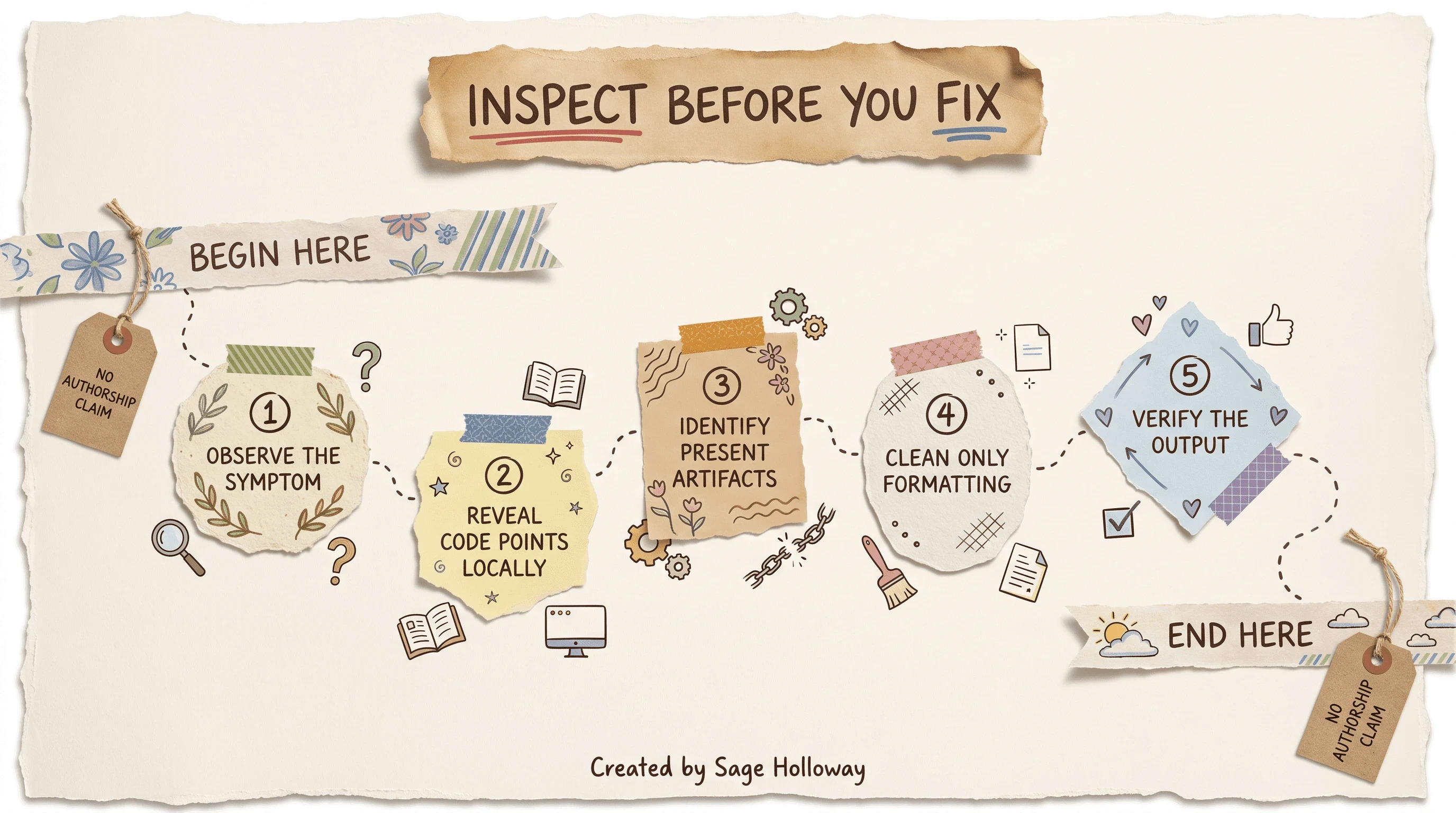
Diagnose the formatting symptom, reveal code points locally, clean only what is present, then verify without making an authorship claim.
The five-step path is deliberately boring: observe the symptom, reveal code points locally, identify the artifacts that are actually there, clean only formatting, verify the output. The luggage tag stays attached on purpose. Cleanup is not a new origin story.
What editing changes, what it does not prove, and the responsible path forward
But here is the thing. The statistical layer is not immortal. IEEE Spectrum reports that significant editing, rewriting, or having another model summarize the text will obscure or eliminate the SynthID watermark. That sentence is true, and it is also the sentence paid humanizers put in the window.
This section is the gap most cleaner pages refuse to write honestly. They either sell you a character strip and call it done, or they sell you a rewriter and call it authorship. Neither is the job.
Edit for factual accuracy, clarity, and personal voice
If Gemini drafted a passage, read it as a draft. Check the claims. Cut the filler. Put the sentences in your cadence. Add the example only you have. Delete the confident wrong number.
That is ordinary writing. It is also, as a side effect, the kind of heavy revision that can weaken a token-level statistical pattern.
I am not going to give you a bypass prompt, a percentage of words to swap, or a “run it through model B” recipe. Those pages exist. They are not this page. A community report in the sources found that a site advertising easy SynthID removal, removemysynthid.com, did not function for text and merely output placeholder example text. Treat miracle removers as a cautionary example, not as a workflow.
The honest version is simpler, and less marketable: if the text is yours to publish, make it true and make it sound like you. Do that because the reader deserves it, not because you are trying to game a detector you cannot see.
Preserve disclosure and provenance where required
Provenance is a record of where the text came from. If your workplace, journal, classroom, or client requires disclosure of AI assistance, keep that record even after you edit. A cleaned paste with no note is convenient. It is also how people accidentally misrepresent origin.
Google’s Generative AI Prohibited Use Policy, as cited by Product Experts on the Gemini Apps community thread about removing watermarks, forbids misrepresenting the origin of AI content by claiming it was solely human-generated in order to deceive. You do not need a courtroom to understand the direction of that rule. If a disclosure is required, cleanup does not retire it.
Save the original generation, or at least a note of the date, the tool, and how much you rewrote. Future-you will not remember which paragraph was a Gemini first pass. Future-you will be the person asked.
Why weaker detection does not establish human authorship
A detector score going down is not a birth certificate.
Significant revision can scramble the statistical pattern that SynthID uses. Human writing can also look like Gemini, or like you, or like a style guide. A teacher, an editor, or a compliance reviewer is not obligated to treat “the watermark got quieter” as “a person wrote this.” They are looking at process, citations, drafts, and policy. They should.
If you need a single line to keep: weaker detection is a statement about a signal. Authorship is a statement about work. They are allowed to diverge.
This is the part the humanizer economy cannot say out loud, because the product only sells if you believe the score is the authorship. It is not. It never was.
For image-and-logo questions that travel under the broader Gemini watermark query, or the even wider Gemini AI watermark bucket, use those pages when they exist. Cropping a picture is not the same job as editing a paragraph, and this guide will not pretend otherwise.
Where clean formatting matters in real workflows
Formatting cleanup earns its keep in boring places. Not in detector theater. In the paste that breaks.
Documents and CMS editors
Google Docs, Microsoft Word, and most CMS editors try to preserve characters they do not understand. That is usually a feature. It becomes a bug when an invisible joiner sits where a normal space should be, and the heading wraps, the template thinks a line is empty, or a “delete trailing space” pass does nothing because the character is not a space.
If you publish, preview the published layout, not just the editor canvas. Themes, Markdown converters, and sanitizers each handle odd code points differently. A paragraph that looked fine in Docs can sprout a blank line in the CMS, or collapse two words together, or refuse to hyphenate.
Cleaners that promise “pastes cleanly into Docs, Word, and CMS editors” are describing this class of fix. Believe them about spacing. Do not believe them about provenance.
CSV, databases, and code blocks
Hidden characters are nastier in structured text. A CSV, a comma-separated values file, splits on delimiters. A zero-width character inside a field can make two rows that look identical fail a match. A database unique index can reject a value you can see with your eyes. A code block can copy a function name that is not the function name.
gptcleanup.com flags exactly this family of failures: broken queries, corrupted exports, compilers that choke on bytes you did not type on purpose. I have not independently reproduced each example, and I will not invent error strings. The mechanism is enough. If matching, compiling, or importing is the symptom, inspect code points before you rewrite the logic.
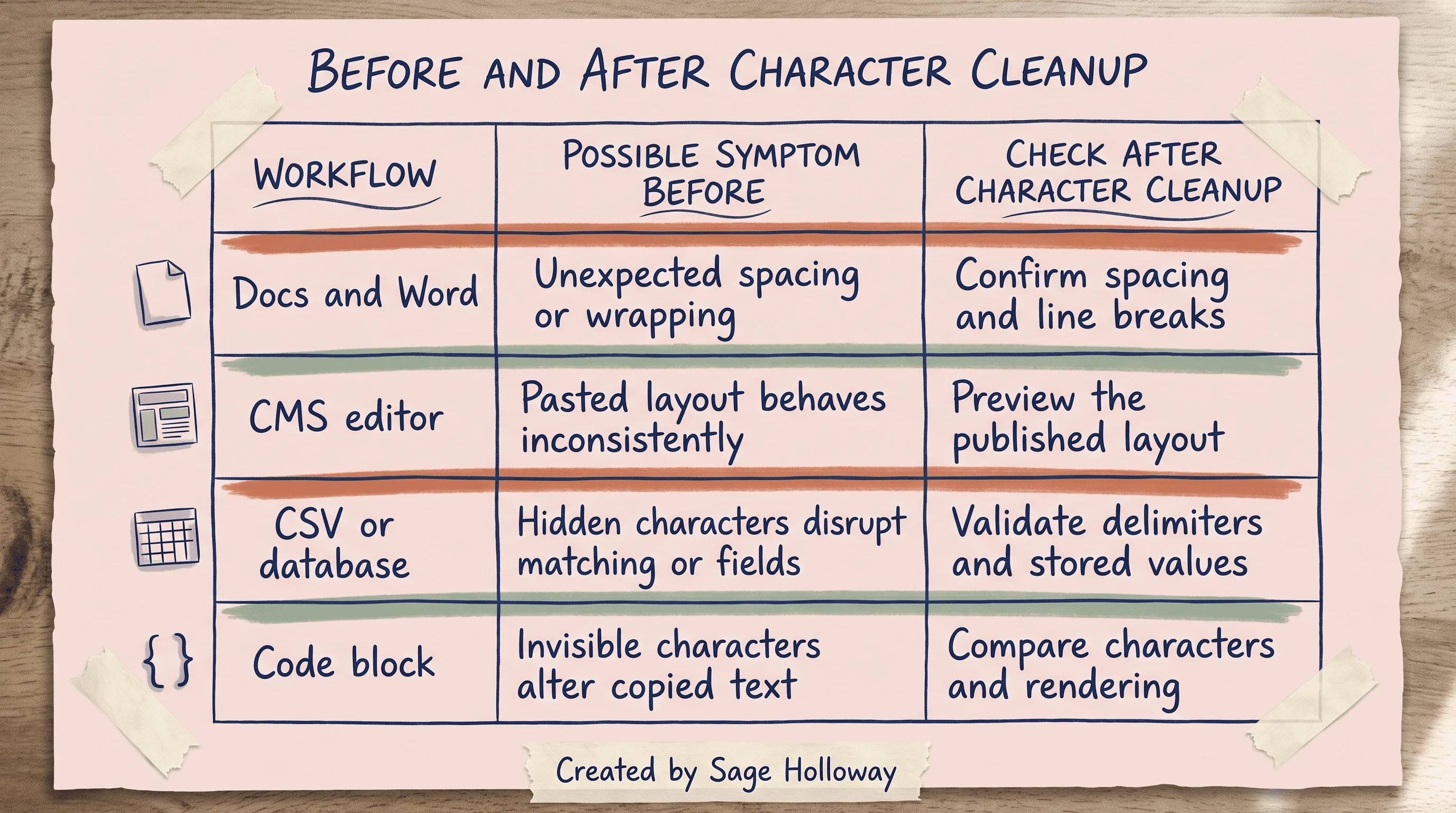
Character cleanup may restore predictable formatting across documents and structured-text workflows.
After cleanup, check the thing that actually broke. Confirm spacing in Word. Preview the CMS. Validate delimiters and stored values. Compare the code characters, not the syntax highlighting. If the symptom remains, you had a different bug.
Policy, disclosure, and academic use
Formatting hygiene and policy are easy to mash together because both get sold as “removing the watermark.” They are not the same decision. One is whether the heading wraps. The other is whether you are allowed to hide how the text was made.
Google’s restrictions on bypassing protective measures
The same Google-hosted Product Expert thread is the policy anchor among the sources. It points to Google’s Generative AI Additional Terms of Service, which prohibit attempting to bypass protective measures or safety features.
Forum users often look for an aesthetic exemption: cropping a logo for a slide, cleaning a diagram for LinkedIn, “no intent to deceive.” The expert answers in that thread do not treat intent as a free pass. I am not going to turn an image-watermark question from that thread into a fake text-specific legal memo. I will say the direction of the rule is not subtle. If you are trying to defeat a protective mark so the origin disappears, you are in the policy’s blast radius, whether the mark was a logo on an image or a statistical pattern in text.
But is cleaning invisible characters the same as bypassing a protective measure? Formatting cleanup is a different act from buying a tool whose only advertised job is bypass. Read the current terms. Do not take a blog’s paraphrase as counsel. This is not legal advice, and I will not pretend a Product Expert post is a statute.
Misrepresentation, institutional rules, and disclosure
The Prohibited Use Policy, as cited in that same thread, forbids claiming AI content was solely human-generated in order to deceive. Schools and workplaces often go further. They may require disclosure even when Google’s terms would not be your first concern.
Can a student run a character cleaner on Gemini text? As a formatting step, maybe, if the institution allows the underlying Gemini use at all. As a way to submit AI-written work as unaided writing, no. A cleaner does not change origin. Universities that scan for AI writing are not only looking for zero-width spaces, and they should not be.
Follow the syllabus, the journal guide, or the client contract you actually have. If disclosure is required, disclose. If AI tools are banned for the assignment, do not use Gemini and then launder the paste. That is not a watermark problem. That is an integrity problem wearing a watermark costume.
What the evidence actually establishes
Community memory on this topic is messy. A r/WritingWithAI thread still contains the claim that text watermarking is something Google plans to do later. That rumor is late. The integration date is sitting in IEEE Spectrum in black and white.
The 2024 SynthID-Text timeline
Google’s consumer chatbot ran as Bard until February 2024, when it was rebranded to Gemini. SynthID-Text was integrated into Gemini on October 23, 2024, per IEEE Spectrum. Google also open-sourced SynthID-Text so developers and businesses could identify outputs from their own models.
Those are three different events. Rebrand is not watermark. Open-source tooling is not public detector access for Gemini chat. If a post collapses all three into “Google watermarked everything and anyone can check,” it is not summarizing the record. It is writing fan fiction on top of it.
Scale testing, access limits, and remaining uncertainty
The 20-million-prompt trial is the number that surprised me most in the sourced material, not because 20 million is a magic threshold, but because it is a real scale test attached to a “did users notice?” question. IEEE Spectrum reports no measured satisfaction drop. That is evidence about quality under watermarking. It is not evidence that every Gemini paragraph you will ever copy is detectably marked in the wild.
Detection access remains specialized. IEEE Spectrum states that only Google and authorized developers have the SynthID-Text detector. Researchers have also flagged a practical limit: tracking text in the wild is harder if you do not know which model produced it. I will leave that as uncertainty, not as a score.
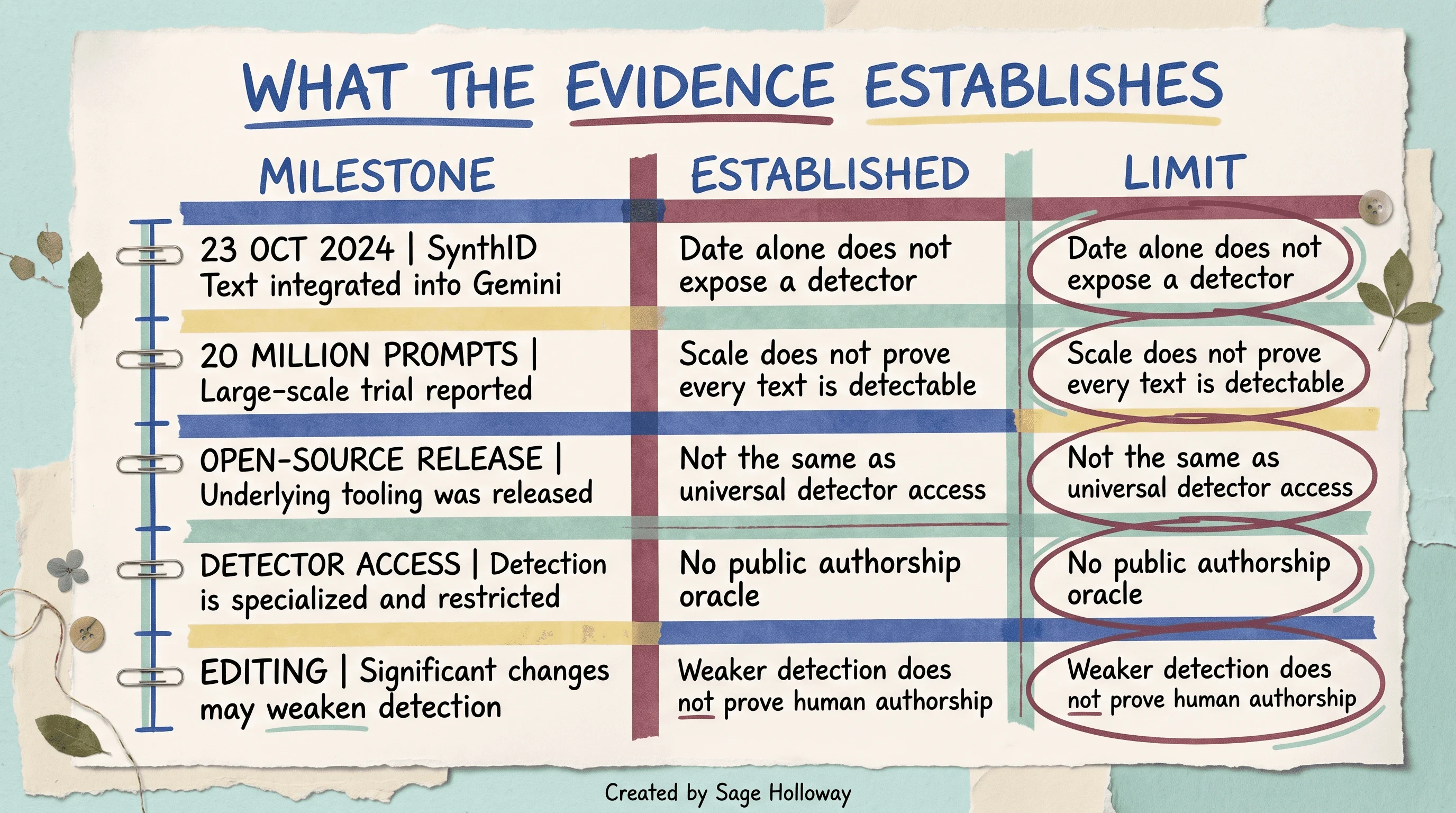
The evidence establishes Gemini integration and large-scale testing, while practical detection access and authorship conclusions remain limited.
Significant editing can weaken detection. Weaker detection still does not prove a human wrote the page. Hold both sentences. Dropping either one is how this topic turns into either panic or a scam.
Frequently asked questions
Does Gemini watermark AI-generated text?
Yes. Google integrated SynthID-Text into Gemini as a statistical watermark in token selection. Copied text may also include invisible Unicode formatting characters, which are a separate layer. Character cleanup addresses the second layer. It does not inspect or remove the first.
What is SynthID-Text?
SynthID-Text is Google DeepMind’s text watermarking method. It assigns scores to candidate tokens and steers generation toward higher-scoring words, creating a statistical pattern in the sequence rather than a visible label or a hidden character. IEEE Spectrum reports it was integrated into Gemini on October 23, 2024, after large-scale testing.
Can a watermark cleaner detect or remove SynthID?
No. Character-stripping tools operate on formatting bytes. SynthID lives in word-choice distribution. Vendor pages that admit this in the body while implying otherwise in the headline are the reason this FAQ exists. A site that claims easy SynthID removal should be treated with suspicion; community reporting on removemysynthid.com described a text feature that did not work.
Why do invisible characters appear in pasted Gemini text?
The best-supported explanation in the sources is copy-paste and rendering: invisible Unicode can hitch a ride when text is copied from a web interface. That is not the same mechanism as SynthID. Sources conflict on whether those characters are deliberate tracking marks, so this guide does not call them a second official Google watermark.
Which invisible Unicode characters can appear in copied text?
Vendor documentation lists five: Zero-Width Space (U+200B), Zero-Width Non-Joiner (U+200C), Zero-Width Joiner (U+200D), Soft Hyphen (U+00AD), and Word Joiner (U+2060). They affect wrapping, joining, and breaks. Their presence is a formatting observation. It is not, by itself, proof of authorship.
Will cleaned text paste cleanly into Docs, Word, and CMS editors?
Often, yes, if the problem was hidden characters disrupting spacing or layout. You still need to preview the real destination, because each editor handles leftovers differently. Cleanup can restore predictable formatting. It cannot certify that the text is unwatermarked at the SynthID layer.
Is online watermark cleaning private?
Only if the specific tool actually processes text on your machine and does not transmit it. At least one vendor, gpt-watermark-remover.com, claims 100 percent client-side JavaScript with no server upload. That claim does not extend to every site with a paste box. If the draft is sensitive, inspect locally and read the tool’s actual behavior before you paste.
Can students use a cleaner on Gemini text?
A cleaner can strip formatting artifacts. It cannot turn Gemini-assisted writing into unaided student work. Follow your institution’s academic integrity rules for Google Gemini and for AI assistance. If the assignment forbids the tool, cleaning the paste does not create permission.
Does editing or summarizing affect SynthID detection?
Significant editing, rewriting, or summarizing with another model can obscure or eliminate the statistical watermark, according to IEEE Spectrum. That is a detection limit, not an authorship certificate, and it is not a recommendation to evade policy. Light copy-editing leaves most of the original token sequence in place.
A practical standard for using Gemini text
Try this on the next Gemini draft you actually intend to use. Duplicate it. If a heading, import, or code paste is misbehaving, inspect the code points locally and clean only the formatting that is there. Then edit the piece until the facts and the voice are yours. Disclose if you are required to. Keep a note of origin even if nobody asked today.
Do not buy a green badge. Do not confuse a tidy paste with a human byline. Do not treat a quieter detector as a personality transplant.
Whether public detection ever catches up to the October 2024 integration, or stays inside Google’s authorized circle while the rest of us argue about zero-width spaces, is still an open systems question. The part you control is smaller and less dramatic: formatting that does not break, writing you will stand behind, and a record of how the words got here.
Until then...
Sage
PS. I once spent twenty minutes fighting a CMS that insisted a heading was empty while I could see the words on screen. The heading was not empty. A joiner character was sitting where a normal space belonged, and the template treated the line as already wrapped. I deleted one character I could not see, and the layout snapped back. That was the day I stopped trusting a paste just because I could read it.
Author
Practical guides, tool teardowns & AI engineering workflows.