AI for Finance
AI Agents for Financial Services Compliance: KYC, AML, and Runtime Controls

Sage Holloway
18 min read
Go back to blog
SHARE

The queue never empties. Every morning the same almost-matches wait for a person who already cleared three identical ones yesterday. The stamp is still human. The draft is the only thing that got faster, and nobody can show an examiner how the draft decided.
AI agents for financial services compliance replace brittle rule engines with goal-oriented systems that reason over unstructured KYC files, adverse media, and watchlists to triage alerts and draft SARs. Humans must keep final sign-off. Deploy them as separate KYC onboarding and AML monitoring pipelines, choose build (LangGraph plus Temporal) or buy (Persona, spektr, Lyzr), and enforce per-agent runtime controls aligned to the 2026 Treasury FS AI RMF so a compromised agent cannot cause speed-of-harm damage.
Last year the L1 tray looked the same at 8 a.m. and at 8 p.m. This year an agent can open the PDFs, pull adverse media, and leave a narrative folder on the desk before lunch. The filing still waits for a person. If you have ever watched a "closed" alert reopen because nobody could reconstruct the decision, this is that wall, named.
This guide will not turn into a vendor directory, a Claude wealth-plugin install, or a broad GRC agent hub. Those jobs live on sibling pages: KYC and transaction monitoring platforms, Claude wealth management plugin, AI agents for compliance, and Anthropic financial services. What follows is the compliance-agent architecture for financial services: what the systems are, why legacy screening breaks, how to keep KYC and AML separate, how to orchestrate multi-agent loops, when to build versus buy, how to contain speed-of-harm risk, and how to ship a Traceability Log an examiner can follow.
On this page
What AI compliance agents are (vs rules and chatbots)
Why legacy screening and adjudication break
Separate KYC, AML, and sanctions agent pipelines
Multi-agent orchestration blueprints
Build vs buy: two valid paths
Runtime security for speed-of-harm (2026)
Ship an examiner-ready reasoning log template
FAQ
Agents triage and draft. Examiners still sign.
What AI compliance agents are (vs rules and chatbots)
Imagine a night kitchen that still runs on laminated checklists. The line cook only flips the steak when the clock hits four minutes. That works until the steak is thicker, the grill runs hot, or a VIP order arrives with three substitutions. The checklist still prints "four minutes." The plate still fails.
Now picture a sous-chef who can taste, adjust heat, read the ticket notes, and still pass every plate under the head chef's stamp before it leaves the pass. That sous-chef is not a timer. They are not a guest FAQ card taped to the wall either.
That is the shift behind AI compliance agents in financial services. They are goal-oriented decision-support systems, not static IF/THEN rule engines and not chat windows that answer one question at a time. They ingest unstructured files (emails, PDFs, registries), assemble a reasoning narrative, and stop at a human gate.
Agents vs static IF/THEN rules
A rule engine is a system that fires when named conditions match: if amount exceeds X and country is Y, raise an alert. Criminal evasion tactics such as smurfing (breaking transfers into smaller pieces) slip past brittle thresholds. When data schemas change, the rules break or explode into false positives.
An AI compliance agent has runtime autonomy inside a bounded SOP. It can open supporting documents, compare aliases, draft why a case looks suspicious, and route the packet for review. WorkFusion-style framing is useful here: these systems are not merely "screening tools." Screening is one input. Investigation and documentation are the job.
Agents vs chatbots
A chatbot answers inside a window. Ask it a policy question, get a paragraph back, close the tab. An agent is a digital teammate that can cross systems: pull a KYC packet, call an identity API, assemble an evidence folder, and leave a SAR draft for a human investigator. Same model family, different contract with the workflow.
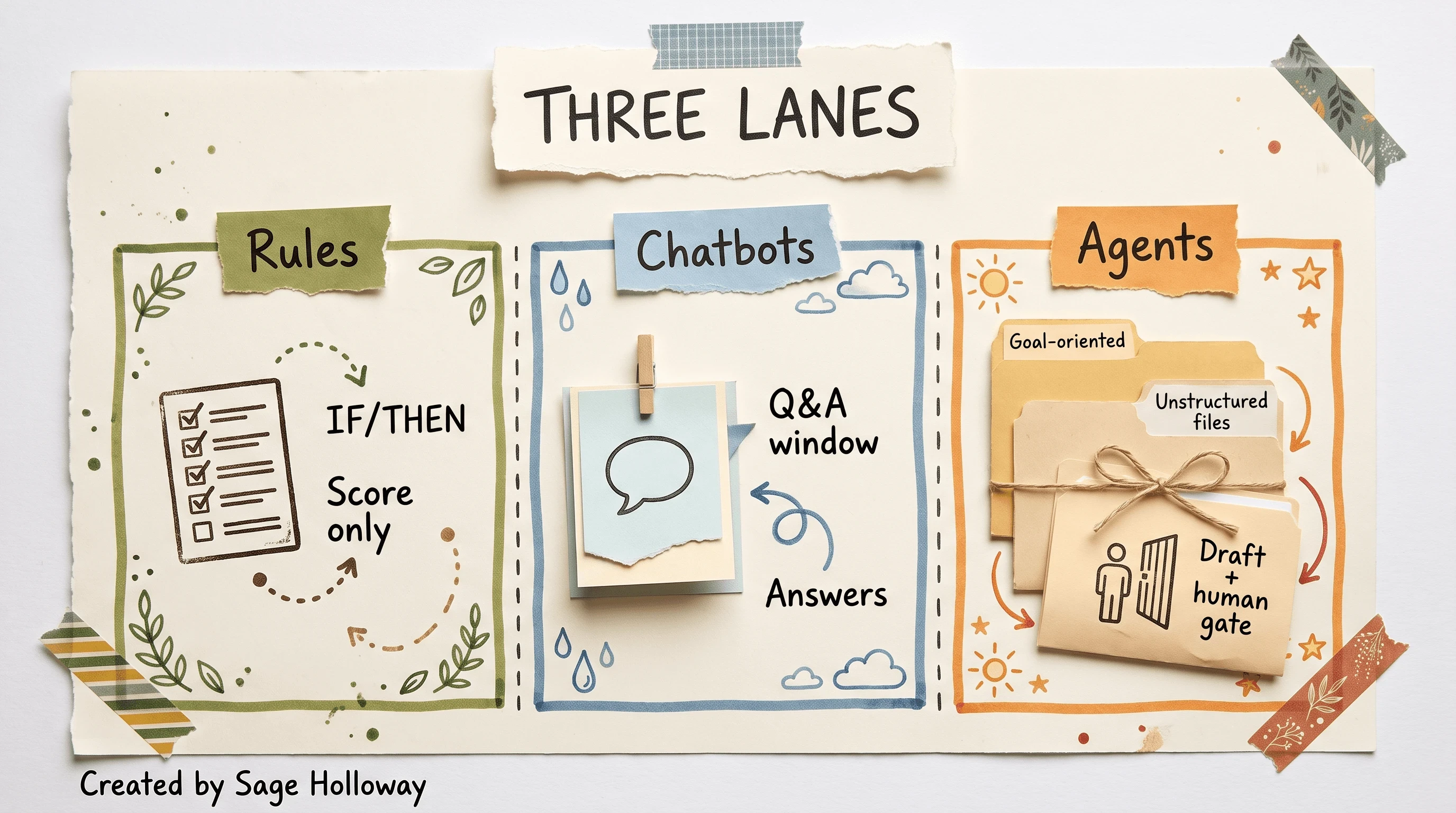
Rules score. Chatbots answer. Agents run multi-step triage with a human gate.
The honest limit lands early: human experts retain final regulatory accountability. Agents draft SARs and case files. They do not own the filing.
Why legacy screening and adjudication break
Before agents, the bottleneck was not "we need a smarter score." It was volume meeting silos meeting inconsistency.
False-positive load and alert fatigue
Legacy screening throws alerts that reviewers must clear one by one. Vendor pages often cite false-positive rates near 95%+ for traditional screening. Treat that figure as vendor-cited, not a universal statistic you can put in an examiner memo without your own baseline. What matters operationally is simpler: most L1 queues are noise, and noise burns the people who should be looking for real risk.
Alert fatigue is the quiet failure mode. After the twentieth near-match for the same common name, the twenty-first starts to look the same even when it is not.
Silos, inconsistent review, and SAR delay
The second failure is structural. Customer data lives in one system, transactions in another, adverse media in a third. Case review quality varies by who owns the queue that week. Suspicious Activity Report (SAR) drafting, the narrative regulators expect when activity looks suspicious, waits at the end of a chain that already lost hours to copy-paste.
Lucinity-style bottleneck lists map cleanly onto what practitioners complain about: alert volume, static rules, fragmented systems, inconsistent reviews, SAR delays, weak explainability, and staff burnout. Agents do not magically delete those problems. They change where the human spends time: from assembling the packet to judging it.
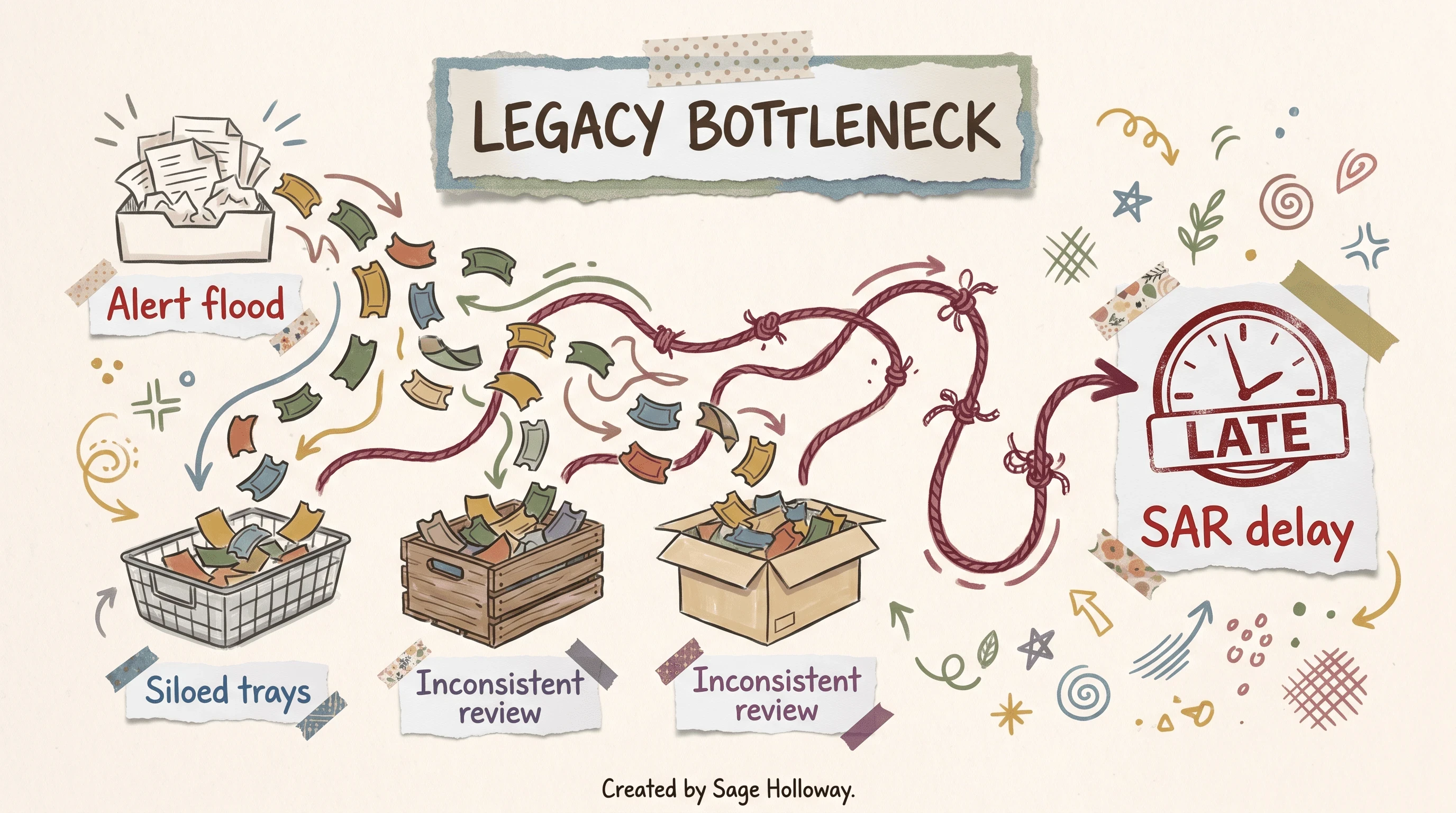
Legacy L1 queues drown reviewers before a SAR ever gets filed.
But here is the thing. Vendor pages love "90% less onboarding time" headlines. Reddit practitioners warn that poorly calibrated agents can double work because every draft still needs a second human pass. Both can be true in the same month. The difference is whether you shipped an audit trail and a QA sample before you trusted the draft.
Everyone upgrades the model. The examiner never asked for a smarter model. They asked for a trail.
Separate KYC, AML, and sanctions agent pipelines
Do not collapse onboarding, monitoring, and watchlist screening into one "compliance agent" monolith. In production they are different engines with different schemas, latency budgets, and APIs.
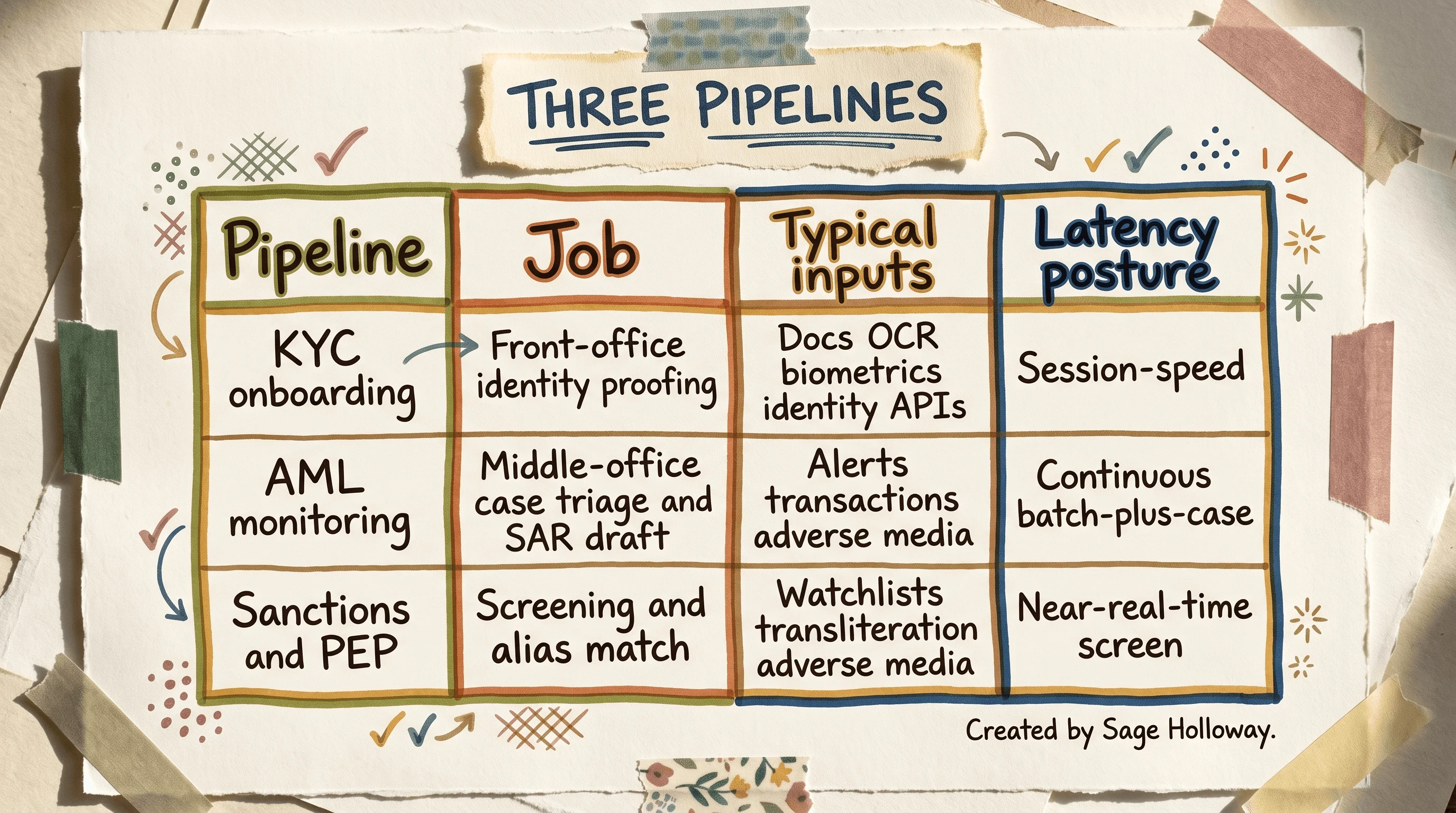
KYC onboards. AML monitors. Sanctions screens. Do not collapse them into one monolith.
Front-office KYC agent
A KYC AI agent (know-your-customer) runs at session speed during onboarding. It ingests identity documents, runs optical character recognition (OCR) to extract fields from scans, performs facial or liveness checks, and calls third-party identity APIs. Sources in this research pack name stacks that include Onfido, LexisNexis, and USPS-style checks alongside modular platforms such as Lyzr.
The front-office job is proofing: is this person who they claim to be, with documents that hold up, before the account opens. Latency is interactive. A five-minute delay feels like a broken funnel.
Public generative AI tools are a bad fit here. They risk PII leakage, GDPR exposure, and they lack proprietary watchlists. Prefer private VPC or private-cloud deployment so identity documents never sit on a consumer chatbot endpoint.
Middle-office AML investigation and detection
AI agents for AML compliance (anti-money-laundering) live in a different tempo. They watch alerts, transactions, and adverse media on a continuous batch-plus-case rhythm. Unit21's framing is the clearest separation inside that world: investigation agents gather evidence and draft case narratives or SARs; detection agents feed outcomes back into rules so the next alert wave is sharper.
Investigation is not the same as detection. One builds the case file. The other closes the loop into the monitoring logic. You need both if you want the system to improve instead of only drafting prettier tickets.
Sanctions and PEP screening
AI agents for sanctions screening sit on near-real-time watchlist and PEP (politically exposed persons) checks. The hard parts are transliteration, aliases, and adverse-media noise: the same person can appear under multiple spellings, shell entities, and news mentions that are not actually matches. Sanctions.io and AML Watcher-style sources emphasize NLP context and alias matching because string equality fails on real names.
Keep sanctions as its own pipeline even when it shares identity APIs with KYC. A failed onboarding check and a mid-life sanctions hit are different regulatory clocks.
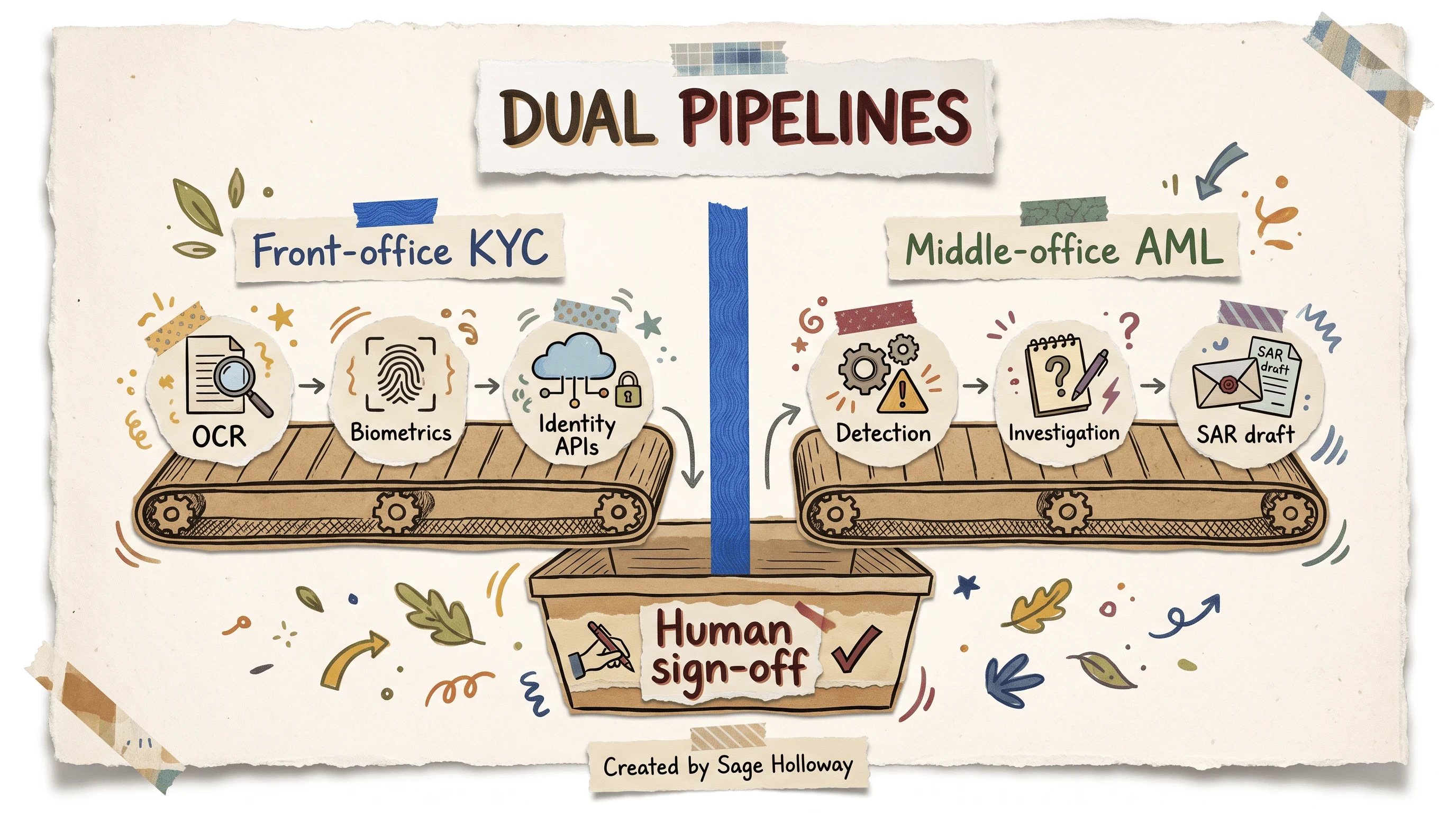
Front-office KYC and middle-office AML stay separate pipelines with a shared human gate.
This will not work if you give a document-reading KYC agent the same rights as a transaction executor "to save a connector." That shortcut is how speed-of-harm starts.
Multi-agent orchestration blueprints
Once pipelines are separate, orchestration is the layer that keeps state honest when APIs flake.
Detection agent vs investigation agent
Unit21's dual-agent pattern is the blueprint worth keeping even if you never buy Unit21. Detection agents score and route; investigation agents assemble evidence and draft. Humans still file. Feedback from closed cases updates detection so the queue does not replay the same false positive forever.
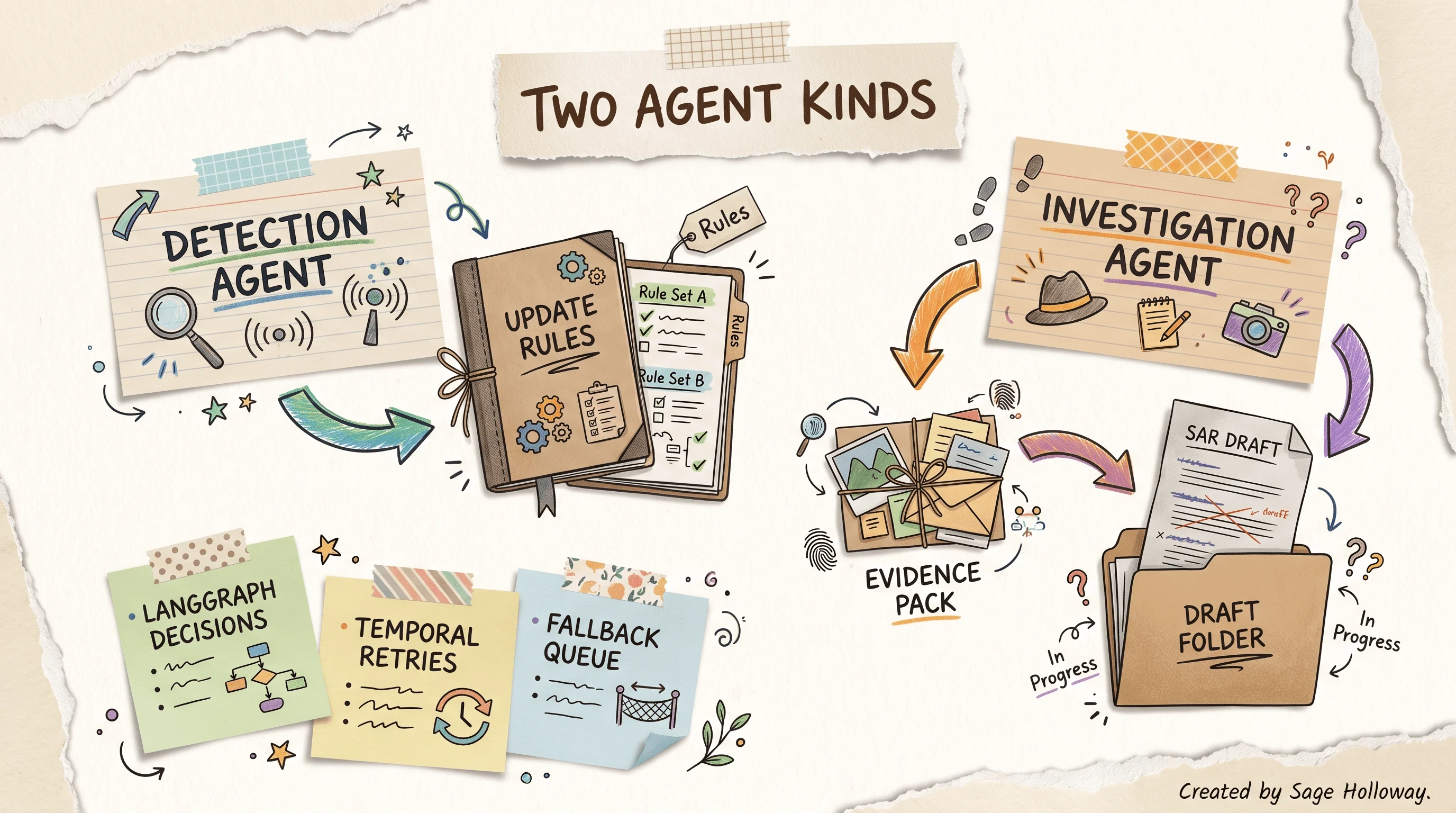
Detection closes the loop into rules. Investigation drafts the case. Humans still file.
Stateful loops without fragile glue
Custom builders on Reddit often name two tools together: LangGraph for agent decision graphs, and Temporal for durable, retryable workflow state. LangGraph decides the next investigative step. Temporal remembers where the run stopped when LexisNexis rate-limits or a webhook dies overnight.
Snowflake's platform writing describes a related enterprise pattern: a unified semantic layer (they name ModelMesh) so agents can reach unstructured "dark data" without every agent inventing its own retrieval path. Treat ModelMesh as a named vendor concept, not a field you invent in your own log schema.
Do not invent CLI flags here. The sources describe the pairing and the pain (state conflicts, dual-platform maintenance), not a paste-ready install script.
Failure modes and retries
Real deployments fail in boring ways. Plan for them as first-class list items:
Rate limits on identity or watchlist APIs
Circuit breakers when a vendor endpoint starts returning garbage
Fallback queues so a stalled enrichment step does not drop the case
Human escalation when confidence falls below your threshold
Replay of Temporal workflows after a partial write
Vendor demos draw straight lines. Your job is the line that bends when the API returns 429 at 2 a.m.
Build vs buy: two valid paths
Both paths are legitimate. The wrong choice is pretending they have the same maintenance profile.
Custom framework path
Build when you need deep control over the graph, private hosting, and a reasoning log you design yourself. The Reddit/custom path stacks LangGraph decisioning, Temporal retries, and your own connectors to OCR, biometrics, and watchlist APIs. Time to first pilot is longer. Audit ownership stays with you. Maintenance is yours when the graph drifts.
Anthropic's finance-agents announcement matters here as continuity, not as a rewrite of this page: ready-to-run financial agent templates include KYC screening patterns under Managed Agents and MCP partner surfaces. Use that as an official starting template if you are already in that ecosystem; do not confuse it with a finished BSA program.
Vendor and platform path
Buy when you need packaged KYC modules and connectors faster than your team can wire them. Sources in this pack repeatedly name Persona, spektr, and Lyzr-style modular stacks, plus Dataiku-style investigation assistants. Time to pilot shrinks. VPC control varies: confirm private VPC or private cloud before you put passports in a multi-tenant box. Audit ownership is shared with vendor exports, so you still need your own Traceability Log overlay.
For a buyer SERP that compares platforms rather than architectures, use the spoke at AI agents for KYC and transaction monitoring platforms. This URL owns the how-to architecture, not the directory.
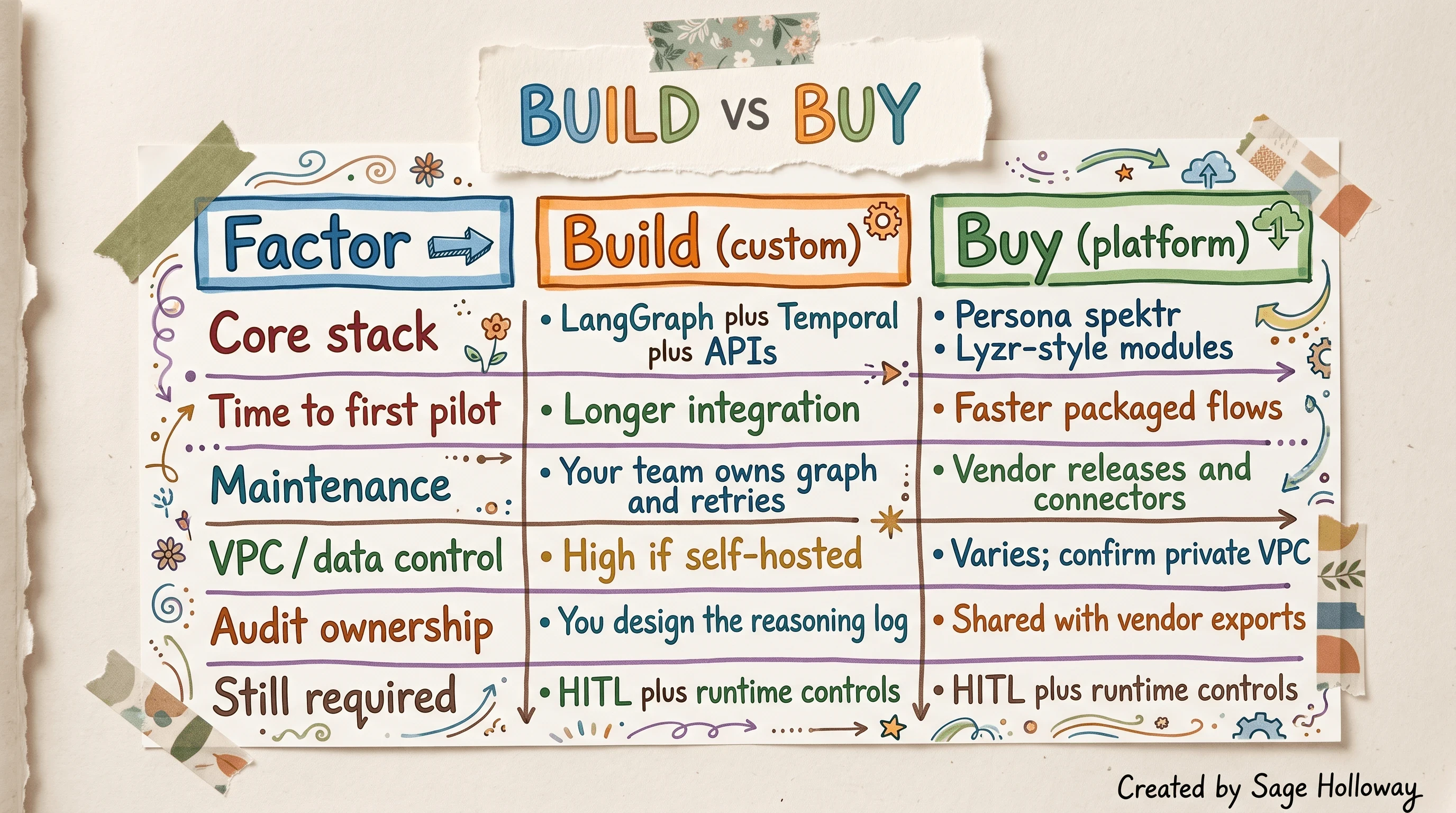
Build owns the graph. Buy owns the modules. Both still need HITL and runtime controls.
Notice the last row. HITL (human-in-the-loop) and runtime controls are required on both paths. Buying modules does not buy you out of the stamp.
Runtime security for speed-of-harm (2026)
Static IAM was built for deterministic apps. Agents are not deterministic apps.
Why static IAM fails for agents
Identity and access management (IAM) that only checks an API key at session start assumes the workload will do what yesterday's diagram said. Agents plan steps at runtime. They inherit broad tools. A compromised or prompt-injected agent can walk sideways faster than a nightly batch job can notice.
Speed-of-harm is the name for that gap: damage in seconds (exfiltration, micro-transactions, bulk reads) versus detection cycles measured in batches. ARMO's 2026 financial-services writing frames this against the U.S. Treasury Financial Services AI Risk Management Framework (FS AI RMF). Read their method as architecture guidance; treat marketing claims about "full containment" as marketing.
Snowflake's operationalizing AI agents in financial services post is useful for the platform side of the same problem: agents that can reach dark data still need governed retrieval and clear accountability, not just a clever prompt.
Observe, posture, detect, enforce
ARMO's implementation path is a four-stage loop you can adopt without buying their product UI:
Observe: see what each agent actually calls at runtime
Posture: define the intended permission shape per agent
Detect: catch behavioral drift and abuse patterns
Enforce: block the call that leaves the lane
eBPF-based runtime visibility shows up in that discussion as a kernel-level way to watch agent behavior without inventing program names in this article. The point is continuous enforcement, not a one-time role spreadsheet.
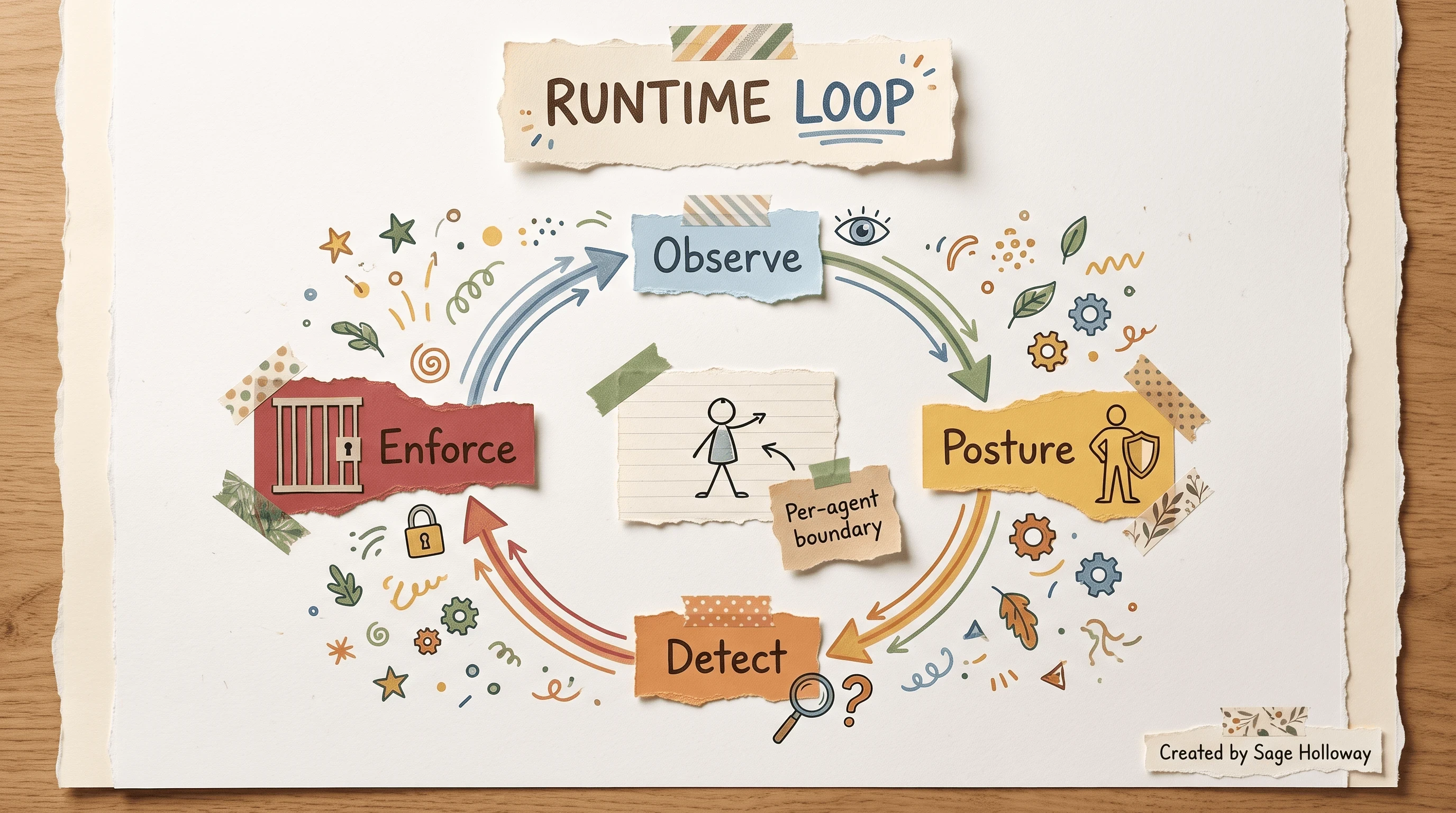
Static IAM is not enough. Runtime follows Observe, Posture, Detect, Enforce.
Per-agent permission boundaries
Map boundaries to jobs. A KYC reader that opens documents must not inherit a transaction executor's rights. A sanctions screener that hits watchlists must not get write access to customer PII stores it does not need. Per-agent risk profiles are the FS AI RMF-shaped habit: treat each agent like a staff role with a badge, not like "the AI user" with a master key.
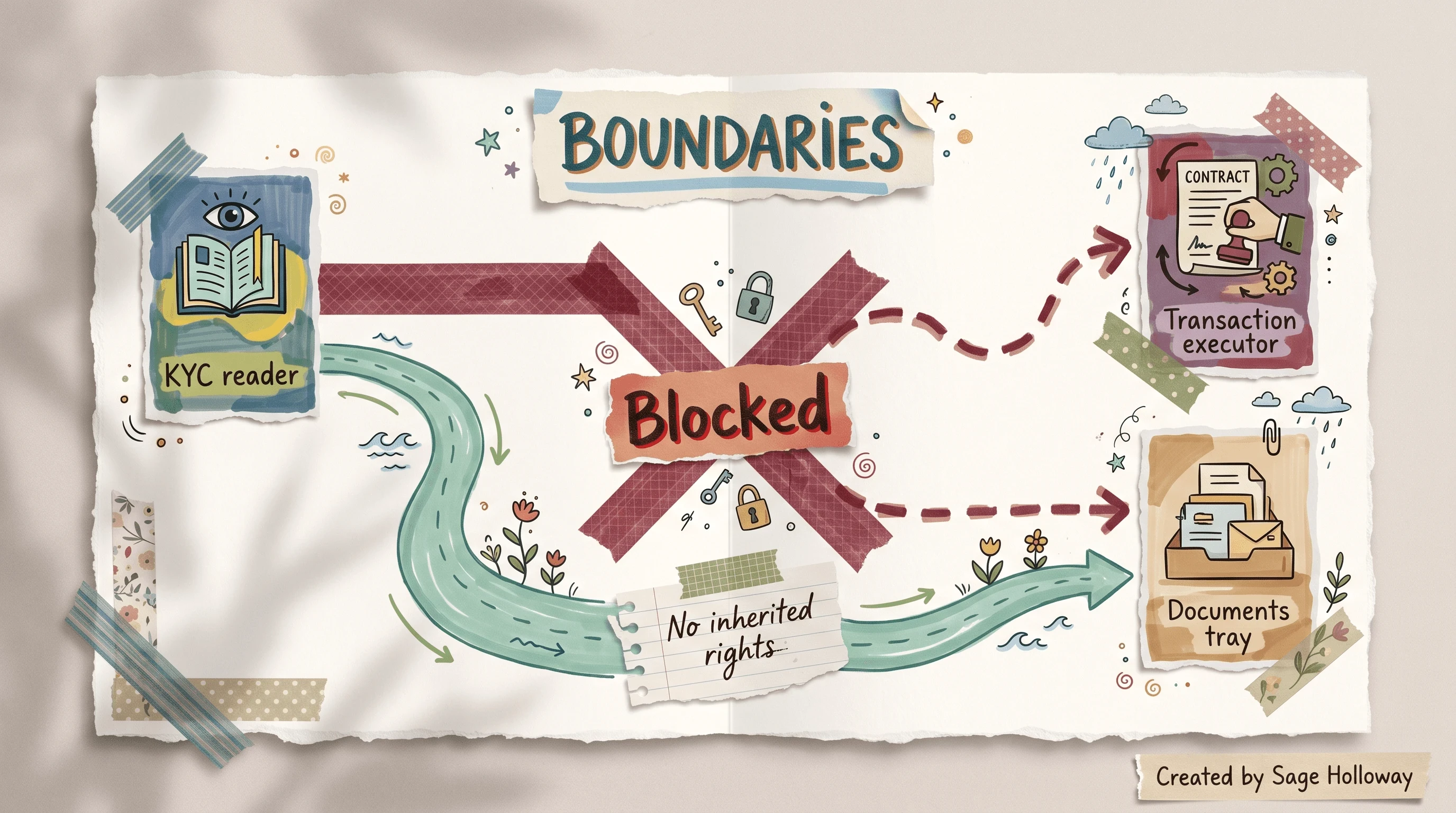
A KYC reader must not inherit a transaction executor's rights.
I tried a broad service account for a pilot once because it made demos smooth. The first time the agent took an unexpected tool path, the smoothness looked like negligence. Narrow the badge before you widen the autonomy.
For a deeper security walkthrough from the same research set, start with How Financial Services Teams Should Secure AI Agents in 2026.
Ship an examiner-ready reasoning log template
Explainability is the gap almost every vendor page names and almost none ship as a pasteable artifact. Here is a Traceability Log skeleton you can drop into case tooling. It is markdown on purpose: examiners read narratives, not screenshots of a vendor timeline.
Auto-close of low-risk queues is opt-in only after audit trails, QA sampling, and proven consistency across a high volume of alerts. Until that bar is met, the default stays "no." Constitutional or policy checks (rules the agent must satisfy before drafting) belong in the log as named evaluations, not as a vibe that "the model was careful."
If your platform uses Snowflake's ModelMesh concept as a semantic routing layer, note the route in the model/route block. Do not invent ModelMesh field IDs that sources never published.
This is the differentiator that survives a sales call. A polished diagram without a trail still fails an exam. A plain markdown trail with a human stamp is what the room can defend.
FAQ
What makes AI compliance agents different from rule-based tools?
Rule-based tools fire static IF/THEN conditions and mostly emit scores or alerts. AI compliance agents execute multi-step SOPs over unstructured files and draft reasoning narratives for human review. They still stop at human accountability; they do not replace the rulebook by themselves.
How do AI agents differ from chatbots in financial services?
Chatbots answer questions inside a conversation window. Agents are goal-oriented teammates that can cross systems, assemble evidence packets, and draft case files or SARs. If the work ends when the chat closes, you built a chatbot. If the work ends at a human stamp on a packet, you are in agent territory.
Can AI agents auto-close false-positive alerts without human oversight?
Only as a careful opt-in after audit trails, QA sampling, and proven consistency. Industry consensus in the sources keeps final regulatory accountability with human experts. Treat auto-close as a privilege you earn per queue, not a default switch.
Are LangGraph and Temporal a solid combo for custom KYC/AML workflows?
Yes for teams that want LangGraph for agent decisioning and Temporal for durable retries, which is a pairing practitioners discuss for custom KYC/AML loops. The tradeoff is operational complexity: two systems to monitor for state and errors, which is why some teams buy packaged modules instead.
Are AI agents secure enough for regulated financial institutions?
They can be, if you enforce permission-aware retrieval and per-agent runtime controls rather than a single broad service account. The 2026 Treasury FS AI RMF direction is continuous behavioral monitoring, not a static key check at deploy time.
What is the speed-of-harm problem for compliance agents?
Speed-of-harm means a compromised autonomous agent with broad access can cause damage in seconds, faster than legacy batch detection cycles. That is why runtime Observe → Posture → Detect → Enforce loops matter more for agents than for yesterday's deterministic batch jobs.
What are the risks of using public AI tools for KYC?
Public tools risk PII leakage, GDPR issues, and weak or missing proprietary watchlist coverage. They also hallucinate or overgeneralize on identity risk. Keep KYC documents inside private VPC or private-cloud agent stacks.
Can KYC verification agents run on private VPC infrastructure?
Yes. Modular multi-agent architectures in the sources support private VPC or private-cloud deployment so identity documents stay off public SaaS endpoints. Confirm that posture in writing before you run a production onboarding flow.
How should teams handle algorithmic bias in KYC face-matching?
Agents trained on biased historical data can reproduce discriminatory face-matching outcomes across groups. Audit models, train on diverse datasets, and keep mandatory human escalation for edge matches. Bias handling belongs in QA and HITL design, not as a silent model tweak.
The agents will keep getting better at drafting. The filing window will not get optional. What I would watch next is not another vendor ROI slide. It is whether firms confuse a confident narrative with a closed case because the prose sounded like the investigator. That failure mode is quieter than a breach headline, and it is already available to anyone who skips the stamp.
Pick one pipeline this week, KYC or AML, not both. Choose build or buy from the matrix above. Draft one Traceability Log for a fake alert using the template. Refuse any auto-filed SAR. If you need the broader GRC agent conversation, start at AI agents for compliance. If you need Anthropic's industry surface rather than this architecture guide, use Anthropic financial services.
Until then...
Sage
PS. The first compliance packet I ever "finished" overnight came back with one handwritten note in the margin: "Who decided?" I still hear that question when a draft looks too clean. If your log cannot answer it in one screen, the packet is not finished.
Author
Practical guides, tool teardowns & AI engineering workflows.


