AI for Finance
Anthropic Financial Services: Agents, MCP, and the Trust-Gap Harness

Sage Holloway
19 min read
Go back to blog
SHARE

The deck looks finished before lunch. The breaks list looks clean. Someone already forwarded the PDF. Nobody can say which check ran outside the chat, or whether the numbers would survive a partner who hates confidence more than delay.
Anthropic financial services delivers 10 pre-built vertical agents for analyst operations like GL reconciliation and pitchbook creation. Because LLM agents are probabilistic by design, regulated deployments need a deterministic validation harness around them, plus a plan for legacy core data beyond premium MCP connectors.
Last year the same close lived in six workbooks and a Slack thread that never archived. This year a named agent can stage a pitch, a model refresh, or a break list while you are still in standup. The ledger still waits. The committee still votes. Anthropic finance did not get the stamp.
If you have ever watched a beautiful draft walk toward a production sheet before anyone ran a schema check, this is that wall, named.
This guide will not become a Claude wealth management plugin tour, a tenant admin manual for adding Claude to Excel, a filings pedagogy page, or a full KYC and AML compliance-agent architecture. Those jobs live on sibling URLs. What follows is the industry offering: what ships, which surfaces to pick, how MCP splits premium feeds from legacy cores, how to build the harness ranking pages skip, and who this stack is not for.
On this page
What Anthropic financial services ships (10 agents)
Office tooling, skills, and file pipelines
MCP connectors: premium feeds vs custom gateways
Build a deterministic harness around FS agents
Client impact and adoption without slide-deck fluff
Who this stack is not for
FAQ
Agents draft. The harness decides what can leave the desk.
What Anthropic financial services ships (10 agents)
Think of a dual-control vault at a small bank. One person can assemble the cash tray. Another person holds the second key. The tray can look perfect and still sit on the wrong side of the door until both keys turn. Nobody confuses a tidy tray with an opened vault. The second key is not pessimism. It is the job.
That is the posture behind Claude for financial services. Anthropic's May 2026 finance-agents materials and the open anthropics/financial-services repo ship ten named agents as starting templates. Each agent drafts analyst work product. The README is blunt: outputs are staged for human sign-off. They do not recommend investments, execute trades, bind risk, post to a ledger, or approve onboarding.
July 2025 pages often framed Claude for Financial Services as a unified data solution. May 2026 materials emphasize modular agents and plugins. Read both eras as the same brand arc, not as identical architecture. If your internal deck still says "one mesh, one install," update the picture before you buy the story.
Research and Client Coverage vs Finance and Operations
Official reference materials group the ten agents across research and coverage work versus finance and operations work. The GitHub table is more granular (coverage and advisory, research and modeling, fund admin, operations and onboarding), but the useful mental model stays two tracks sharing one stack.
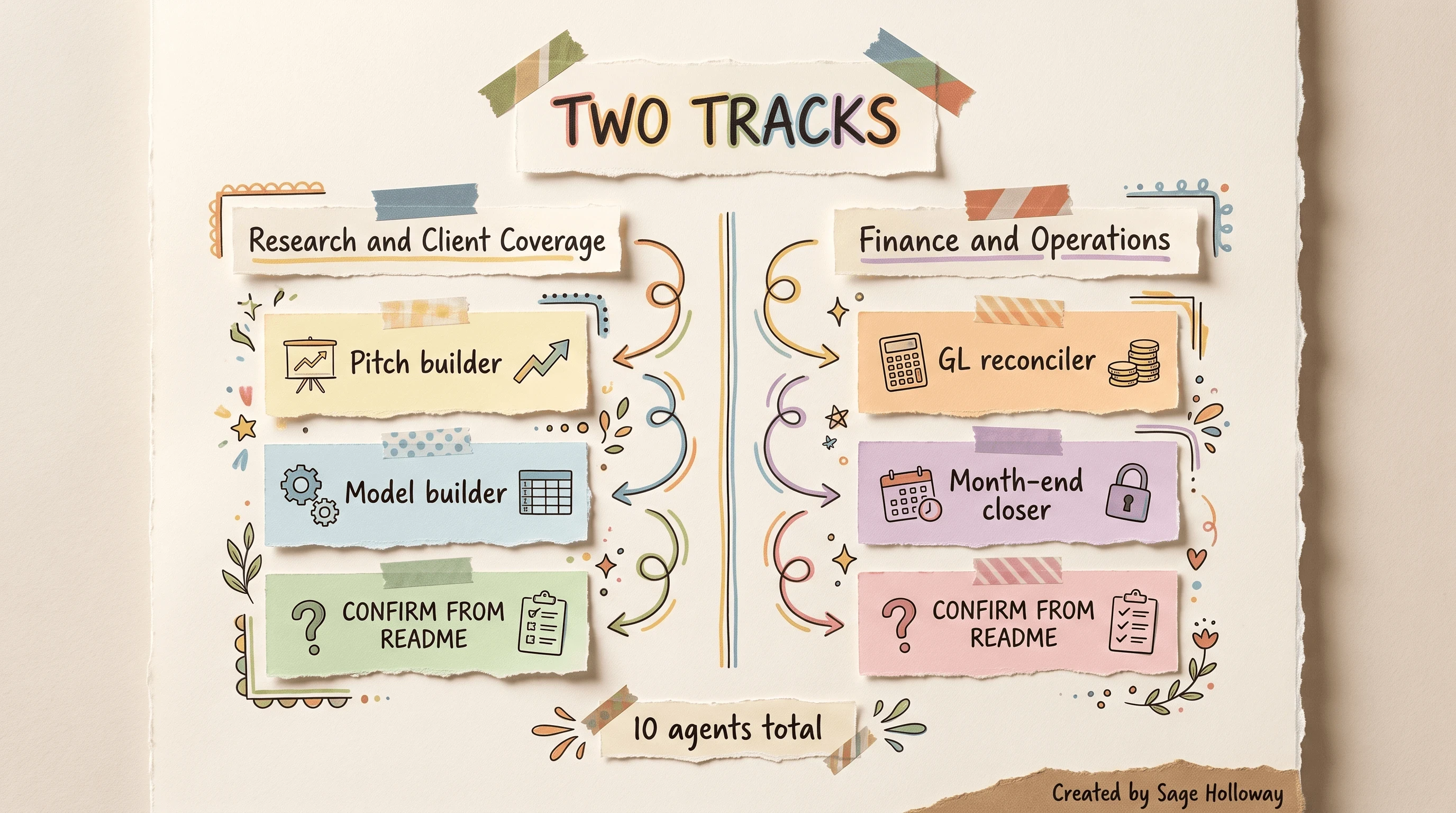
Research covers clients. Operations closes the books. Same stack, two tracks.
Research and client coverage agents include the Pitch Agent (comps, precedents, LBO into a branded deck), Meeting Prep Agent, Market Researcher, Earnings Reviewer, and Model Builder. Finance and operations agents include the Valuation Reviewer, GL Reconciler, Month-End Closer, Statement Auditor, and KYC Screener. Claude financial services naming in search often lands on the same inventory; treat it as a synonym for this offering, not a second product.
Agent jobs and slash commands as inventory
Agents are job templates. Slash commands are explicit triggers for skills inside vertical plugins. Neither is a ledger post.
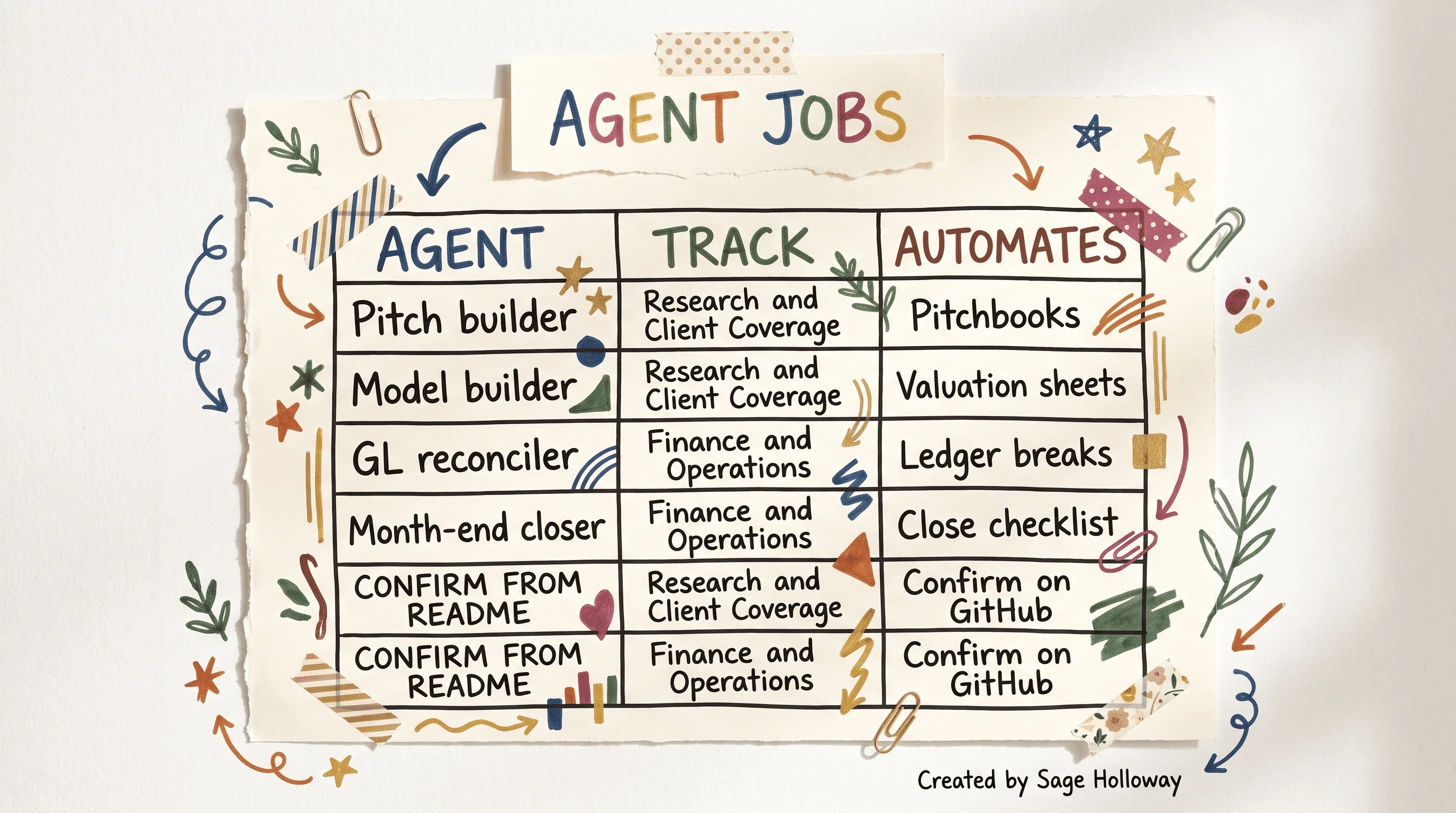
Pre-built agents are job templates. Confirm the full ten against the GitHub README before you pilot.
The official agent list to confirm against the live README:
Pitch Agent: comps, precedents, LBO into a pitch deck draft
Meeting Prep Agent: client briefing pack
Market Researcher: sector overview, peers, idea shortlist
Earnings Reviewer: call plus filings into model update and note draft
Model Builder: DCF, LBO, three-statement, comps in Excel
Valuation Reviewer: GP packages into valuation template and LP reporting stage
GL Reconciler: finds breaks, traces cause, routes for sign-off
Month-End Closer: accruals, roll-forwards, variance commentary
Statement Auditor: LP statement review before distribution
KYC Screener: onboarding docs through a rules grid with gap flags
Vertical plugins also register slash commands such as /comps, /dcf, /earnings, and /ic-memo. Use them as drafts. Treat them as committee votes only after a human says so.
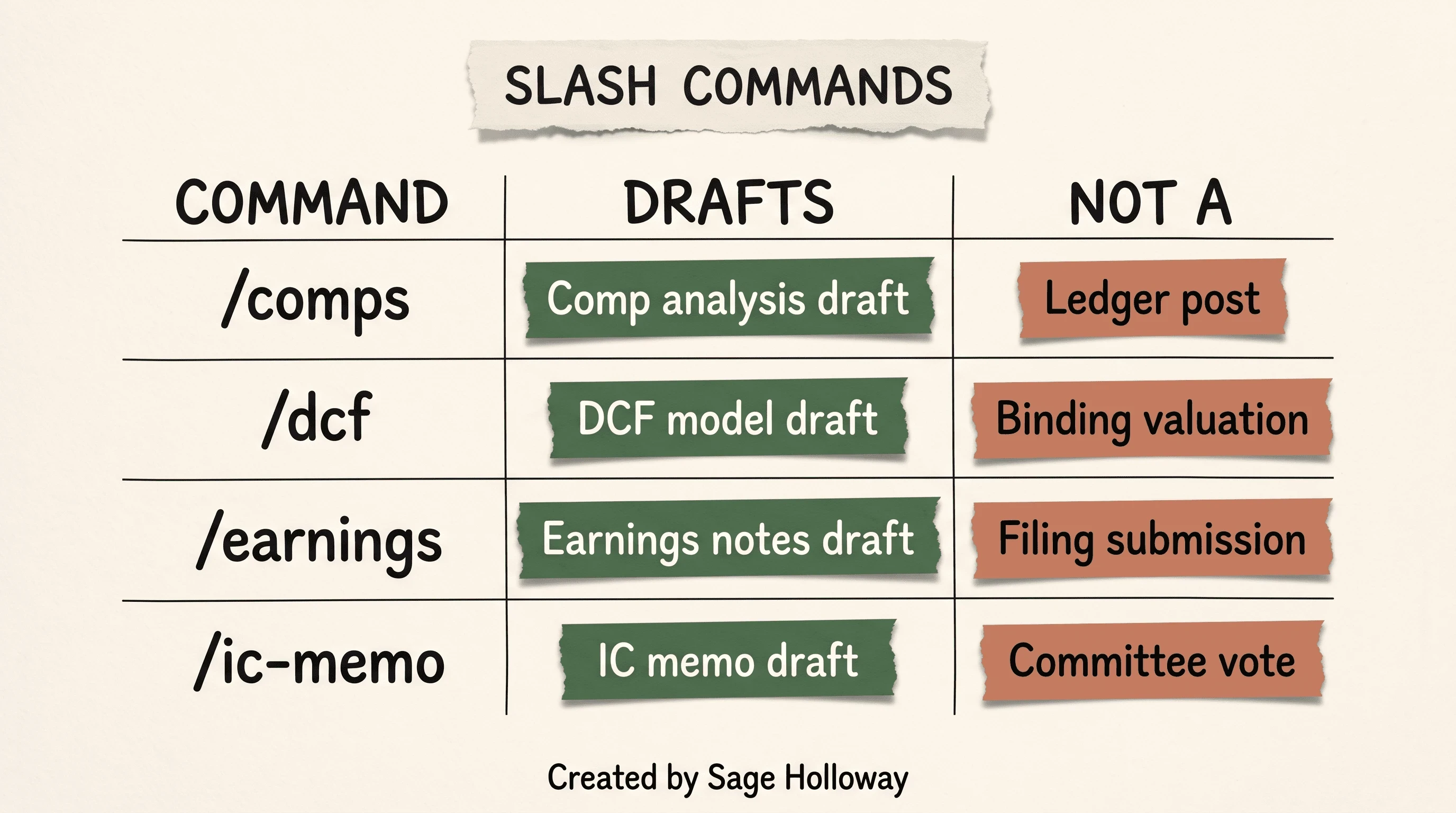
Slash commands draft analyst work product. They are not ledger posts.
If you want the live demo texture before you touch a CLI, Anthropic's Briefing recording walks the agents and Office add-in flows in one sitting:
https://www.youtube.com/watch?v=W3RLgeUiUXY
Anthropic Briefing keynote: finance agents and Office add-in demos (Bloomberg Television cut of the unveil).
Office tooling, skills, and file pipelines
Agents do not live in one window. Claude for financial services shows up across Chat, Cowork, Code, Microsoft 365, the Platform API, and Managed Agents. Pick the surface for the job, not the surface with the nicest screenshot.
Product surfaces (Chat, Cowork, Code, M365, Platform, Managed Agents)
Six surfaces. Same stack. Different jobs and runtimes.
Chat fits interactive analysis in a browser. Cowork fits multi-app desktop projects where you dispatch agents and drop files. Claude Code fits repo and CLI work for engineers who want marketplace installs and scripts. Claude for Microsoft 365 puts the model inside Excel, PowerPoint, Word, and Outlook for finance teams. Platform is the custom skills and API path. Managed Agents is the headless /v1/agents path for platform teams who want the same system prompts behind their own workflow engine.
Tenant admin depth for Microsoft Graph, Azure consent, and private routing belongs on the Excel install guide, not here. Soft-link when you need it: how to add Claude to Excel. Headless cloud deploy is a different SERP entirely: keep Claude Managed Agents API as the spoke, and treat Claude Code as the terminal workflow spoke when you are writing quant CLI runbooks.
Marketplace install without a Prerequisites chapter
You do not need a twelve-step "prerequisites" essay to get a non-production sample running. You need the marketplace, the core vertical, and one agent.
In Cowork, Settings → Plugins → Add plugin also accepts the GitHub repo URL, or a zip of a single agent directory under plugins/agent-plugins/. Zip the whole repo and you will earn the plugin validation error practitioners keep filing. Zip plugins/agent-plugins/pitch-agent/ when you only want Pitch Agent.
Repo scripts worth knowing once you customize YAML: python3 scripts/sync-agent-skills.py to propagate skill edits, python3 scripts/check.py before you trust a fork, and scripts/deploy-managed-agent.sh gl-reconciler when you leave desktop for Managed Agents.
This will not work if you skip auth, if you install an agent before the financial-analysis core when you still need its connectors, or if you treat a staged draft as a posted journal entry.
Excel to PPT to PDF pipeline pattern
The cookbook pattern that saves tokens is boring and correct. Build one structured dataset (JSON or CSV). Feed Excel, PowerPoint, and PDF skills in sequence from that same file. Do not regenerate the narrative from chat three times and hope the totals match.
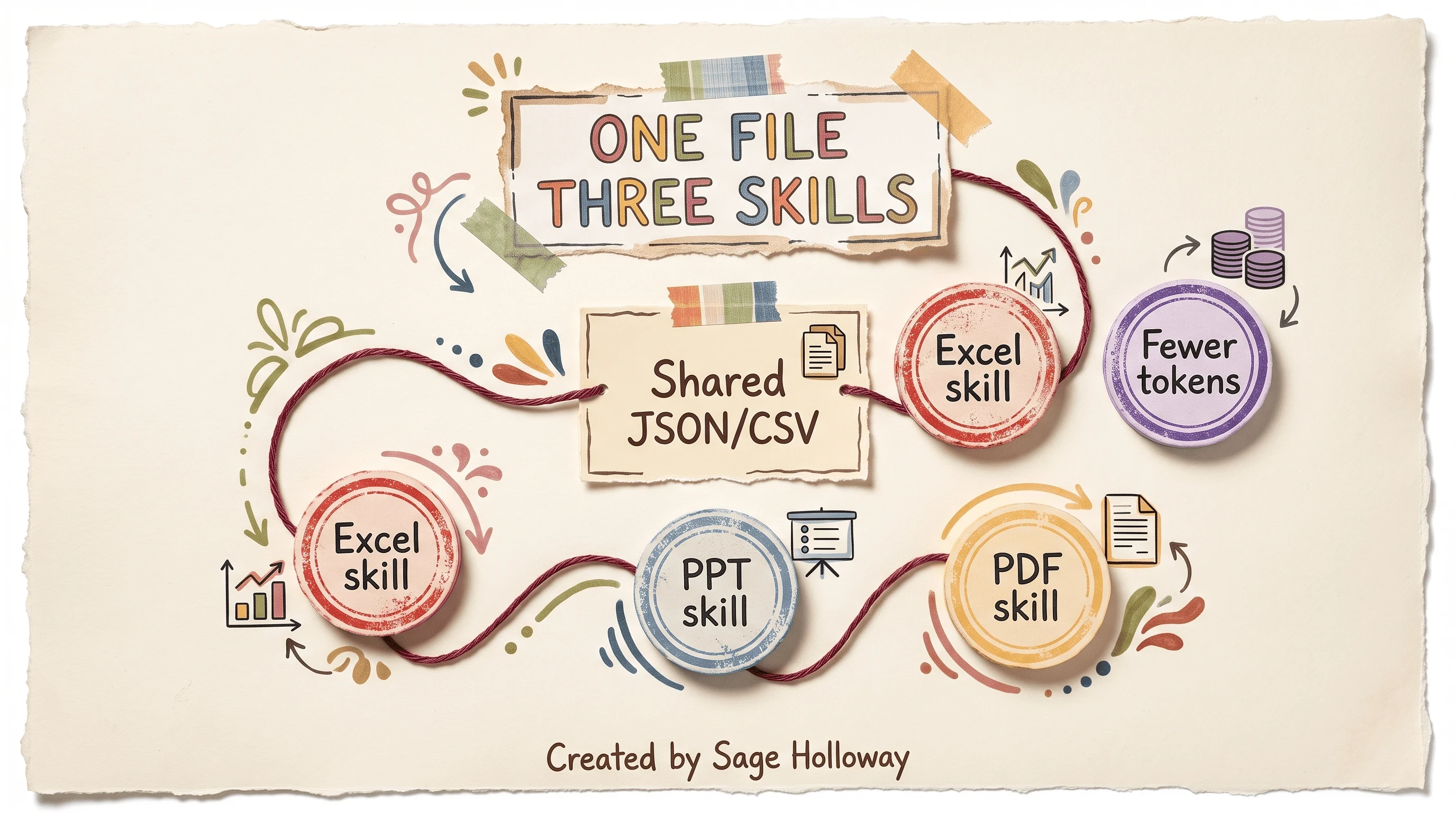
One structured file. Three skills. Fewer tokens than regenerating from chat each time.
Skills such as comps-analysis, dcf-model, and audit-xls show up as table rows in the vertical plugin reference, not as magic menu chrome. They are methods Claude draws on when relevant, or when you fire the matching slash command. For modeling pedagogy rather than this industry inventory, use AI financial modeling. For filings and audit workflows, use Claude financial analysis.
Custom skills on the Platform path need a pinned SDK and explicit betas. Cookbook finance notebooks in the pack call for Python SDK 0.69.0, a message create that passes container={"skills": skills}, and betas including code-execution-2025-08-25, files-api-2025-04-14, and skills-2025-10-02.
Claude can author spreadsheet charts and write Python that draws plots. It cannot natively mint logo vectors or video files inside chat. Plan brand assets elsewhere.
MCP connectors: premium feeds vs custom gateways
Model Context Protocol (MCP) is the wiring pattern that lets Claude talk to external tools and data servers through a declared config instead of a one-off scrape. Anthropic financial services documents partner MCP connectors for market and document feeds. That is the premium path. Your legacy core is a different path.
Partner MCP connector set
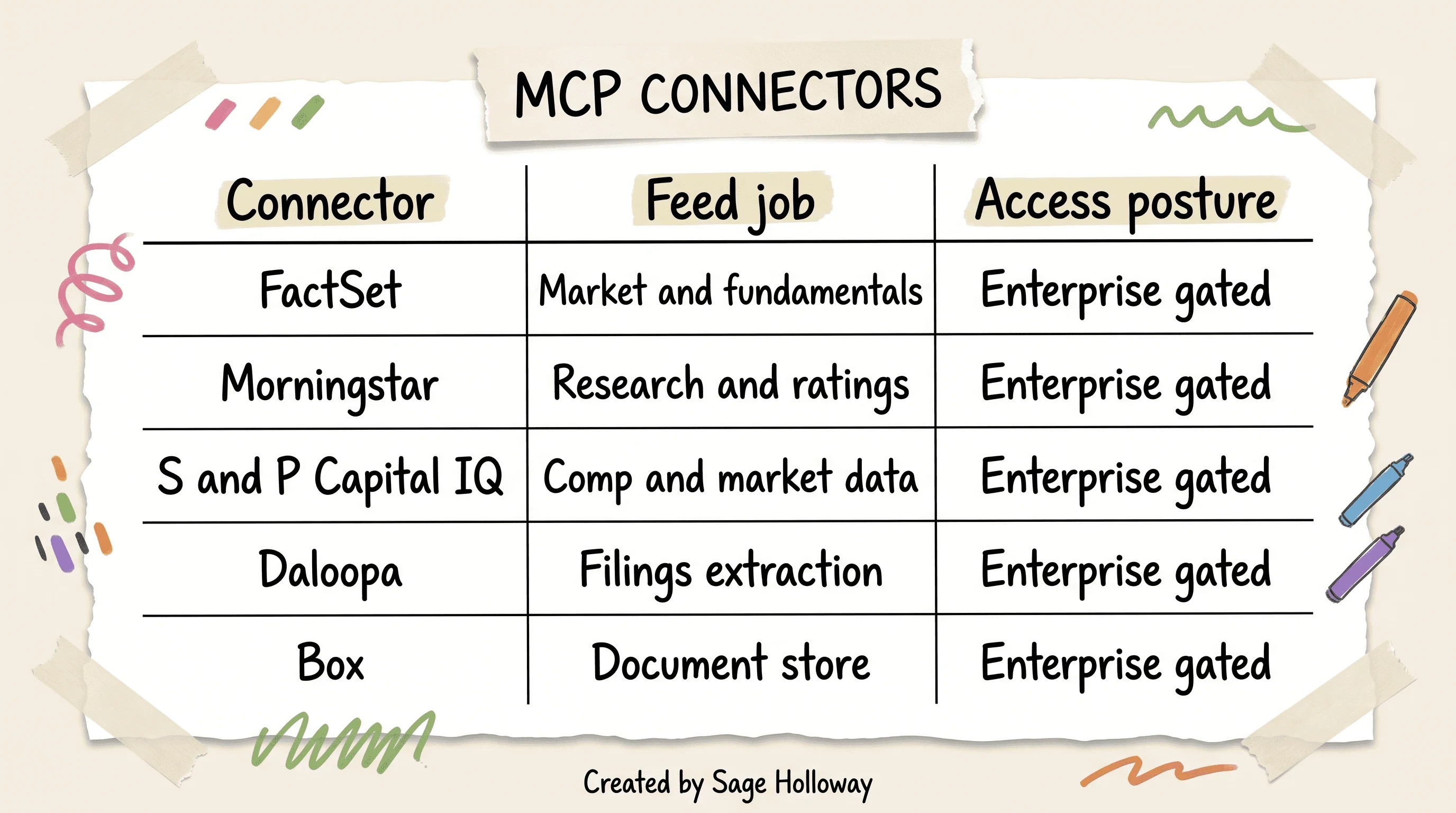
Official connectors are enterprise feeds. They do not replace a legacy-core plan.
The financial-analysis core plugin centralizes connectors. Named partners in the pack include FactSet (market and fundamentals), Morningstar (research and ratings), S&P Capital IQ (comp and market data), Daloopa (filings extraction), and Box (document store). The live README also lists additional providers such as Moody's, LSEG, PitchBook, and others. Treat access as enterprise-gated. Subscriptions and API keys sit with the provider, not inside a free Chat session.
Do not turn this section into a small-team tutorial for feeds you cannot buy. If you need the connector inventory for architecture slides, point to the finance-agents announcement and the repo MCP table. If you need examiner-ready controls around KYC screening agents, return to AI agents for financial services compliance.
Private and legacy gateway patterns
Premium trays do not speak to every battered filing cabinet in your estate. Practitioners keep repeating the same gap: official sources shine on modern SaaS connectors and say little about messy legacy SQL or filesystem cores.
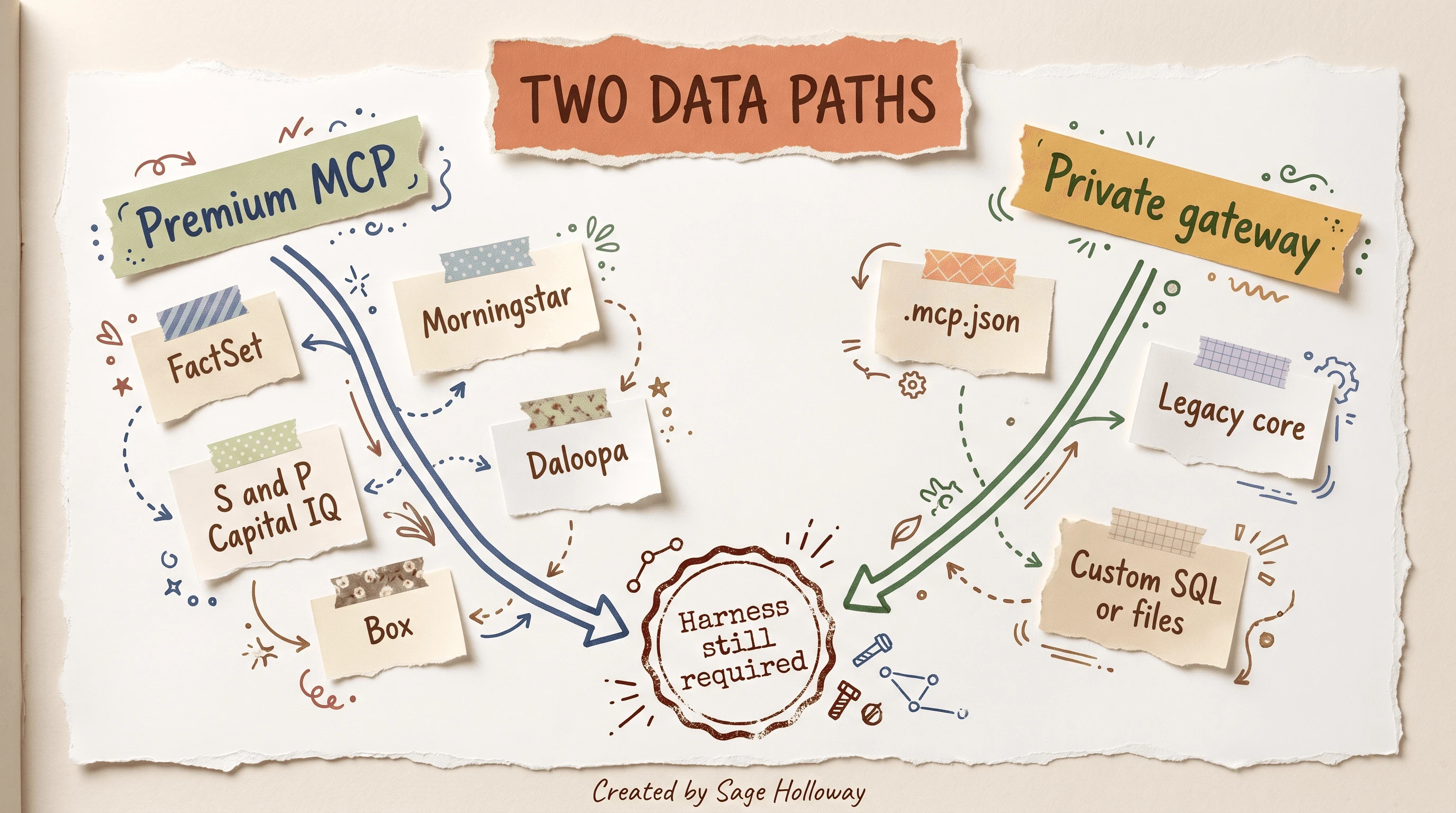
Premium feeds ship. Legacy cores need a private gateway and a harness.
The repo expresses connector wiring in .mcp.json under the financial-analysis vertical. Partner entries look like URL-backed MCP servers. For private systems, the pattern is the same shape with your own gateway in the middle: Claude talks to a controlled MCP server; that server talks to legacy data under your IAM, logging, and redaction rules. Do not invent hostnames. Do invent a review gate before any agent output can write downstream.
The legacy-core block above is a shape, not a shipped binary. Your platform team fills the command. Your risk team fills the data boundaries. Your harness decides whether an agent draft may leave the desk.
Retail traders do not get native live market data through this stack. That barrier is intentional enterprise positioning, not a missing FAQ answer you can prompt away. More on that under Who this stack is not for.
Build a deterministic harness around FS agents
Here is the gap almost nobody puts in the launch post.
You bought templates. Templates are markdown, YAML, skills, and connectors. Reddit practitioners call that a small fraction of production integration work. One thread framed GitHub templates as about 5% of the job. Whether your number is 5% or 15%, the remaining work is the same category: deterministic systems around a probabilistic model.
The trust gap in probabilistic finance agents
A probabilistic agent samples likely next actions and text. A deterministic check returns the same answer for the same inputs every time. Finance ops has a low tolerance for "usually right." That mismatch is the trust gap.
Official pages present agents like the GL Reconciler and Month-End Closer as ready workflow starters. They are. Starter is not production-safe. The honest constraint Anthropic cannot delete for you: the model will still be a model. Your firm still owns the stamp.
I tried shipping a recon draft to reviewers with only "looks good in chat" as the gate. It did not work the way I expected. The break list was fluent. Two of the "resolved" items were still open in the source extract. Fluency is not a control.
You are not buying ten agents. You are buying ten draft writers and still owing the gate.
Validation, state tracking, and human review
Build the loop outside the model. Agent draft lands in a staging store. Schema validation rejects malformed packets. State tracking records which inputs, which skill versions, and which human saw the packet. A human-in-the-loop (HITL) queue holds anything that would touch a ledger, a client memo distribution, or an onboarding decision. Optional branch: send spreadsheet math to a code sandbox instead of trusting nested formula invention in-sheet.
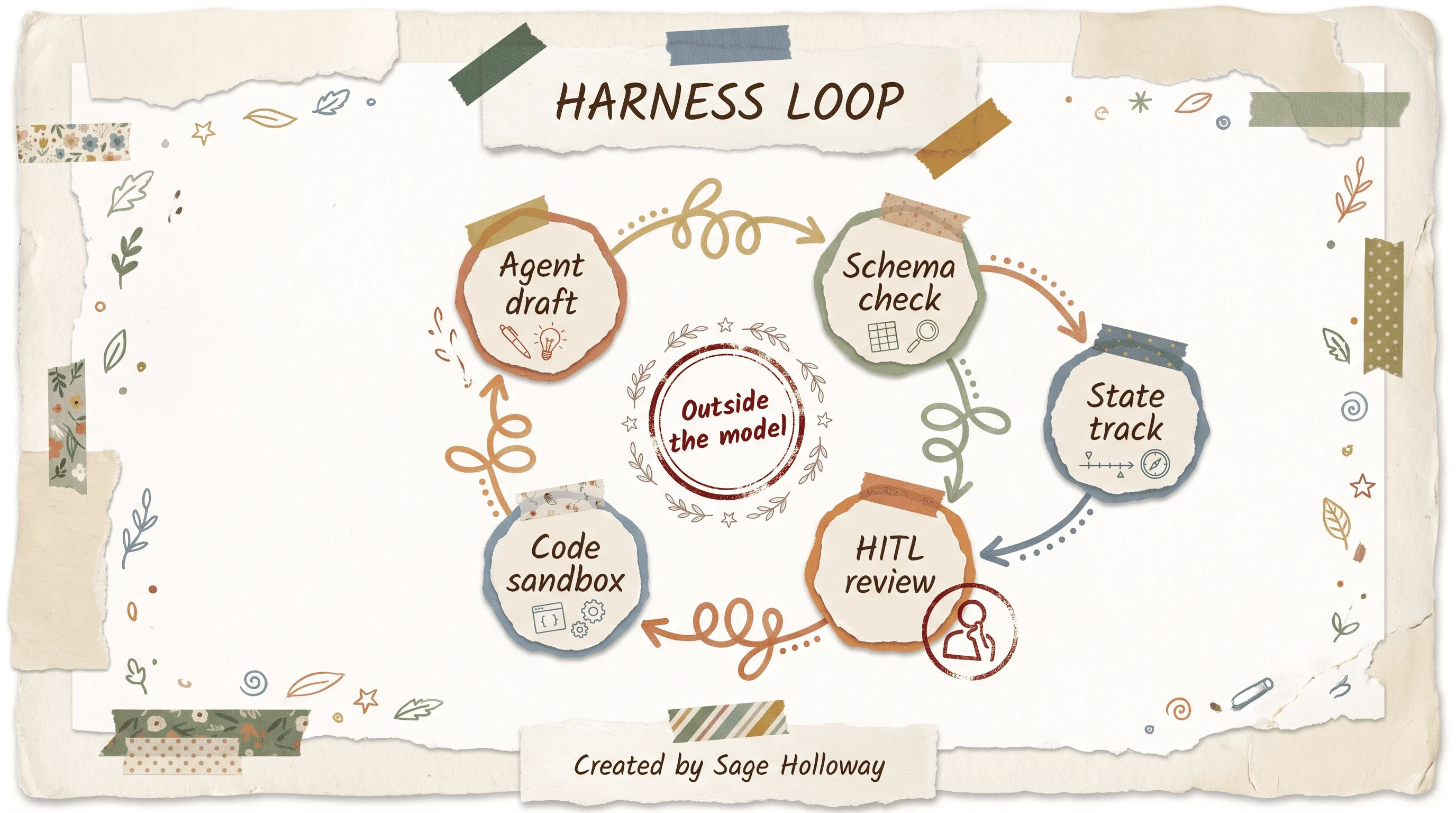
Probabilistic agents need a deterministic loop outside the model.
Minimum harness checklist for a pilot:
Define the output schema for one agent (fields, types, required cites).
Reject drafts that fail schema before a human opens them.
Store run state: input hash, skill or plugin version, model id, reviewer id, decision.
Route ledger-bound or client-bound packets to a named review queue.
Log refusals the same way you log approvals. Silence is not an audit trail.
No invented hook filenames. No claim that a clever prompt replaces the queue. If your compliance sibling page already owns examiner Traceability Logs, borrow the spirit and keep this page on FS agent inventory plus harness shape.
Offload spreadsheet math to deterministic code
Official materials cite strong Excel benchmark numbers, including an 83% score on complex Financial Modeling World Cup-style tasks in older Claude for Financial Services positioning. Practitioner threads still report nested formula hallucinations and confident wrong math on messy CSVs. Both can be true. A benchmark on clean tasks is not a permission slip for unsupervised arithmetic on production extracts.
Use the code-execution beta path so Claude writes Python (or calls a sandbox) and the runtime does the math. Keep openpyxl-style file edits behind tests you own. Pair heavy sheets with /debug-model style audit skills when you stay in Excel. Prefer a regenerated CSV of calculated columns over a chat that "fixed" a circular reference by deleting the link.
But here is the thing. The harness does not make agents useless. It makes them shippable. Without it, you have a demo. With it, you have a desk that can survive a skeptical partner.
Client impact and adoption without slide-deck fluff
Anthropic finance marketing will give you ROI minutes. Your job is to keep the minutes honest.
De-biased ROI and human overhead
Case metrics in the pack include examples such as Moody's memo prep compressing from 40 hours to 2 minutes, and AIG underwriting speed cited around a 5x compression. Those numbers are real marketing claims in Anthropic materials. They are not a full cost model until you add pre-processing, post-processing, and review overhead.
Ask two numbers every time someone pastes a case study into a steering deck: minutes of model time, and minutes of human time still required after the draft lands. If the second number is missing, the first number is unfinished.
Foundation, pilot, and scale as actions
The deployment PDF frames adoption as Foundation, Pilot, and Scale. Keep it as actions with exit gates, not as consulting poetry.
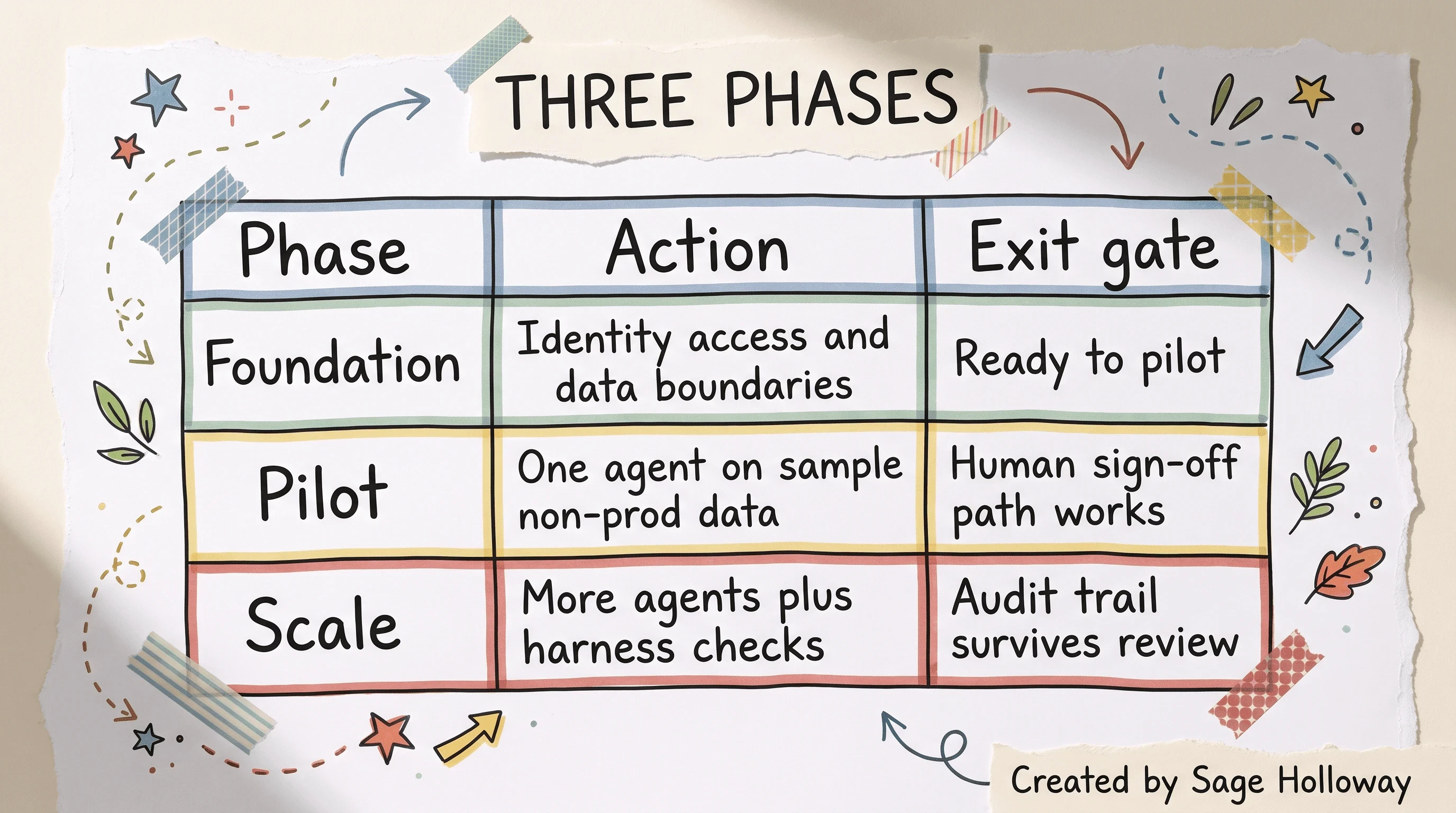
Foundation, Pilot, Scale. Actions only. No slide-deck fluff.
Foundation: identity, access, and data boundaries until you are ready to pilot. Pilot: one agent on sample non-production data until a human sign-off path works end to end. Scale: more agents plus harness checks until the audit trail survives an internal review. Exit early if the harness is still a spreadsheet of vibes.
Privacy defaults and implementation partners
Default enterprise posture in Anthropic's financial services materials: client data is not used to train models. Confirm the contract language your firm actually signed. Implementation partners named across Anthropic's ecosystem materials include Deloitte, KPMG, PwC, Slalom, and Accenture. Treat partner logos as delivery capacity, not as a substitute for your harness.
Governance without runtime controls is a slide. Runtime controls without a Traceability habit is a gap. Soft-link the compliance depth when you need examiner-ready logs: AI agents for financial services compliance.
Who this stack is not for
This stack is an enterprise-gated industry offering. It is not a free retail day-trading bot. Official high-trust live market feeds sit behind enterprise relationships. Personal budget templates and consumer expense agents are intentionally out of scope in official FS positioning.
If your job is a household cash-flow sheet, this page will waste your afternoon. If your job is a regulated desk that needs pitch drafts, recon breaks, and MCP-fed research under human sign-off, stay. If you need advisor staging commands specifically, use the Claude wealth management plugin spoke instead of forcing wealth depth onto this hub.
Do not promote retail workarounds here. Do not invent video IDs for paper-trading demos. The boundary is the product.
FAQ
What are the 10 pre-built financial agents, and what do they automate?
Anthropic's reference architecture ships ten ready agents across research and coverage versus finance and operations work. They automate drafts such as pitchbooks (Pitch Agent), valuation sheets (Model Builder), GL break lists (GL Reconciler), month-end close commentary (Month-End Closer), and related workflows listed in the GitHub agents table. Every output stays staged for human sign-off.
How do I install the financial services plugins in Claude Code?
Add the marketplace with claude plugin marketplace add anthropics/financial-services, install the core with claude plugin install financial-analysis@claude-for-financial-services, then install named agents such as pitch-agent@claude-for-financial-services or gl-reconciler@claude-for-financial-services. Confirm slugs against the live README before you script them.
How does Anthropic handle enterprise client data and training use?
Anthropic's financial services materials state that, by default, client data processed through enterprise products is not used to train generative models. Confirm the exact terms in your enterprise agreement before you treat marketing language as the control.
What is the trust gap in agentic finance workflows, and how do engineers close it?
The trust gap is the risk of using probabilistic LLM agents for workflows that demand deterministic math and auditability. Engineers close it with infrastructure outside the model: schema validation, state tracking, and human-in-the-loop review queues, not with a smarter prompt alone.
Can retail traders get official live market data through Claude for Financial Services?
No. Official high-trust market data integrations are enterprise-gated. Retail traders do not get native live feeds through this stack and should not treat community bots as a substitute for the official connectors.
Why do I get a plugin validation error when loading an agent in Claude Cowork?
Cowork rejects a zip of the entire financial-services repository as one plugin. Zip only the self-contained agent folder you want, for example plugins/agent-plugins/pitch-agent/, then upload that archive.
Can Claude generate charts, logo vectors, or videos inside chat?
Claude cannot natively generate videos or static logo-vector images in chat. It can write Python or produce spreadsheet files that contain data-driven charts. Plan brand video and logo work outside the chat surface.
How do I chain Excel, PowerPoint, and PDF deliverables without wasting tokens?
Use a pipeline pattern: one shared JSON or CSV dataset, then sequential Excel, PowerPoint, and PDF skills. Structured rows cost far fewer tokens than regenerating the same narrative as prose three times, and the numbers stay aligned across files.
What SDK version and beta headers are required for custom finance skills?
Cookbook finance skill paths in the pack call for Python SDK 0.69.0, a container={"skills": skills} argument on message create, and betas code-execution-2025-08-25, files-api-2025-04-14, and skills-2025-10-02. Re-check the live notebook before you pin versions in CI.
The agents will keep getting better at drafting. The second key will not become optional. What I would watch next is whether firms confuse a polished Office pipeline with a closed control environment because the PDF landed before the harness did. That failure mode is quieter than a breach headline, and it is already available to anyone who skips the gate.
Install one agent plugin on a non-production sample this week. Run one slash command. Refuse any output that would post to a ledger without harness checks. If you need advisor staging depth, open the wealth management plugin. If you need Excel tenant install, open how to add Claude to Excel. If you need filings workflows, open Claude financial analysis. If you need examiner-ready compliance agents, open AI agents for financial services compliance. For the industry hub you just read, start from the finance-agents announcement and the financial-services GitHub repo.
Until then...
Sage
PS. Open yesterday's cleanest AI draft. Cover the totals with a sticky note. Write what you think the three most important numbers are from memory, then uncover the sheet. If any guess is wrong, that miss is your first harness rule for the week.
Author
Practical guides, tool teardowns & AI engineering workflows.


